


-
Book Overview & Buying
-
Table Of Contents

Python Feature Engineering Cookbook - Third Edition
By :


Python Feature Engineering Cookbook
By:
Overview of this book
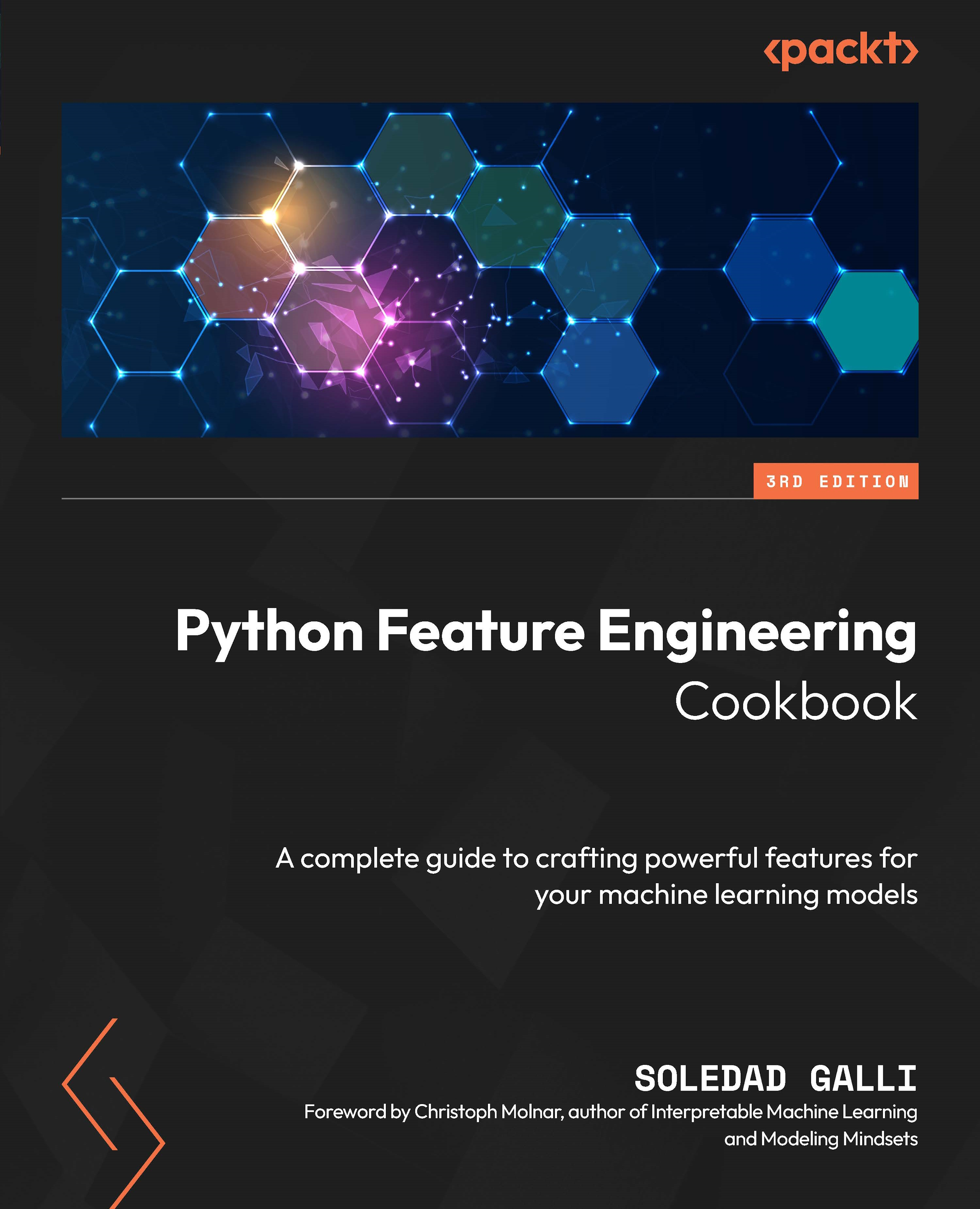
Streamline data preprocessing and feature engineering in your machine learning project with this third edition of the Python Feature Engineering Cookbook to make your data preparation more efficient.
This guide addresses common challenges, such as imputing missing values and encoding categorical variables using practical solutions and open source Python libraries.
You’ll learn advanced techniques for transforming numerical variables, discretizing variables, and dealing with outliers. Each chapter offers step-by-step instructions and real-world examples, helping you understand when and how to apply various transformations for well-prepared data.
The book explores feature extraction from complex data types such as dates, times, and text. You’ll see how to create new features through mathematical operations and decision trees and use advanced tools like Featuretools and tsfresh to extract features from relational data and time series.
By the end, you’ll be ready to build reproducible feature engineering pipelines that can be easily deployed into production, optimizing data preprocessing workflows and enhancing machine learning model performance.
Table of Contents (14 chapters)
Preface


 Free Chapter
Chapter 1: Imputing Missing Data
Chapter 2: Encoding Categorical Variables
Chapter 3: Transforming Numerical Variables
Chapter 4: Performing Variable Discretization
Chapter 5: Working with Outliers
Chapter 6: Extracting Features from Date and Time Variables

Chapter 7: Performing Feature Scaling
Chapter 8: Creating New Features
Chapter 9: Extracting Features from Relational Data with Featuretools
Chapter 10: Creating Features from a Time Series with tsfresh
Chapter 11: Extracting Features from Text Variables
Index


