Sign In Start Free Trial
Account

Add to playlist

Create a Playlist

Modal Close icon
You need to login to use this feature.
  • Book Overview & Buying Machine Learning for Time Series with Python
  • Table Of Contents Toc
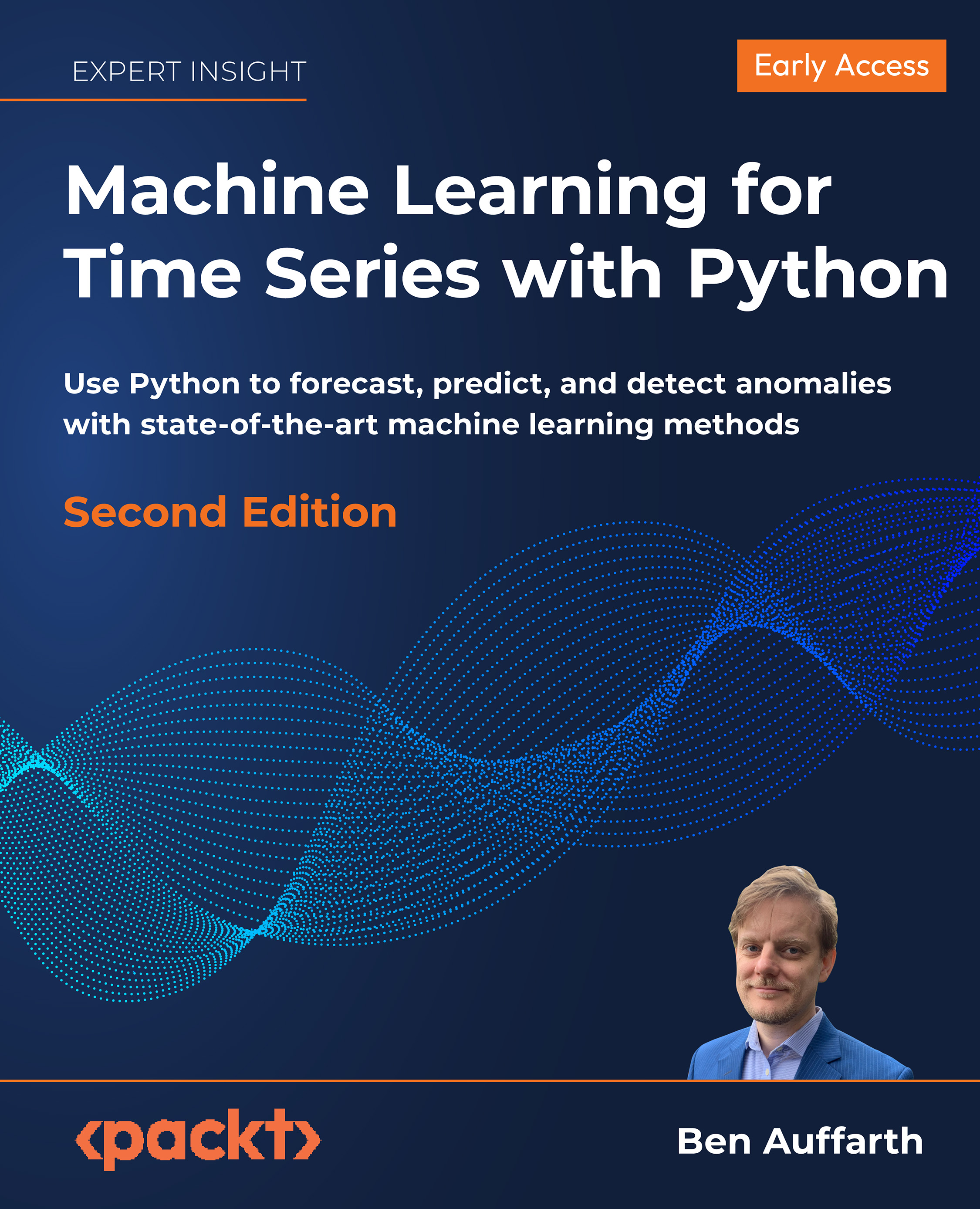
Machine Learning for Time Series with Python

Machine Learning for Time Series with Python - Second Edition

By : Ben Auffarth
close
close
Machine Learning for Time Series with Python

Machine Learning for Time Series with Python

By: Ben Auffarth

Overview of this book

The Python ecosystem offers a wide range of tools for time series analysis and time series forecasting. Machine Learning for Time Series, Second Edition provides a practical guide to building forecasting systems while developing a solid understanding of modern predictive modeling techniques. Starting with the fundamentals of time series data, you'll learn how to prepare datasets, perform feature engineering, and build forecasting pipelines. The book covers traditional methods such as ARIMA, SARIMA, and GARCH, alongside machine learning approaches including gradient boosting, recurrent neural networks, and deep learning models. Through practical examples and clear explanations, you'll learn how to choose the right model for the right problem and improve forecasting accuracy across multiple applications. Updated content includes forecasting and signal extraction for financial markets, plus case studies from operations management, digital marketing, healthcare, and financial forecasting. By the end of this book, you'll be able to confidently perform time series analysis and build effective forecasting systems using Python.
Table of Contents (7 chapters)
close
close

Classical baselines

In this section we look at some of the classical baselines. In professional forecasting, a model earns adoption only if it improves outcomes enough to justify added complexity. That is why we start with strong classical baselines: they are fast, interpretable, and difficult to beat. The goal is not to 'avoid modern methods', but to ensure that any advanced approach improves meaningfully over a robust benchmark..

Exponential smoothing

In my experience building forecasting systems, exponential smoothing often outperforms complex machine learning models. It represents one of the most robust foundations you can establish.

When R.G. Brown developed the core recursive formula in the 1950s, he solved a critical business problem in operations research when companies like IBM needed fast, reliable demand forecasts: how to forecast demand when computational resources were scarce and data was noisy. His solution can be explained using the following formula:

B19536_03_001.png

This recursive...

Unlock full access

Continue reading for free

A Packt free trial gives you instant online access to our library of over 7000 practical eBooks and videos, constantly updated with the latest in tech
notes
bookmark Notes and Bookmarks search Search in title playlist Add to playlist download Download options font-size Font size

Change the font size

margin-width Margin width

Change margin width

day-mode Day/Sepia/Night Modes

Change background colour

Close icon Search
Country selected

Close icon Your notes and bookmarks

Confirmation

Modal Close icon
claim successful

Buy this book with your credits?

Modal Close icon
Are you sure you want to buy this book with one of your credits?
Close
YES, BUY

Submit Your Feedback

Modal Close icon
Modal Close icon
Modal Close icon