Sign In Start Free Trial
Account

Add to playlist

Create a Playlist

Modal Close icon
You need to login to use this feature.
  • Book Overview & Buying Machine Learning for Time Series with Python
  • Table Of Contents Toc
Machine Learning for Time Series with Python

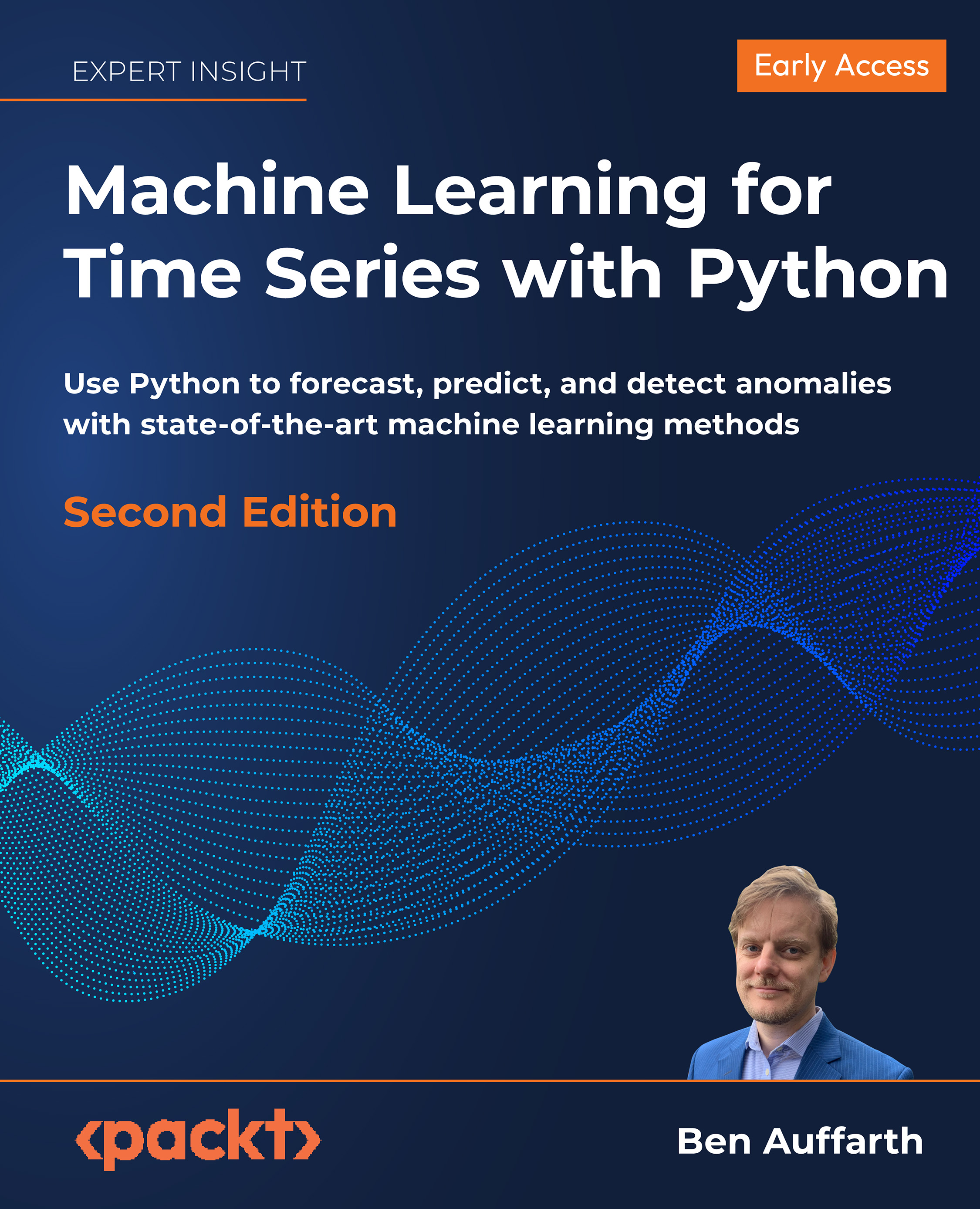
Machine Learning for Time Series with Python - Second Edition

By : Ben Auffarth
close
close
Machine Learning for Time Series with Python

Machine Learning for Time Series with Python

By: Ben Auffarth

Overview of this book

The Python ecosystem offers a wide range of tools for time series analysis and time series forecasting. Machine Learning for Time Series, Second Edition provides a practical guide to building forecasting systems while developing a solid understanding of modern predictive modeling techniques. Starting with the fundamentals of time series data, you'll learn how to prepare datasets, perform feature engineering, and build forecasting pipelines. The book covers traditional methods such as ARIMA, SARIMA, and GARCH, alongside machine learning approaches including gradient boosting, recurrent neural networks, and deep learning models. Through practical examples and clear explanations, you'll learn how to choose the right model for the right problem and improve forecasting accuracy across multiple applications. Updated content includes forecasting and signal extraction for financial markets, plus case studies from operations management, digital marketing, healthcare, and financial forecasting. By the end of this book, you'll be able to confidently perform time series analysis and build effective forecasting systems using Python.
Table of Contents (7 chapters)
close
close

Summary

This chapter equipped you to move beyond univariate forecasting. Where previous chapters treated each time series as an independent entity, you now understand how to model the relationships and hierarchies that define real-world business operations.

You've mastered three distinct approaches to modeling interconnected series. For small systems of two to ten tightly coupled variables, you can implement VAR models and use Granger causality tests to identify genuine leading indicators. For hierarchical business structures where forecasts must aggregate consistently, you can apply MinT reconciliation to ensure that regional predictions sum correctly to corporate totals without sacrificing forecast accuracy. And for large-scale production systems with hundreds or thousands of series, you've learned to use mlforecast's global modeling paradigm, training a single tree-based model that shares parameters across all series while respecting their individual patterns through...

Unlock full access

Continue reading for free

A Packt free trial gives you instant online access to our library of over 7000 practical eBooks and videos, constantly updated with the latest in tech
notes
bookmark Notes and Bookmarks search Search in title playlist Add to playlist download Download options font-size Font size

Change the font size

margin-width Margin width

Change margin width

day-mode Day/Sepia/Night Modes

Change background colour

Close icon Search
Country selected

Close icon Your notes and bookmarks

Confirmation

Modal Close icon
claim successful

Buy this book with your credits?

Modal Close icon
Are you sure you want to buy this book with one of your credits?
Close
YES, BUY

Submit Your Feedback

Modal Close icon
Modal Close icon
Modal Close icon