


-
Book Overview & Buying
-
Table Of Contents

Machine Learning for Time Series with Python - Second Edition
By :


Machine Learning for Time Series with Python
By:
Overview of this book
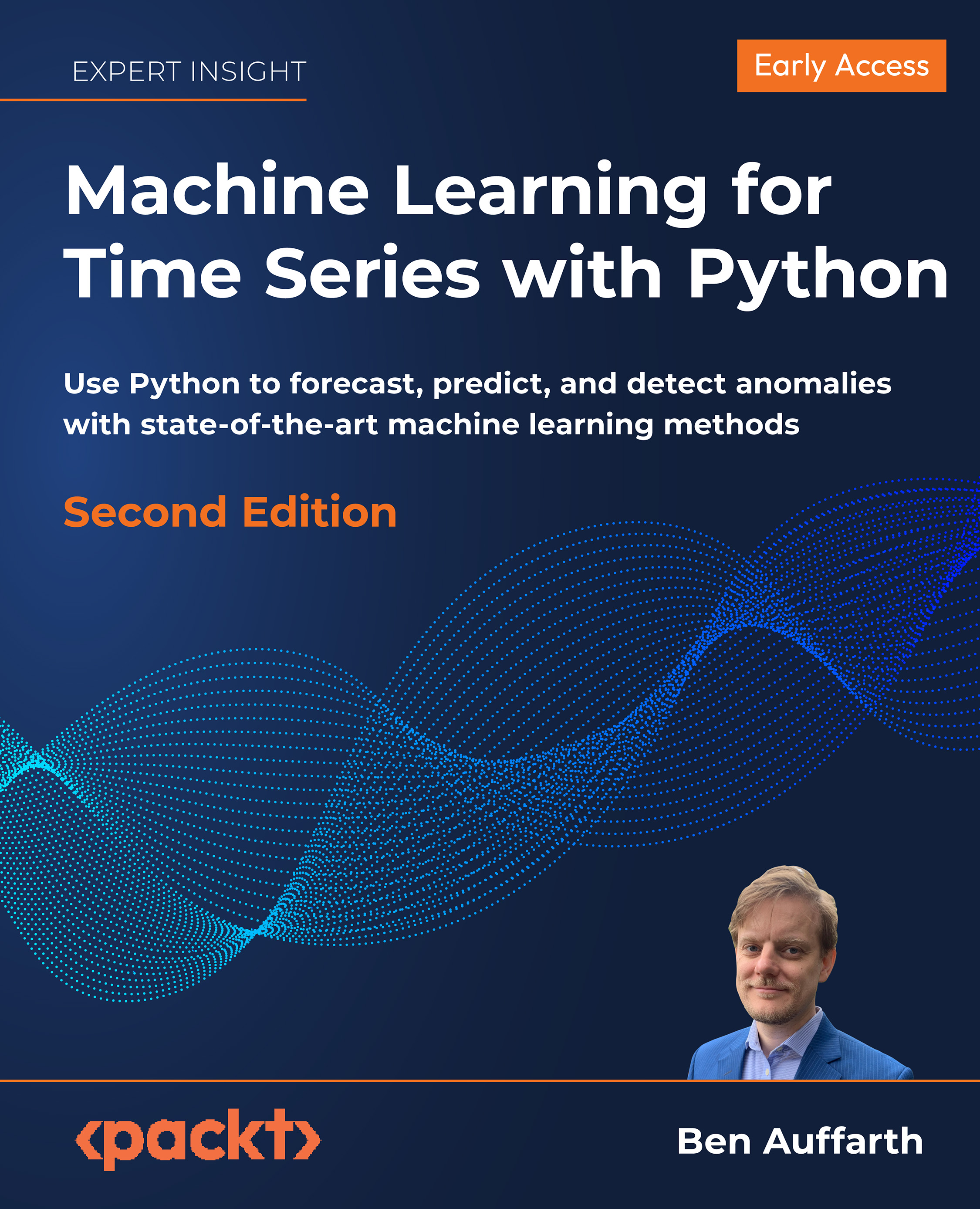
The Python ecosystem offers a wide range of tools for time series analysis and time series forecasting. Machine Learning for Time Series, Second Edition provides a practical guide to building forecasting systems while developing a solid understanding of modern predictive modeling techniques.
Starting with the fundamentals of time series data, you'll learn how to prepare datasets, perform feature engineering, and build forecasting pipelines. The book covers traditional methods such as ARIMA, SARIMA, and GARCH, alongside machine learning approaches including gradient boosting, recurrent neural networks, and deep learning models.
Through practical examples and clear explanations, you'll learn how to choose the right model for the right problem and improve forecasting accuracy across multiple applications. Updated content includes forecasting and signal extraction for financial markets, plus case studies from operations management, digital marketing, healthcare, and financial forecasting.
By the end of this book, you'll be able to confidently perform time series analysis and build effective forecasting systems using Python.
Table of Contents (7 chapters)
Welcome to Packt Early Access


 Free Chapter
Chapter 1: Towards Modern Forecasting
Chapter 2: Preparing and Visualizing Time Series Data
Chapter 3: Classical Models and Validation
Chapter 4: Forecasting with Machine Learning

Chapter 5: Feature Engineering and Tree-Based Models
Chapter 6: Multivariate and Hierarchical Forecasting


