
Sign In Start Free Trial
Account

Add to playlist

Create a Playlist

Modal Close icon
You need to login to use this feature.
  • Book Overview & Buying Training Systems Using Python Statistical Modeling
  • Table Of Contents Toc
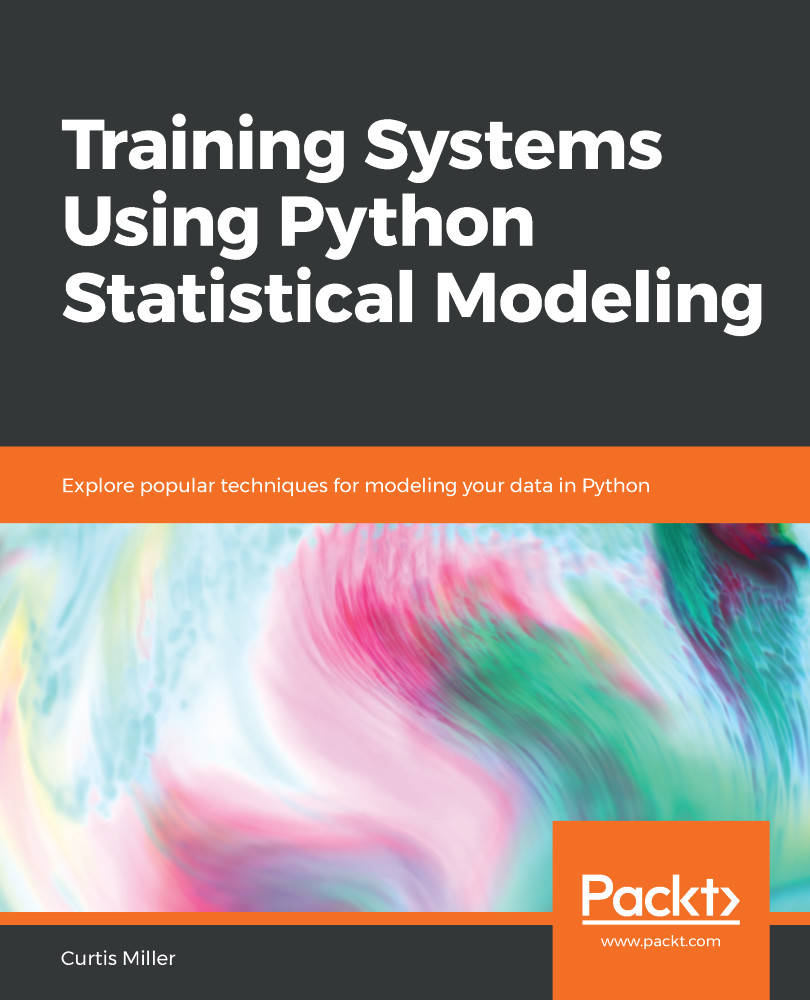
Training Systems Using Python Statistical Modeling

Training Systems Using Python Statistical Modeling

By : Miller
1 (1)
close
close
Training Systems Using Python Statistical Modeling

Training Systems Using Python Statistical Modeling

1 (1)
By: Miller

Overview of this book

Python's ease-of-use and multi-purpose nature has made it one of the most popular tools for data scientists and machine learning developers. Its rich libraries are widely used for data analysis, and more importantly, for building state-of-the-art predictive models. This book is designed to guide you through using these libraries to implement effective statistical models for predictive analytics. You’ll start by delving into classical statistical analysis, where you will learn to compute descriptive statistics using pandas. You will focus on supervised learning, which will help you explore the principles of machine learning and train different machine learning models from scratch. Next, you will work with binary prediction models, such as data classification using k-nearest neighbors, decision trees, and random forests. The book will also cover algorithms for regression analysis, such as ridge and lasso regression, and their implementation in Python. In later chapters, you will learn how neural networks can be trained and deployed for more accurate predictions, and understand which Python libraries can be used to implement them. By the end of this book, you will have the knowledge you need to design, build, and deploy enterprise-grade statistical models for machine learning using Python and its rich ecosystem of libraries for predictive analytics.
Table of Contents (9 chapters)
close
close

Classical Statistical Analysis

Welcome to the first chapter of our book! In this book, we will use our knowledge of Python and machine learning to create data models and perform statistical analysis on different data schemas. We will learn about various techniques pertaining to statistical learning and how to apply them in data analysis. By the end of this book, you will be confident in using various machine learning models, training them, and learning how to evaluate model results and implement various dimensionality reduction techniques. So, without further ado, let's dive right in! In this chapter, we will look at the following topics:

  • Computing descriptive statistics
  • Classical inference for proportions
  • Classical inference for means
  • Diving into Bayesian analysis
  • Bayesian analysis for proportions
  • Bayesian analysis for means
  • Finding correlations
CONTINUE READING
83
Tech Concepts
36
Programming languages
73
Tech Tools
Icon Unlimited access to the largest independent learning library in tech of over 8,000 expert-authored tech books and videos.
Icon Innovative learning tools, including AI book assistants, code context explainers, and text-to-speech.
Icon 50+ new titles added per month and exclusive early access to books as they are being written.
Training Systems Using Python Statistical Modeling
notes
bookmark Notes and Bookmarks search Search in title playlist Add to playlist download Download options font-size Font size

Change the font size

margin-width Margin width

Change margin width

day-mode Day/Sepia/Night Modes

Change background colour

Close icon Search
Country selected

Close icon Your notes and bookmarks

Confirmation

Modal Close icon
claim successful

Buy this book with your credits?

Modal Close icon
Are you sure you want to buy this book with one of your credits?
Close
YES, BUY

Submit Your Feedback

Modal Close icon
Modal Close icon
Modal Close icon