
Sign In Start Free Trial
Account

Add to playlist

Create a Playlist

Modal Close icon
You need to login to use this feature.
  • Book Overview & Buying The Data Wrangling Workshop
  • Table Of Contents Toc
  • Feedback & Rating feedback
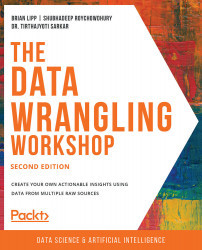
The Data Wrangling Workshop

The Data Wrangling Workshop - Second Edition

By : Brian Lipp , Roychowdhury, Dr. Tirthajyoti Sarkar
4.8 (11)
close
close
The Data Wrangling Workshop

The Data Wrangling Workshop

4.8 (11)
By: Brian Lipp , Roychowdhury, Dr. Tirthajyoti Sarkar

Overview of this book

While a huge amount of data is readily available to us, it is not useful in its raw form. For data to be meaningful, it must be curated and refined. If you’re a beginner, then The Data Wrangling Workshop will help to break down the process for you. You’ll start with the basics and build your knowledge, progressing from the core aspects behind data wrangling, to using the most popular tools and techniques. This book starts by showing you how to work with data structures using Python. Through examples and activities, you’ll understand why you should stay away from traditional methods of data cleaning used in other languages and take advantage of the specialized pre-built routines in Python. Later, you’ll learn how to use the same Python backend to extract and transform data from an array of sources, including the internet, large database vaults, and Excel financial tables. To help you prepare for more challenging scenarios, the book teaches you how to handle missing or incorrect data, and reformat it based on the requirements from your downstream analytics tool. By the end of this book, you will have developed a solid understanding of how to perform data wrangling with Python, and learned several techniques and best practices to extract, clean, transform, and format your data efficiently, from a diverse array of sources.
Table of Contents (11 chapters)
close
close
Preface

Detecting Outliers and Handling Missing Values

Outlier detection and handling missing values fall under the subtle art of data quality checking. A modeling or data mining process is fundamentally a complex series of computations whose output quality largely depends on the quality and consistency of the input data being fed. The responsibility of maintaining and gatekeeping that quality often falls on the shoulders of a data wrangling team.

Apart from the obvious issue of poor-quality data, missing data can sometimes wreak havoc with the Machine Learning (ML) model downstream. A few ML models, such as Bayesian learning, are inherently robust to outliers and missing data, but common techniques such as Decision Trees and Random Forest have an issue with missing data because the fundamental splitting strategy employed by these techniques depends on an individual piece of data and not a cluster. Therefore, it is almost always imperative to impute missing data before handing it over to...

Visually different images
CONTINUE READING
83
Tech Concepts
36
Programming languages
73
Tech Tools
Icon Unlimited access to the largest independent learning library in tech of over 8,000 expert-authored tech books and videos.
Icon Innovative learning tools, including AI book assistants, code context explainers, and text-to-speech.
Icon 50+ new titles added per month and exclusive early access to books as they are being written.
The Data Wrangling Workshop
notes
bookmark Notes and Bookmarks search Search in title playlist Add to playlist download Download options font-size Font size

Change the font size

margin-width Margin width

Change margin width

day-mode Day/Sepia/Night Modes

Change background colour

Close icon Search
Country selected

Close icon Your notes and bookmarks

Confirmation

Modal Close icon
claim successful

Buy this book with your credits?

Modal Close icon
Are you sure you want to buy this book with one of your credits?
Close
YES, BUY

Submit Your Feedback

Modal Close icon
Modal Close icon
Modal Close icon