Sign In Start Free Trial
Account

Add to playlist

Create a Playlist

Modal Close icon
You need to login to use this feature.
  • Book Overview & Buying The Machine Learning Workshop
  • Table Of Contents Toc
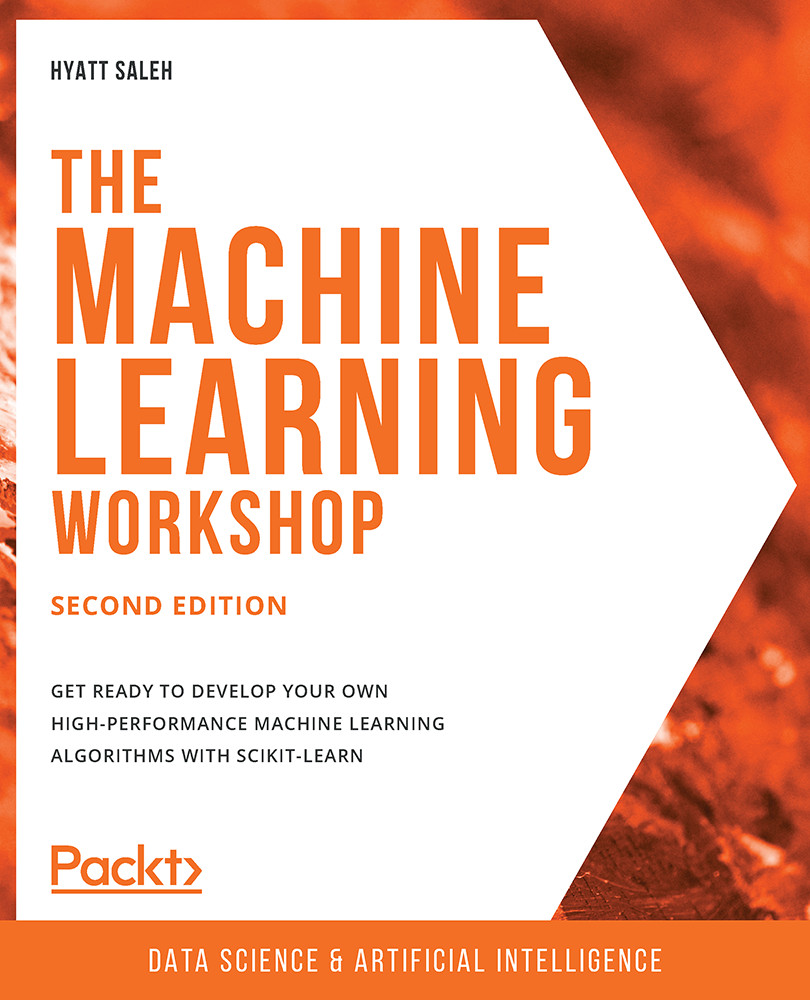
The Machine Learning Workshop

The Machine Learning Workshop - Second Edition

By : Hyatt Saleh
4.3 (6)
close
close
The Machine Learning Workshop

The Machine Learning Workshop

4.3 (6)
By: Hyatt Saleh

Overview of this book

Machine learning algorithms are an integral part of almost all modern applications. To make the learning process faster and more accurate, you need a tool flexible and powerful enough to help you build machine learning algorithms quickly and easily. With The Machine Learning Workshop, you'll master the scikit-learn library and become proficient in developing clever machine learning algorithms. The Machine Learning Workshop begins by demonstrating how unsupervised and supervised learning algorithms work by analyzing a real-world dataset of wholesale customers. Once you've got to grips with the basics, you'll develop an artificial neural network using scikit-learn and then improve its performance by fine-tuning hyperparameters. Towards the end of the workshop, you'll study the dataset of a bank's marketing activities and build machine learning models that can list clients who are likely to subscribe to a term deposit. You'll also learn how to compare these models and select the optimal one. By the end of The Machine Learning Workshop, you'll not only have learned the difference between supervised and unsupervised models and their applications in the real world, but you'll also have developed the skills required to get started with programming your very own machine learning algorithms.
Table of Contents (8 chapters)
close
close
Preface

1. Introduction to Scikit-Learn

Activity 1.01: Selecting a Target Feature and Creating a Target Matrix

Solution:

  1. Load the titanic dataset using the seaborn library:
    import seaborn as sns
    titanic = sns.load_dataset('titanic')
    titanic.head(10)

    The first couple of rows should look as follows:

    Figure 1.22: An image showing the first 10 instances of the Titanic dataset

  2. Select your preferred target feature for the goal of this activity.

    The preferred target feature could be either survived or alive. This is mainly because both of them label whether a person survived the crash. For the following steps, the variable that's been chosen is survived. However, choosing alive will not affect the final shape of the variables.

  3. Create both the features matrix and the target matrix. Make sure that you store the data from the features matrix in a variable, X, and the data from the target matrix in another variable, Y:
    X = titanic.drop('survived',axis = 1)
    Y = titanic...
CONTINUE READING
83
Tech Concepts
36
Programming languages
73
Tech Tools
Icon Unlimited access to the largest independent learning library in tech of over 8,000 expert-authored tech books and videos.
Icon Innovative learning tools, including AI book assistants, code context explainers, and text-to-speech.
Icon 50+ new titles added per month and exclusive early access to books as they are being written.
The Machine Learning Workshop
notes
bookmark Notes and Bookmarks search Search in title playlist Add to playlist download Download options font-size Font size

Change the font size

margin-width Margin width

Change margin width

day-mode Day/Sepia/Night Modes

Change background colour

Close icon Search
Country selected

Close icon Your notes and bookmarks

Confirmation

Modal Close icon
claim successful

Buy this book with your credits?

Modal Close icon
Are you sure you want to buy this book with one of your credits?
Close
YES, BUY

Submit Your Feedback

Modal Close icon
Modal Close icon
Modal Close icon