


Sign In Start Free Trial
Account

Add to playlist

Create a Playlist

Modal Close icon
You need to login to use this feature.
  • Book Overview & Buying React Native By Example
  • Table Of Contents Toc
React Native By Example

React Native By Example

By : Richard Kho
3.7 (3)
close
close
React Native By Example

React Native By Example

3.7 (3)
By: Richard Kho

Overview of this book

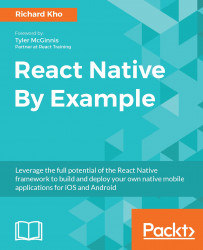
React Native's ability to build performant mobile applications with JavaScript has resulted in its popularity amongst developers. Developers now have the luxury to create incredible mobile experiences that look and feel native to their platforms with the comfort of a well-known language and the popular React.js library. This book will show you how to build your own native mobile applications for the iOS and Android platforms while leveraging the finesse and simplicity of JavaScript and React. Throughout the book you will build three projects, each of increasing complexity. You will also link up with the third-party Facebook SDK, convert an app to support the Redux architecture, and learn the process involved in making your apps available for sale on the iOS App Store and Google Play. At the end of this book, you will have learned and implemented a wide breadth of core APIs and components found in the React Native framework that are necessary in creating great mobile experiences.
Table of Contents (10 chapters)
close
close

Creating a PostView


At the end of Chapter 5, Third Project - The Facebook Client, we created a FeedListRow component with a TouchableHighlight that fired the following function when pressed:

// Friends/app/components/FeedListRow/index.js 

... 
  _navigateToPostView () { 
    console.log('pushed'); 
  } 
... 

We will build a PostView component that our users will navigate to when the TouchableHighlight component is pressed in FeedListRow and replace the current login within this _navigfateToPostView function to handle that navigation.

This PostView component should, upon loading, look in AsyncStorage for this post's details and load them if it exists. If it does not, then it should make a request to the Facebook Graph API for the post's details and save them into AsyncStorage for future use.

The details that we are interested in, are the post's attachments, comments, and likes. Since each post on Facebook is assigned a unique post ID, we can also save an object...

CONTINUE READING
83
Tech Concepts
36
Programming languages
73
Tech Tools
Icon Unlimited access to the largest independent learning library in tech of over 8,000 expert-authored tech books and videos.
Icon Innovative learning tools, including AI book assistants, code context explainers, and text-to-speech.
Icon 50+ new titles added per month and exclusive early access to books as they are being written.
React Native By Example
notes
bookmark Notes and Bookmarks search Search in title playlist Add to playlist download Download options font-size Font size

Change the font size

margin-width Margin width

Change margin width

day-mode Day/Sepia/Night Modes

Change background colour

Close icon Search
Country selected

Close icon Your notes and bookmarks

Confirmation

Modal Close icon
claim successful

Buy this book with your credits?

Modal Close icon
Are you sure you want to buy this book with one of your credits?
Close
YES, BUY

Submit Your Feedback

Modal Close icon
Modal Close icon
Modal Close icon