Sign In Start Free Trial
Account

Add to playlist

Create a Playlist

Modal Close icon
You need to login to use this feature.
  • Book Overview & Buying Mastering Julia
  • Table Of Contents Toc
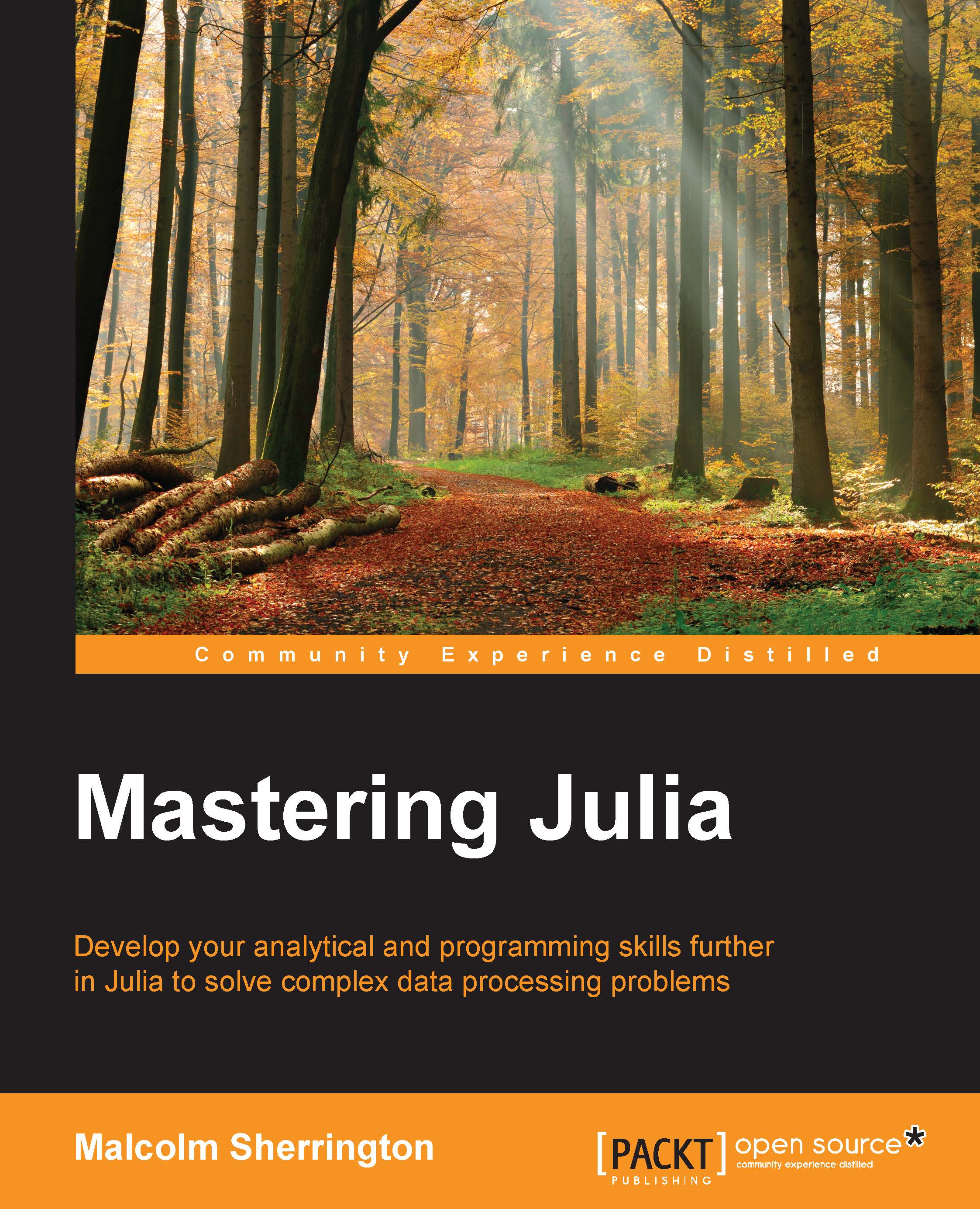
Mastering Julia

Mastering Julia

By : Malcolm Sherrington
4.4 (7)
close
close
Mastering Julia

Mastering Julia

4.4 (7)
By: Malcolm Sherrington

Overview of this book

Julia is a well-constructed programming language with fast execution speed, eliminating the classic problem of performing analysis in one language and translating it for performance into a second. This book will help you develop and enhance your programming skills in Julia to solve real-world automation challenges. This book starts off with a refresher on installing and running Julia on different platforms. Next, you will compare the different ways of working with Julia and explore Julia's key features in-depth by looking at design and build. You will see how data works using simple statistics and analytics, and discover Julia's speed, its real strength, which makes it particularly useful in highly intensive computing tasks and observe how Julia can cooperate with external processes in order to enhance graphics and data visualization. Finally, you will look into meta-programming and learn how it adds great power to the language and establish networking and distributed computing with Julia.
Table of Contents (12 chapters)
close
close
11
Index

Arrays


An array is an indexable collection of (normally) homogeneous values such as integers, floats, booleans. In Julia, unlike many programming languages, the index starts at 1 not 0.

One simple way to create an array is to enumerate its values:

julia> A = [0, 1, 1, 2, 3, 5, 8, 13, 21, 34, 55, 89, 144, 233, 377];
15-element Array{Int64,1}

These are the first 15 values of the Fibonacci series and because all values are listed as integers the array created is of type Int64. The other number refers to the number of dimensions of the array, in this case 1.

In conjunction of loops in the Asian option example in the previous chapter, we meet the definition of a range as: start:[step]:end

julia> A = [1:10]; B = [1:3:15]; C =[1:0.5:5];

Here A is [1,2,3,4,5,6,7,8,9,10], B is [1,4,7,10,13] and C is [1.0,1.5,2.0,2.5,3.0,3.5,4.0,4.5,5.0]

Because the step in C is specified as a float value the array is of type Float64 not Int64.

Julia also provides functions such as zeros, ones and rand which provide...

CONTINUE READING
83
Tech Concepts
36
Programming languages
73
Tech Tools
Icon Unlimited access to the largest independent learning library in tech of over 8,000 expert-authored tech books and videos.
Icon Innovative learning tools, including AI book assistants, code context explainers, and text-to-speech.
Icon 50+ new titles added per month and exclusive early access to books as they are being written.
Mastering Julia
notes
bookmark Notes and Bookmarks search Search in title playlist Add to playlist font-size Font size

Change the font size

margin-width Margin width

Change margin width

day-mode Day/Sepia/Night Modes

Change background colour

Close icon Search
Country selected

Close icon Your notes and bookmarks

Confirmation

Modal Close icon
claim successful

Buy this book with your credits?

Modal Close icon
Are you sure you want to buy this book with one of your credits?
Close
YES, BUY

Submit Your Feedback

Modal Close icon
Modal Close icon
Modal Close icon