Sign In Start Free Trial
Account

Add to playlist

Create a Playlist

Modal Close icon
You need to login to use this feature.
  • Book Overview & Buying Mastering Julia
  • Table Of Contents Toc
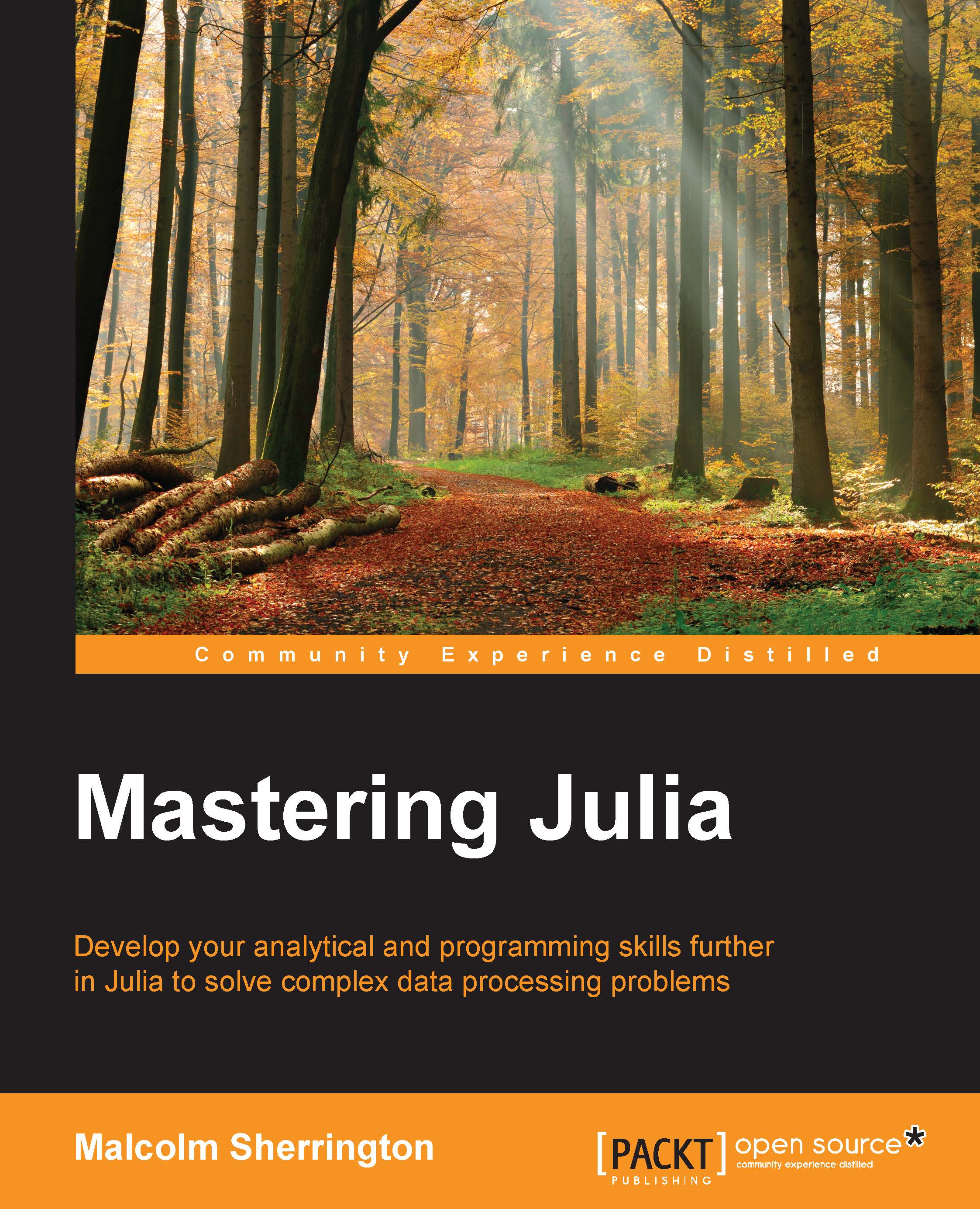
Mastering Julia

Mastering Julia

By : Malcolm Sherrington
4.4 (7)
close
close
Mastering Julia

Mastering Julia

4.4 (7)
By: Malcolm Sherrington

Overview of this book

Julia is a well-constructed programming language with fast execution speed, eliminating the classic problem of performing analysis in one language and translating it for performance into a second. This book will help you develop and enhance your programming skills in Julia to solve real-world automation challenges. This book starts off with a refresher on installing and running Julia on different platforms. Next, you will compare the different ways of working with Julia and explore Julia's key features in-depth by looking at design and build. You will see how data works using simple statistics and analytics, and discover Julia's speed, its real strength, which makes it particularly useful in highly intensive computing tasks and observe how Julia can cooperate with external processes in order to enhance graphics and data visualization. Finally, you will look into meta-programming and learn how it adds great power to the language and establish networking and distributed computing with Julia.
Table of Contents (12 chapters)
close
close
11
Index

Preface

Julia is a relatively young programming language. The initial design work on the Julia project began at MIT in August 2009, and by February 2012, it became open source. It is largely the work of three developers Stefan Karpinski, Jeff Bezanson, and Viral Shah. These three, together with Alan Edelman, still remain actively committed to Julia and MIT currently hosts a variety of courses in Julia, many of which are available over the Internet.

Initially, Julia was envisaged by the designers as a scientific language sufficiently rapid to make the necessity of modeling in an interactive language and subsequently having to redevelop in a compiled language, such as C or Fortran. At that time the major scientific languages were propriety ones such as MATLAB and Mathematica, and were relatively slow. There were clones of these languages in the open source domain, such as GNU Octave and Scilab, but these were even slower. When it launched, the community saw Julia as a replacement for MATLAB, but this is not exactly case. Although the syntax of Julia is similar to MATLAB, so much so that anyone competent in MATLAB can easily learn Julia, it was not designed as a clone. It is a more feature-rich language with many significant differences that will be discussed in depth later.

The period since 2009 has seen the rise of two new computing disciplines: big data/cloud computing, and data science. Big data processing on Hadoop is conventionally seen as the realm of Java programming, since Hadoop runs on the Java virtual machine. It is, of course, possible to process big data by using programming languages other than those that are Java-based and utilize the streaming-jar paradigm and Julia can be used in a way similar to C++, C#, and Python.

The emergence of data science heralded the use of programming languages that were simple for analysts with some programming skills but who were not principally programmers. The two languages that stepped up to fill the breach have been R and Python. Both of these are relatively old with their origins back in the 1990s. However, the popularity of these two has seen a rapid growth, ironically from around the time when Julia was introduced to the world. Even so, with such estimated and staid opposition, Julia has excited the scientific programming community and continues to make inroads in this space.

The aim of this book is to cover all aspects of Julia that make it appealing to the data scientist. The language is evolving quickly. Binary distributions are available for Linux, Mac OS X, and Linux, but these will lag behind the current sources. So, to do some serious work with Julia, it is important to understand how to obtain and build a running system from source. In addition, there are interactive development environments available for Julia and the book will discuss both the Jupyter and Juno IDEs.

CONTINUE READING
83
Tech Concepts
36
Programming languages
73
Tech Tools
Icon Unlimited access to the largest independent learning library in tech of over 8,000 expert-authored tech books and videos.
Icon Innovative learning tools, including AI book assistants, code context explainers, and text-to-speech.
Icon 50+ new titles added per month and exclusive early access to books as they are being written.
Mastering Julia
notes
bookmark Notes and Bookmarks search Search in title playlist Add to playlist font-size Font size

Change the font size

margin-width Margin width

Change margin width

day-mode Day/Sepia/Night Modes

Change background colour

Close icon Search
Country selected

Close icon Your notes and bookmarks

Confirmation

Modal Close icon
claim successful

Buy this book with your credits?

Modal Close icon
Are you sure you want to buy this book with one of your credits?
Close
YES, BUY

Submit Your Feedback

Modal Close icon
Modal Close icon
Modal Close icon