Sign In Start Free Trial
Account

Add to playlist

Create a Playlist

Modal Close icon
You need to login to use this feature.
  • Book Overview & Buying Scala Functional Programming Patterns
  • Table Of Contents Toc
Scala Functional Programming Patterns

Scala Functional Programming Patterns

By : S. Khot
3.5 (2)
close
close
Scala Functional Programming Patterns

Scala Functional Programming Patterns

3.5 (2)
By: S. Khot

Overview of this book

Scala is used to construct elegant class hierarchies for maximum code reuse and extensibility and to implement their behavior using higher-order functions. Its functional programming (FP) features are a boon to help you design “easy to reason about” systems to control the growing software complexities. Knowing how and where to apply the many Scala techniques is challenging. Looking at Scala best practices in the context of what you already know helps you grasp these concepts quickly, and helps you see where and why to use them. This book begins with the rationale behind patterns to help you understand where and why each pattern is applied. You will discover what tail recursion brings to your table and will get an understanding of how to create solutions without mutations. We then explain the concept of memorization and infinite sequences for on-demand computation. Further, the book takes you through Scala’s stackable traits and dependency injection, a popular technique to produce loosely-coupled software systems. You will also explore how to currying favors to your code and how to simplify it by de-construction via pattern matching. We also show you how to do pipeline transformations using higher order functions such as the pipes and filters pattern. Then we guide you through the increasing importance of concurrent programming and the pitfalls of traditional code concurrency. Lastly, the book takes a paradigm shift to show you the different techniques that functional programming brings to your plate. This book is an invaluable source to help you understand and perform functional programming and solve common programming problems using Scala’s programming patterns.
Table of Contents (13 chapters)
close
close
12
Index

Functions

Functional programming includes a lot about functions. There are different kinds of functions in programming, for example, pure functions. A pure function depends only on its input to compute the output. Let's try the following example to make use of functions:

scala> val addThem = (x: Int, y: Int) => x + y + 1
addThem: (Int, Int) => Int = <function2>
scala> addThem(3,4)
res2: Int = 8

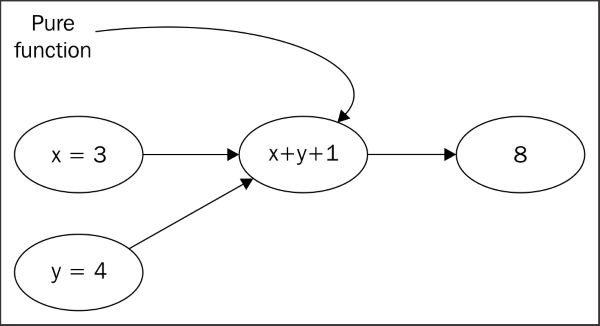
As long as the function lives, it will always give the result 8 given the input (3,4).Take a look at the following example of a pure function:

Functions

Figure 1.1: Pure functions

The functions worked on the input and produced the output, without changing any state. What does the phrase "did not change any state" mean? Here is an example of a not-so-pure function:

scala> var p = 1
p: Int = 1
scala> val addP = (x: Int, y: Int) => {
     | p += 1
     | x + y + p
     | }
addP: (Int, Int) => Int = <function2>

scala> addP(3, 4)
res4: Int = 9
scala> addP(3, 4)
res5: Int = 10

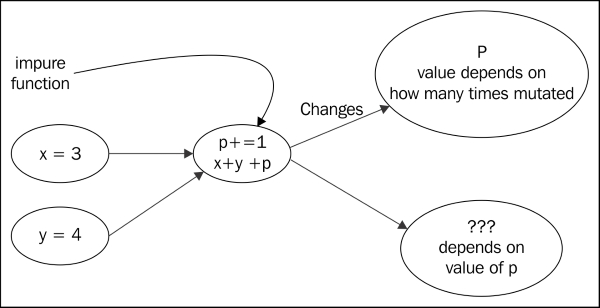
This addP function changes the world—this means that it affects its surroundings. In this case, the variable p. Here is the diagrammatic representation for the preceding code:

Functions

Figure 1.2 :An impure function

Comparing addThem and addP, which of the two is clearer to reason about? Remember that while debugging, we look for the trouble spot, and we wish to find it quickly. Once found, we can fix the problem quickly and keep things moving.

For the pure function, we can take a paper and pen, and since we know that it is side effects free, we can write the following:

addThem(3, 4) = 8
             addThem(1,1) = 3

For small numbers, we can do the function computation in our heads. We can even replace the function call with the value:

scala> addThem(1,1) + addThem(3,4)
res10: Int = 11
scala> 3 + 8
res11: Int = 11  

Both the preceding expressions are equivalent. When we replace the function, we deal with referentially transparent expressions. If the function is a long running one, we could call it just once and cache the results. The cached results would be used for the second and subsequent calls.

The addP function, on the other hand, is referentially opaque.

Visually different images
CONTINUE READING
83
Tech Concepts
36
Programming languages
73
Tech Tools
Icon Unlimited access to the largest independent learning library in tech of over 8,000 expert-authored tech books and videos.
Icon Innovative learning tools, including AI book assistants, code context explainers, and text-to-speech.
Icon 50+ new titles added per month and exclusive early access to books as they are being written.
Scala Functional Programming Patterns
notes
bookmark Notes and Bookmarks search Search in title playlist Add to playlist font-size Font size

Change the font size

margin-width Margin width

Change margin width

day-mode Day/Sepia/Night Modes

Change background colour

Close icon Search
Country selected

Close icon Your notes and bookmarks

Confirmation

Modal Close icon
claim successful

Buy this book with your credits?

Modal Close icon
Are you sure you want to buy this book with one of your credits?
Close
YES, BUY

Submit Your Feedback

Modal Close icon
Modal Close icon
Modal Close icon