-
Book Overview & Buying
-
Table Of Contents
-
Feedback & Rating
Delphi Cookbook - Second Edition
By :
The adage "A picture is worth a thousand words" refers to the notion that a complex idea can be conveyed with just a single still image. Sometimes, even a simple concept is easier to understand and nicer to see if it is represented by images. In this recipe, we'll see how to customize TDBGrid to visualize a graphical representation of data.
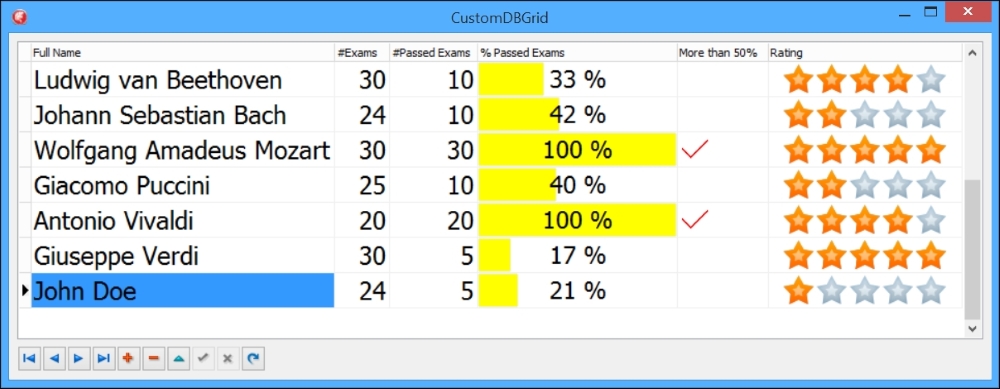
Many VCL controls are able to delegate their drawing, or part of it, to user code. It means that we can use simple event handlers to draw standard components in different ways. It is not always simple, but TDBGrid is customizable in a really easy way. Let's say that we have a class of musicians that have to pass a set of exams. We want to show the percent of exams already passed with a progress bar and, if the percent is higher than 50, there should also be a check in another column. Moreover, after listening to the pieces played at the exams, each musician received votes from an external examination committee. The last column needs to show the mean of votes from this committee as a rating from 0 to 5.
We'll use a special in memory table from the FireDAC library. FireDAC is a new data access library from Embarcadero included in RAD Studio since version XE5. If some of the code seems unclear at the moment, consider the in-memory table as a normal TDataSet descendant, which holds its data only in memory. However, at the end of the section, there are some links to the FireDAC documentation, and I strongly suggest that you read them if you still don't know FireDAC:
18. This will create more space in the cell for our graphical representation.Active property to True:|
Field name |
Field data type |
Field type |
|---|---|---|
|
|
|
Data |
|
|
|
Data |
|
|
|
Data |
|
|
|
Data |
|
|
|
Calculated |
|
|
|
Calculated |
FullNameTotalExamsPassedExamsPercPassedExamsMoreThan50PercentRatingprocedure TMainForm.FormCreate(Sender: TObject); begin FDMemTable1.AppendRecord( ['Ludwig van Beethoven', 30, 10, 4]); FDMemTable1.AppendRecord( ['Johann Sebastian Bach', 24, 10, 2.5]); FDMemTable1.AppendRecord( ['Wolfgang Amadeus Mozart', 30, 30, 5]); FDMemTable1.AppendRecord( ['Giacomo Puccini', 25, 10, 2.2]); FDMemTable1.AppendRecord( ['Antonio Vivaldi', 20, 20, 4.7]); FDMemTable1.AppendRecord( ['Giuseppe Verdi', 30, 5, 5]); FDMemTable1.AppendRecord( ['John Doe', 24, 5, 1.2]); end;
OnCalcFields that allows the developer to do so. Create the OnCalcFields event handler on TFDMemTable and fill it with the following code:procedure TMainForm.FDMemTable1CalcFields( DataSet: TDataSet); var LPassedExams: Integer; LTotExams: Integer; begin LPassedExams := FDMemTable1. FieldByName('PassedExams').AsInteger; LTotExams := FDMemTable1. FieldByName('TotalExams').AsInteger; if LTotExams = 0 then FDMemTable1.FieldByName('PercPassedExams').AsFloat := 0 else FDMemTable1.FieldByName('PercPassedExams').AsFloat := LPassedExams / LTotExams * 100; FDMemTable1.FieldByName('MoreThan50Percent').AsBoolean := FDMemTable1.FieldByName('PercPassedExams').AsFloat > 50; end; end;

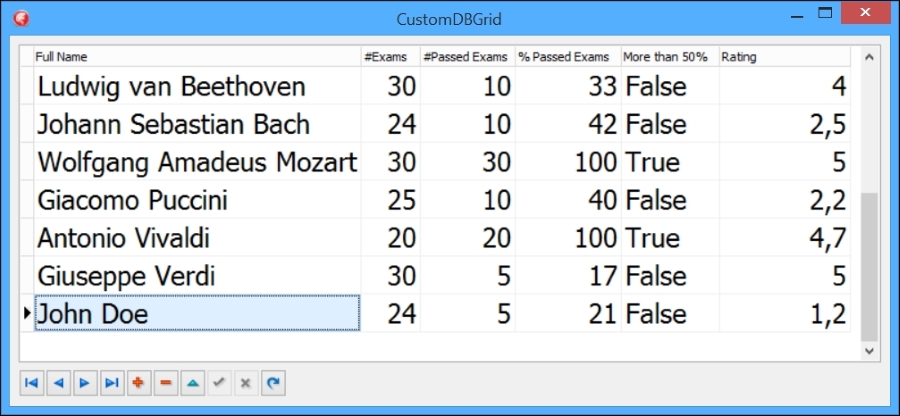
Figure 3.1: A normal form with some data
False.Rating field will be drawn using a 5-star rating image from 0 to 5. It starts with a 0.5 incremental step (0, 0.5, 1, 1.5, and so on). So, drop TImageList on the form, and set Height as 32 and Width as 160.ICONS\RATING_IMAGES). Load the images in the correct order as shown here:image 0_0_rating.pngimage 0_5_rating.pngimage 1_0_rating.pngimage 1_5_rating.pngimage 2_0_rating.pngGo to TDBGrid events and create the event handler for OnDrawColumnCell. All the customization code goes in this event.
Include the Vcl.GraphUtil unit, and write the following code in the DBGrid1DrawColumnCell event:
procedure TMainForm.DBGrid1DrawColumnCell(Sender: TObject; const Rect: TRect; DataCol: Integer; Column: TColumn; State: TGridDrawState); var LRect: TRect; LGrid: TDBGrid; LText: string; LPerc: Extended; LTextWidth: TSize; LSavedPenColor, LSavedBrushColor: Integer; LSavedPenStyle: TPenStyle; LSavedBrushStyle: TBrushStyle; LRating: Extended; LNeedOwnerDraw: Boolean; begin LGrid := TDBGrid(Sender); if [gdSelected, gdFocused] * State <> [] then LGrid.Canvas.Brush.Color := clHighlight; LNeedOwnerDraw := (Column.Field.FieldKind = fkCalculated) or Column.FieldName.Equals('Rating'); if LNeedOwnerDraw then begin LRect := Rect; LSavedPenColor := LGrid.Canvas.Pen.Color; LSavedBrushColor := LGrid.Canvas.Brush.Color; LSavedPenStyle := LGrid.Canvas.Pen.Style; LSavedBrushStyle := LGrid.Canvas.Brush.Style; if Column.FieldName.Equals('PercPassedExams') then begin LText := FormatFloat('##0', Column.Field.AsFloat) + ' %'; LGrid.Canvas.Brush.Style := bsSolid; LGrid.Canvas.FillRect(LRect); LPerc := Column.Field.AsFloat / 100 * LRect.Width; LGrid.Canvas.Font.Size := LGrid.Font.Size - 1; LGrid.Canvas.Font.Color := clWhite; LGrid.Canvas.Brush.Color := clYellow; LGrid.Canvas.RoundRect(LRect.Left, LRect.Top, Trunc(LRect.Left + LPerc), LRect.Bottom, 2, 2); LRect.Inflate(-1, -1); LGrid.Canvas.Pen.Style := psClear; LGrid.Canvas.Font.Color := clBlack; LGrid.Canvas.Brush.Style := bsClear; LTextWidth := LGrid.Canvas.TextExtent(LText); LGrid.Canvas.TextOut(LRect.Left + ( (LRect.Width div 2) - (LTextWidth.cx div 2)), LRect.Top + ((LRect.Height div 2) - (LTextWidth.cy div 2)), LText); end else if Column.FieldName. Equals('MoreThan50Percent') then begin LGrid.Canvas.Brush.Style := bsSolid; LGrid.Canvas.Pen.Style := psClear; LGrid.Canvas.FillRect(LRect); if Column.Field.AsBoolean then begin LRect.Inflate(-4, -4); LGrid.Canvas.Pen.Color := clRed; LGrid.Canvas.Pen.Style := psSolid; DrawCheck(LGrid.Canvas, TPoint.Create(LRect.Left, LRect.Top + LRect.Height div 2), LRect.Height div 3); end; end else if Column.FieldName.Equals('Rating') then begin LRating := Column.Field.AsFloat; if LRating.Frac < 5 then LRating := Trunc(LRating); if LRating.Frac >= 5 then LRating := Trunc(LRating) + 0.5; LText := LRating.ToString; LGrid.Canvas.Brush.Color := clWhite; LGrid.Canvas.Brush.Style := bsSolid; LGrid.Canvas.Pen.Style := psClear; LGrid.Canvas.FillRect(LRect); Inc(LRect.Left); ImageList1.Draw(LGrid.Canvas, LRect.CenterPoint.X - (ImageList1.Width div 2), LRect.CenterPoint.Y - (ImageList1.Height div 2), Trunc(LRating) * 2); end; end else LGrid.DefaultDrawColumnCell(Rect, DataCol, Column, State); if LNeedOwnerDraw then begin LGrid.Canvas.Pen.Color := LSavedPenColor; LGrid.Canvas.Brush.Color := LSavedBrushColor; LGrid.Canvas.Pen.Style := LSavedPenStyle; LGrid.Canvas.Brush.Style := LSavedBrushStyle; end; end;

Figure 3.2: The same grid with a bit of customization
By setting the DBGrid property DefaultDrawing to False, we told the grid that we want to manually draw all the data into every cell. OnDrawColumnCell allows us to actually draw using standard Delphi code. For each cell we are about to draw, the event handler is called with a list of useful parameters to know which cell we're about to draw and what data we have to read considering the column we are currently drawing. In this case, we want to draw only the calculated columns and the Rating field in a custom way. This is not a rule, but this can be done to manipulate all cells. We can draw any cell in the way we like. For the cells where we don't want to do custom drawing, a simple call method, DefaultDrawColumnCell that passes the same parameters we got from the event and the VCL code will draw the current cell as usual.
Among the event parameters, there is a Rect object (of type TRect) that represents the specific area we're about to draw. There is a column object (of type TColumn) that is a reference to the current column of the grid and a State (of type TGridDrawState) that is a set of the grid cell states (for example, Selected, Focused, HotTrack, and many more). If our drawing code ignores the State parameter, all the cells will be drawn in the same way, and users cannot see which cell or row is selected.
The event handler uses a
Pascal Sets Intersect to know whether the current cell should be drawn as a Selected or Focused cell. Refer the following code for better clarity:
if [gdSelected, gdFocused] * State <> [] then Grid.Canvas.Brush.Color := clHighlight;
Remember that if your dataset has 100 records and 20 fields, OnDrawColumnCell will potentially be called 2000 times! So, the event code must be fast; otherwise, the application will become less responsive.
Owner drawing is a really large topic and can be simple or tremendously complex, involving much Canvas-related code. However, often the kind of drawing you need will be relatively similar. So, if you need checks, arrows, color gradients, and so on, check the procedures into the Vcl.GraphUtil unit. Otherwise, if you need images, you could use TImageList to hold all the images needed by your grid, as we did in this recipe for the Rating field.
The good news is that the drawing code can be reused by different kinds of controls, so try to organize your code in a way that allows code reutilization by avoiding direct dependencies to the form where the control is.
The code in the drawing events should not contain business logic or presentation logic. If you need presentation logic, put it in a separate, testable function or class.
Change the font size
Change margin width
Change background colour