Sign In Start Free Trial
Account

Add to playlist

Create a Playlist

Modal Close icon
You need to login to use this feature.
  • Book Overview & Buying .Go Programming Blueprints
  • Table Of Contents Toc
  • Feedback & Rating feedback
.Go Programming Blueprints

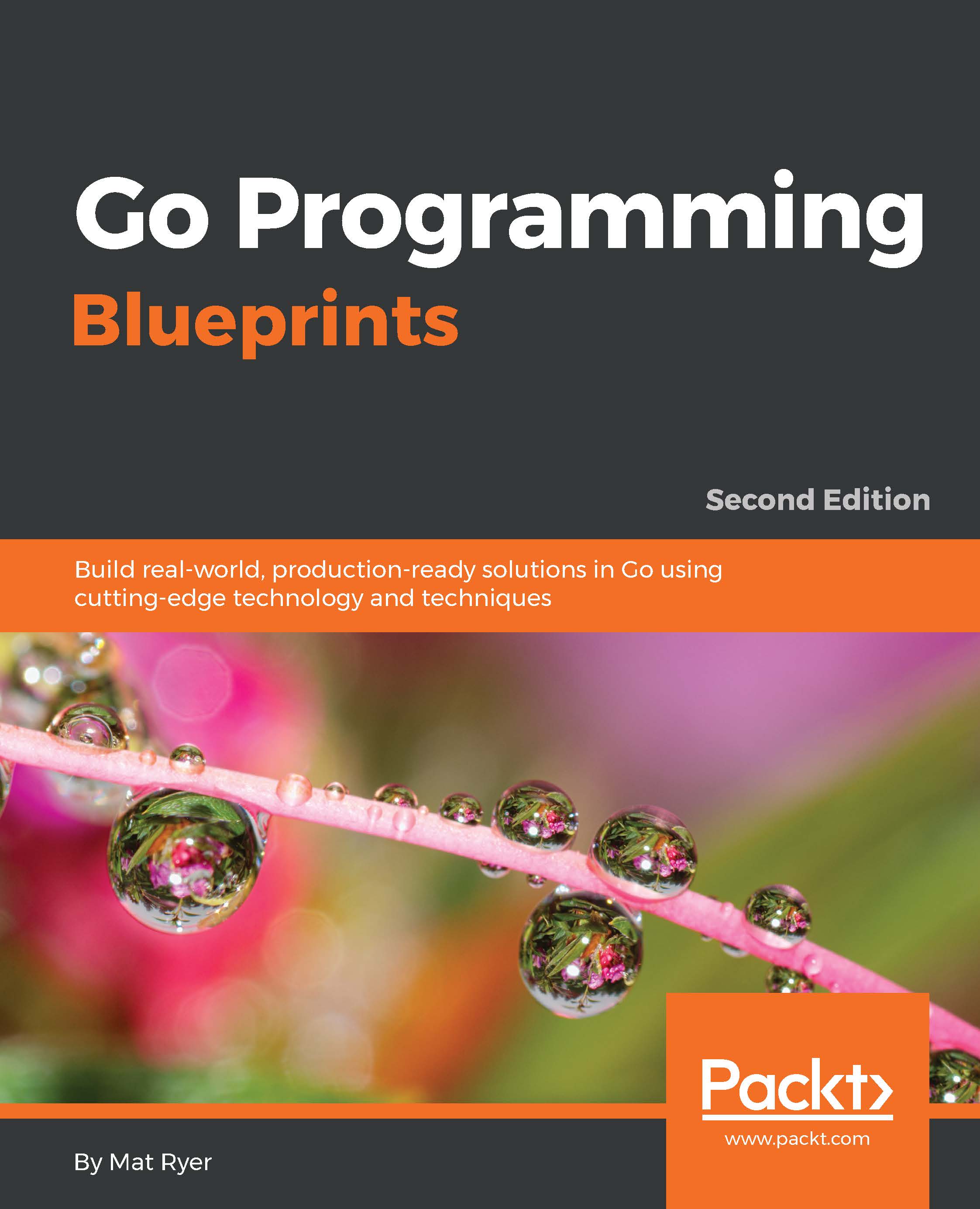
.Go Programming Blueprints - Second Edition

By : Mat Ryer
3.9 (12)
close
close
.Go Programming Blueprints

.Go Programming Blueprints

3.9 (12)
By: Mat Ryer

Overview of this book

Go is the language of the Internet age, and the latest version of Go comes with major architectural changes. Implementation of the language, runtime, and libraries has changed significantly. The compiler and runtime are now written entirely in Go. The garbage collector is now concurrent and provides dramatically lower pause times by running in parallel with other Go routines when possible. This book will show you how to leverage all the latest features and much more. This book shows you how to build powerful systems and drops you into real-world situations. You will learn to develop high quality command-line tools that utilize the powerful shell capabilities and perform well using Go's in-built concurrency mechanisms. Scale, performance, and high availability lie at the heart of our projects, and the lessons learned throughout this book will arm you with everything you need to build world-class solutions. You will get a feel for app deployment using Docker and Google App Engine. Each project could form the basis of a start-up, which means they are directly applicable to modern software markets.
Table of Contents (13 chapters)
close
close

Preface

I have been blown away by the response Go Programming Blueprints has received, both from newcomers to Go, as well as well-respected titans of the community. The positive feedback has inspired me to do this second edition, where the code has been updated to the latest thinking and three new chapters have been added. Thanks to the contributions and questions from readers on the GitHub repository (https://github.com/matryer/goblueprints), I have been able to address some errors, fix some bugs, and clear some things up. See the README file on GitHub for a complete list of their names.

I decided to write Go Programming Blueprints because I wanted to expel the myth that Go, being a relatively young language and community, is a bad choice to write and iterate on software quickly. I have a friend who knocks out complete Ruby on Rails apps in a weekend by mashing up pre-existing gems and libraries; Rails as a platform has become known for enabling rapid development. As I do the same with Go and the ever-growing buffet of open source packages, I wanted to share some real-world examples of how we can quickly build and release software that performs well from day one and is ready to scale when our projects take off in a way that Rails cannot compete with. Of course, most scalability happens outside the language, but features such as Go's built-in concurrency mean you can get some very impressive results from even the most basic hardware, giving you a head start when things start to get real.

This book explores some very different projects, any of which can form the basis of a genuine startup. Whether it's a low-latency chat application, a domain name suggestion tool, a social polling and election service built on Twitter, or a random night out generator powered by Google Places, each chapter touches upon a variety of problems that most products or services written in Go will need to address. The solutions I present in this book are just one of many ways to tackle each project, and I will encourage you to make up your own mind about how I approached them. The concepts are more important than the code itself, but you'll hopefully pick up a few tips and tricks here and there that can go into your Go toolbelt.

New to this second edition, we will explore some practical modern architectural thinking, such as how to build for Google App Engine, what a microservice looks like, and how to package up our code with Docker and deploy to anywhere.

The process by which I wrote this book may be interesting because it represents something about the philosophies adopted by many agile developers. I started by giving myself the challenge of building a real deployable product (albeit a simple one; a minimum viable product, if you will) before getting stuck into it and writing a version 1. Once I got it working, I would rewrite it from scratch. It is said many times by novelists and journalists that the art of writing is rewriting; I have found this to be true for software as well. The first time we write a piece of code, all we are really doing is learning about the problem and how it might be tackled, as well as getting some of our thinking out of our heads and onto paper, or into a text editor. The second time we write it, we are applying our new knowledge to actually solve the problem. If you've never tried this, give it a shot—you might find that the quality of your code shoots up quite dramatically as I did. It doesn't mean the second time will be the last time—software evolves and we should try to keep it as cheap and disposable as possible so we don't mind throwing pieces away if they go stale or start to get in the way.

I write all of my code following Test-driven development (TDD) practices, some of which we will do together throughout the book and some you'll just see the result of in the final code. All of the test code can be found in the GitHub repositories for this book, even if it's not included in print.

Once I had my test-driven second versions completed, I started writing the chapter describing how and why I did what I did. In most cases, the iterative approach I took is left out of the book because it would just add pages of tweaks and edits, which would probably just become frustrating for the reader. However, on a couple of occasions, we will iterate together to get a feel of how a process of gradual improvements and small iterations (starting and keeping it simple and introducing complexity only when absolutely necessary) can be applied when writing Go packages and programs.

I moved to the United States from England in 2012, but that is not why the chapters are authored in American English; it was a requirement from the publisher. I suppose this book is aimed at an American audience, or perhaps it's because American English is the standard language of computing (in British code, properties that deal with color are spelled without the U). Either way, I apologize in advance for any trans-Atlantic slips; I know how pedantic programmers can be.

Any questions, improvements, suggestions, or debates (I love how opinionated the Go community—as well as the core team and the language itself—is) are more than welcome. These should probably take place in the GitHub issues for the book setup, specifically at https://github.com/matryer/goblueprints, so that everybody can take part.

Finally, I would be thrilled if somebody forms a start-up based on any of these projects, or makes use of them in other places. I would love to hear about it; you can tweet me at @matryer.

Visually different images
CONTINUE READING
83
Tech Concepts
36
Programming languages
73
Tech Tools
Icon Unlimited access to the largest independent learning library in tech of over 8,000 expert-authored tech books and videos.
Icon Innovative learning tools, including AI book assistants, code context explainers, and text-to-speech.
Icon 50+ new titles added per month and exclusive early access to books as they are being written.
.Go Programming Blueprints
notes
bookmark Notes and Bookmarks search Search in title playlist Add to playlist download Download options font-size Font size

Change the font size

margin-width Margin width

Change margin width

day-mode Day/Sepia/Night Modes

Change background colour

Close icon Search
Country selected

Close icon Your notes and bookmarks

Confirmation

Modal Close icon
claim successful

Buy this book with your credits?

Modal Close icon
Are you sure you want to buy this book with one of your credits?
Close
YES, BUY

Submit Your Feedback

Modal Close icon
Modal Close icon
Modal Close icon