Sign In Start Free Trial
Account

Add to playlist

Create a Playlist

Modal Close icon
You need to login to use this feature.
  • Book Overview & Buying Spring 5.0 Cookbook
  • Table Of Contents Toc
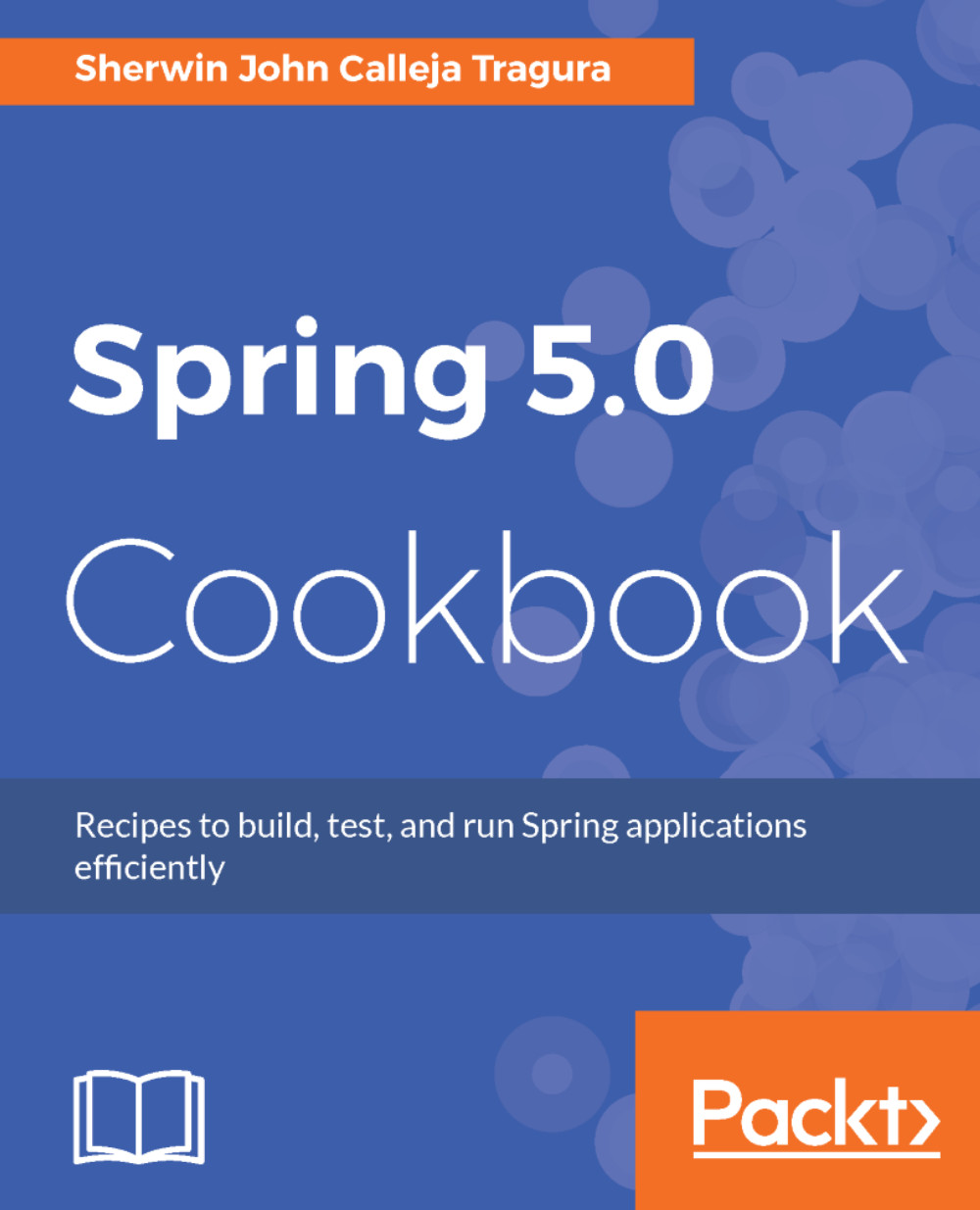
Spring 5.0 Cookbook

Spring 5.0 Cookbook

By : Sherwin John C. Tragura
3.5 (2)
close
close
Spring 5.0 Cookbook

Spring 5.0 Cookbook

3.5 (2)
By: Sherwin John C. Tragura

Overview of this book

The Spring framework has been the go-to framework for Java developers for quite some time. It enhances modularity, provides more readable code, and enables the developer to focus on developing the application while the underlying framework takes care of transaction APIs, remote APIs, JMX APIs, and JMS APIs. The upcoming version of the Spring Framework has a lot to offer, above and beyond the platform upgrade to Java 9, and this book will show you all you need to know to overcome common to advanced problems you might face. Each recipe will showcase some old and new issues and solutions, right from configuring Spring 5.0 container to testing its components. Most importantly, the book will highlight concurrent processes, asynchronous MVC and reactive programming using Reactor Core APIs. Aside from the core components, this book will also include integration of third-party technologies that are mostly needed in building enterprise applications. By the end of the book, the reader will not only be well versed with the essential concepts of Spring, but will also have mastered its latest features in a solution-oriented manner.
Table of Contents (14 chapters)
close
close

Building a reactive Spring MVC application


Spring Boot 2.0 supports building reactive Spring MVC applications and also has a starter POM to provide components with Reactor Core 3.x libraries. Likewise, it has the capability to easily integrate with RxJava 2.x APIs to provide us with another option for building reactive transactions. This recipe will be about creating a web application with a 100% reactive web framework of Spring 5.

Getting started

Reopen ch09 and prepare to build a reactive application using Spring Boot 2.0 with all non-blocking and functional components derived from the previous chapter.

How to do it...

Chapter 8, Reactive Web Application, introduced us to the reactive APIs of FreeMarker and Thymeleaf from Spring Reactive module of Spring 5. Let us now explore the reactive components of Spring Boot by doing the following steps:

  1. There is only one starter POM dependency that is responsible for creating a 100% reactive application that can only be inherited from the Spring Boot...
CONTINUE READING
83
Tech Concepts
36
Programming languages
73
Tech Tools
Icon Unlimited access to the largest independent learning library in tech of over 8,000 expert-authored tech books and videos.
Icon Innovative learning tools, including AI book assistants, code context explainers, and text-to-speech.
Icon 50+ new titles added per month and exclusive early access to books as they are being written.
Spring 5.0 Cookbook
notes
bookmark Notes and Bookmarks search Search in title playlist Add to playlist download Download options font-size Font size

Change the font size

margin-width Margin width

Change margin width

day-mode Day/Sepia/Night Modes

Change background colour

Close icon Search
Country selected

Close icon Your notes and bookmarks

Confirmation

Modal Close icon
claim successful

Buy this book with your credits?

Modal Close icon
Are you sure you want to buy this book with one of your credits?
Close
YES, BUY

Submit Your Feedback

Modal Close icon
Modal Close icon
Modal Close icon