
Sign In Start Free Trial
Account

Add to playlist

Create a Playlist

Modal Close icon
You need to login to use this feature.
  • Book Overview & Buying R Programming By Example
  • Table Of Contents Toc
R Programming By Example

R Programming By Example

By : Trejo Navarro, Omar Trejo Navarro
3 (4)
close
close
R Programming By Example

R Programming By Example

3 (4)
By: Trejo Navarro, Omar Trejo Navarro

Overview of this book

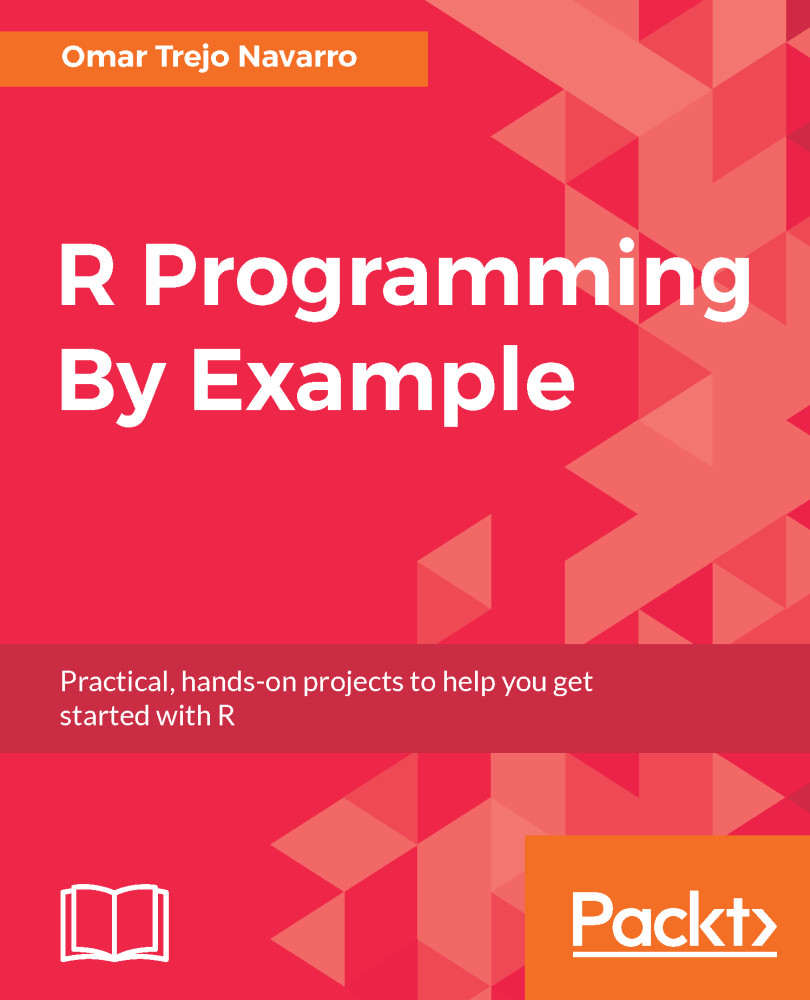
R is a high-level statistical language and is widely used among statisticians and data miners to develop analytical applications. Often, data analysis people with great analytical skills lack solid programming knowledge and are unfamiliar with the correct ways to use R. Based on the version 3.4, this book will help you develop strong fundamentals when working with R by taking you through a series of full representative examples, giving you a holistic view of R. We begin with the basic installation and configuration of the R environment. As you progress through the exercises, you'll become thoroughly acquainted with R's features and its packages. With this book, you will learn about the basic concepts of R programming, work efficiently with graphs, create publication-ready and interactive 3D graphs, and gain a better understanding of the data at hand. The detailed step-by-step instructions will enable you to get a clean set of data, produce good visualizations, and create reports for the results. It also teaches you various methods to perform code profiling and performance enhancement with good programming practices, delegation, and parallelization. By the end of this book, you will know how to efficiently work with data, create quality visualizations and reports, and develop code that is modular, expressive, and maintainable.
Table of Contents (12 chapters)
close
close

Reducing dimensionality with SVD

As we have seen in the previous section, the dimensionality course in our data was amplified due to the n-gram technique. We would like to be able to use n-grams to bring back word ordering into our DFM, but we would like to reduce the feature space at the same time. To accomplish this, we can use a number of different dimensionality reduction techniques. In this case, we will show how to use the SVD.

The SVD helps us compress the data by using it's singular vectors instead of the original features. The math behind the technique is out of the scope of the book, but we encourage you to look at Meyer's, Matrix Analysis & Applied Linear Algebra, 2000. Basically, you can think of the singular vectors as the important directions in the data, so instead of using our normal axis, we can use these singular vectors in a transformed space where...

CONTINUE READING
83
Tech Concepts
36
Programming languages
73
Tech Tools
Icon Unlimited access to the largest independent learning library in tech of over 8,000 expert-authored tech books and videos.
Icon Innovative learning tools, including AI book assistants, code context explainers, and text-to-speech.
Icon 50+ new titles added per month and exclusive early access to books as they are being written.
R Programming By Example
notes
bookmark Notes and Bookmarks search Search in title playlist Add to playlist download Download options font-size Font size

Change the font size

margin-width Margin width

Change margin width

day-mode Day/Sepia/Night Modes

Change background colour

Close icon Search
Country selected

Close icon Your notes and bookmarks

Confirmation

Modal Close icon
claim successful

Buy this book with your credits?

Modal Close icon
Are you sure you want to buy this book with one of your credits?
Close
YES, BUY

Submit Your Feedback

Modal Close icon
Modal Close icon
Modal Close icon