Sign In Start Free Trial
Account

Add to playlist

Create a Playlist

Modal Close icon
You need to login to use this feature.
  • Book Overview & Buying Rust Programming By Example
  • Table Of Contents Toc
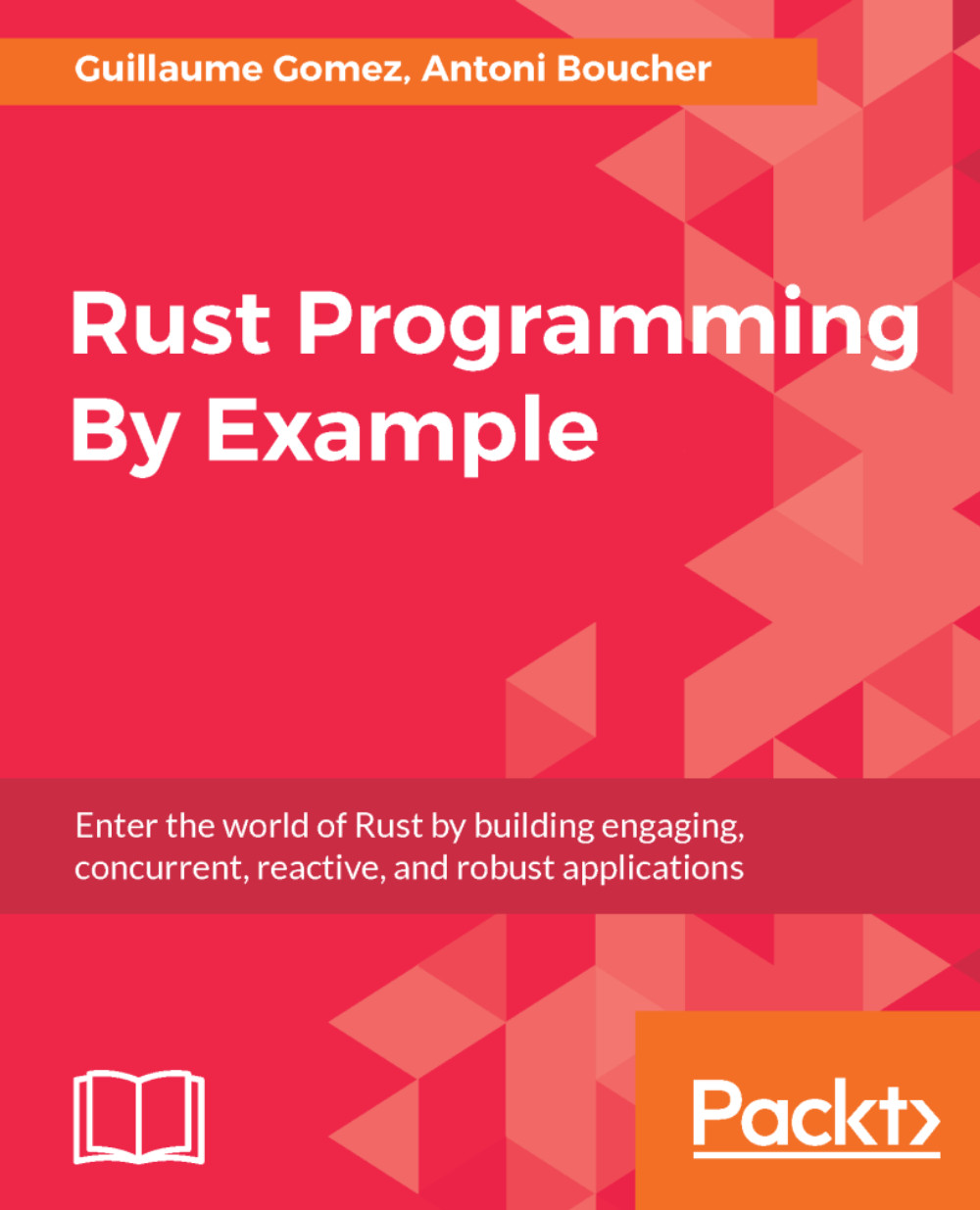
Rust Programming By Example

Rust Programming By Example

By : Gomez, Antoni Boucher
3.5 (4)
close
close
Rust Programming By Example

Rust Programming By Example

3.5 (4)
By: Gomez, Antoni Boucher

Overview of this book

Rust is an open source, safe, concurrent, practical language created by Mozilla. It runs blazingly fast, prevents segfaults, and guarantees safety. This book gets you started with essential software development by guiding you through the different aspects of Rust programming. With this approach, you can bridge the gap between learning and implementing immediately. Beginning with an introduction to Rust, you’ll learn the basic aspects such as its syntax, data types, functions, generics, control flows, and more. After this, you’ll jump straight into building your first project, a Tetris game. Next you’ll build a graphical music player and work with fast, reliable networking software using Tokio, the scalable and productive asynchronous IO Rust library. Over the course of this book, you’ll explore various features of Rust Programming including its SDL features, event loop, File I/O, and the famous GTK+ widget toolkit. Through these projects, you’ll see how well Rust performs in terms of concurrency—including parallelism, reliability, improved performance, generics, macros, and thread safety. We’ll also cover some asynchronous and reactive programming aspects of Rust. By the end of the book, you’ll be comfortable building various real-world applications in Rust.
Table of Contents (13 chapters)
close
close
3
Events and Basic Game Mechanisms

Communicating between widgets


We'll now communicate between the widgets to indicate we want to add a song to the playlist. But before we do so, we'll look in more detail at how a widget can communicate with itself.

Communicating with the same widget

We previously saw how to communicate with the same widget. To send a message to the same widget from an event handler in the view, we simply need to specify the message to be sent on the right side of =>, like in the following example:

gtk::ToolButton {
    icon_widget: &new_icon("gtk-quit"),
    clicked => Quit,
}

Here, the Quit message is sent to the same widget (that is, App) when the user clicks this tool button. But this is syntax sugar for a call to the emit() method on the stream of events of a relm widget.

Emit

So, let's see how to send a message to the same widget without using this syntax: this is useful in more complex cases, such as when we want to conditionally send a message. Let's go back to our Playlist and add a play() method...

CONTINUE READING
83
Tech Concepts
36
Programming languages
73
Tech Tools
Icon Unlimited access to the largest independent learning library in tech of over 8,000 expert-authored tech books and videos.
Icon Innovative learning tools, including AI book assistants, code context explainers, and text-to-speech.
Icon 50+ new titles added per month and exclusive early access to books as they are being written.
Rust Programming By Example
notes
bookmark Notes and Bookmarks search Search in title playlist Add to playlist download Download options font-size Font size

Change the font size

margin-width Margin width

Change margin width

day-mode Day/Sepia/Night Modes

Change background colour

Close icon Search
Country selected

Close icon Your notes and bookmarks

Confirmation

Modal Close icon
claim successful

Buy this book with your credits?

Modal Close icon
Are you sure you want to buy this book with one of your credits?
Close
YES, BUY

Submit Your Feedback

Modal Close icon
Modal Close icon
Modal Close icon