Sign In Start Free Trial
Account

Add to playlist

Create a Playlist

Modal Close icon
You need to login to use this feature.
  • Book Overview & Buying Rust High Performance
  • Table Of Contents Toc
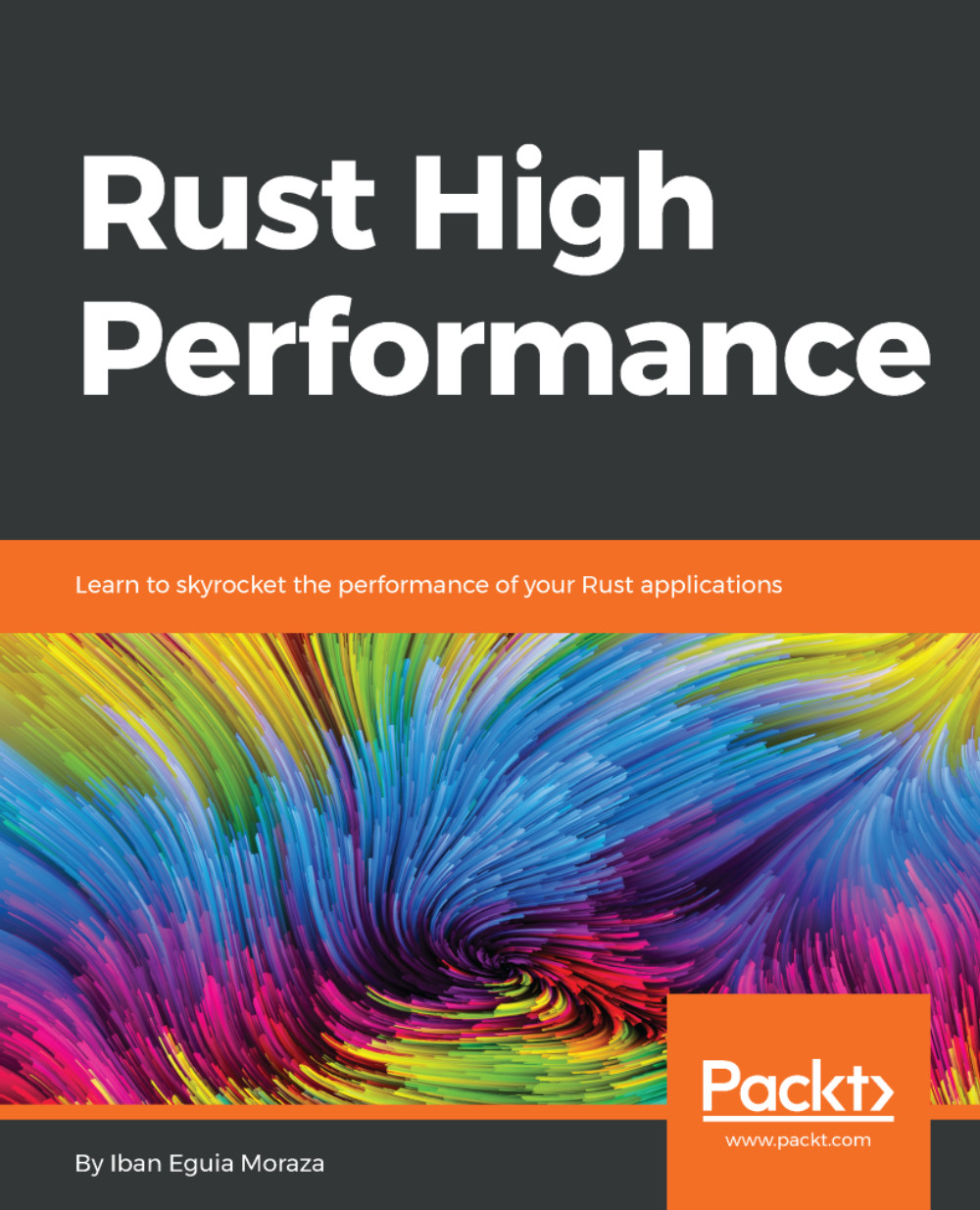
Rust High Performance

Rust High Performance

By : Eguia Moraza
3 (3)
close
close
Rust High Performance

Rust High Performance

3 (3)
By: Eguia Moraza

Overview of this book

This book teaches you how to optimize the performance of your Rust code so that it is at the same level as languages such as C/C++. You'll understand and fi x common pitfalls, learn how to improve your productivity by using metaprogramming, and speed up your code. You will master the features of the language, which will make you stand out, and use them to greatly improve the efficiency of your algorithms. The book begins with an introduction to help you identify bottlenecks when programming in Rust. We highlight common performance pitfalls, along with strategies to detect and resolve these issues early. We move on to mastering Rust's type system, which will enable us to optimize both performance and safety at compile time. You will learn how to effectively manage memory in Rust, mastering the borrow checker. We move on to measuring performance and you will see how this affects the way you write code. Moving forward, you will perform metaprogramming in Rust to boost the performance of your code and your productivity. Finally, you will learn parallel programming in Rust, which enables efficient and faster execution by using multithreading and asynchronous programming.
Table of Contents (13 chapters)
close
close

Macros


One of the most useful Rust functionalities is its macro ecosystem. You probably already know the println!() macro, but there are many more. These macros allow you to write complex boilerplate code (such as stdio handling in the println!() case) in a simple way and without having to add a ton of boilerplate code. Let's check out some of the most used ones.

Console printing

When you need to lock the standard I/O interface, then write bytes to it, and finally flush it for each call, the print!() and println!() macros allow you to do that by just giving them a formatting static string and a series of parameters. Not only that, you can use the whole std::fmt module to specify number precision, format things in debug mode, and so on.

Similar macros exist for the standard error output interface or stderr. They are called eprint!() and eprintln!(), and allow you to easily print in stderr with the same format as print!() and println!(). The four macros use the syntax from the format!() macro...

CONTINUE READING
83
Tech Concepts
36
Programming languages
73
Tech Tools
Icon Unlimited access to the largest independent learning library in tech of over 8,000 expert-authored tech books and videos.
Icon Innovative learning tools, including AI book assistants, code context explainers, and text-to-speech.
Icon 50+ new titles added per month and exclusive early access to books as they are being written.
Rust High Performance
notes
bookmark Notes and Bookmarks search Search in title playlist Add to playlist download Download options font-size Font size

Change the font size

margin-width Margin width

Change margin width

day-mode Day/Sepia/Night Modes

Change background colour

Close icon Search
Country selected

Close icon Your notes and bookmarks

Confirmation

Modal Close icon
claim successful

Buy this book with your credits?

Modal Close icon
Are you sure you want to buy this book with one of your credits?
Close
YES, BUY

Submit Your Feedback

Modal Close icon
Modal Close icon
Modal Close icon