Sign In Start Free Trial
Account

Add to playlist

Create a Playlist

Modal Close icon
You need to login to use this feature.
  • Book Overview & Buying Swift 4 Protocol-Oriented Programming
  • Table Of Contents Toc
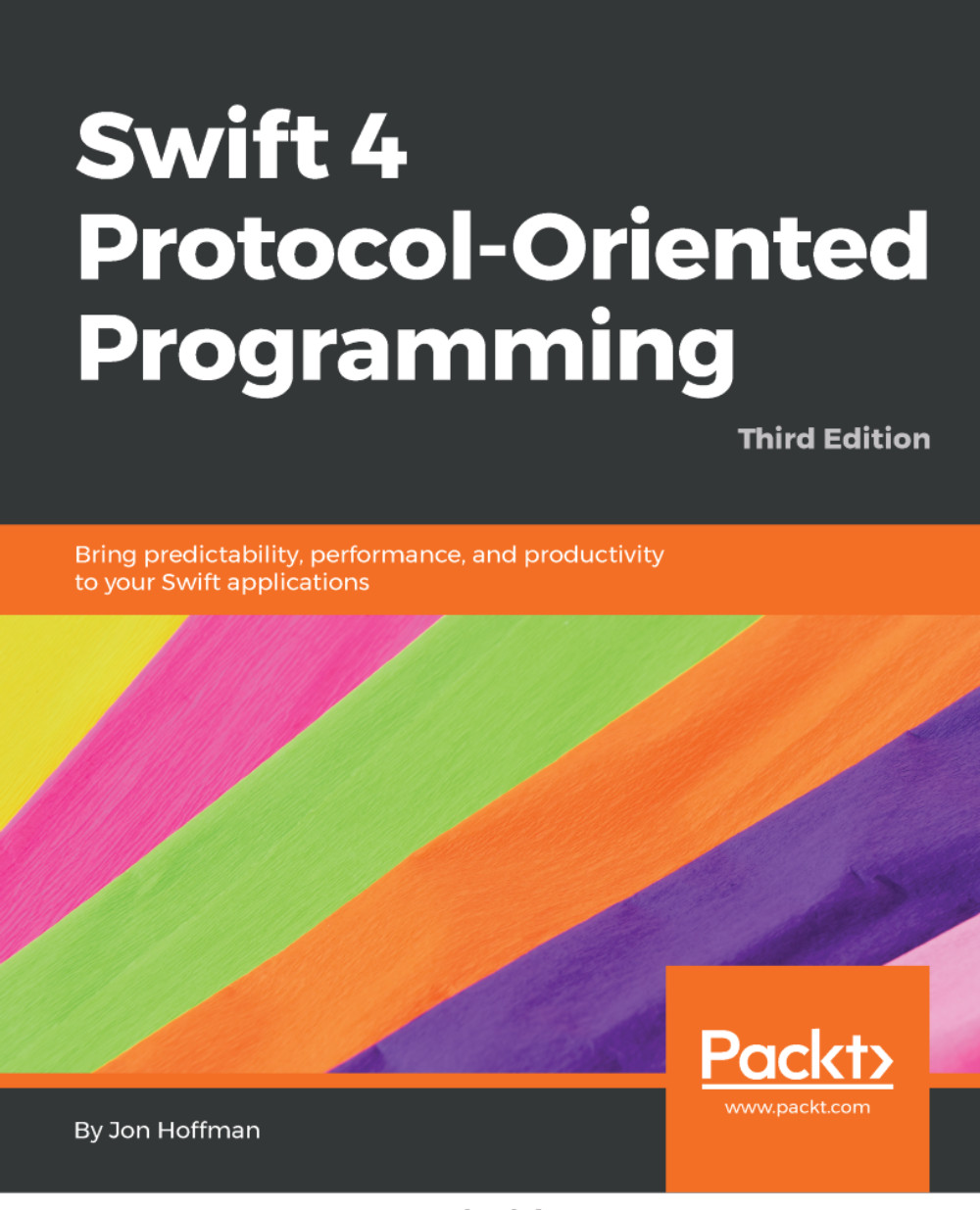
Swift 4 Protocol-Oriented Programming

Swift 4 Protocol-Oriented Programming - Third Edition

By : Jon Hoffman
4.1 (29)
close
close
Swift 4 Protocol-Oriented Programming

Swift 4 Protocol-Oriented Programming

4.1 (29)
By: Jon Hoffman

Overview of this book

Swift has become the number one language used in iOS and macOS development. The Swift standard library is developed using protocol-oriented programming techniques, generics, and first-class value semantics; therefore, every Swift developer should understand these powerful concepts and how to take advantage of them in their application design. This book will help you understand the differences between object-oriented programming and protocol-oriented programming. It will demonstrate how to work with protocol-oriented programming using real-world use cases. You will gain a solid knowledge of the various types that can be used in Swift and the differences between value and reference types. You will be taught how protocol-oriented programming techniques can be used to develop very flexible and easy-to-maintain code. By the end of the book, you will have a thorough understanding of protocol-oriented programming and how to utilize it to build powerful and practical applications.
Table of Contents (9 chapters)
close
close

Tuples


In Swift, a tuple is a finite, ordered, comma-separated list of elements. While there are tuples in other languages that I have used, I never really took advantage of them. To be honest, I was only vaguely aware that they actually existed in those other languages. In Swift, tuples are more prominent than they are in other languages, which forced me to take a closer look at them. What I found is that they are extremely useful. In my opinion, tuples are one of the most underutilized types in Swift and, as we go through this book (especially in the case study section), I will point out some cases where the tuple type can be used.

We can create a tuple and access the information within it, as shown in the following example:

let mathGrade1 = ("Jon", 100)  
let (name, score) = mathGrade1  
print("\(name) - \(score)") 

In the previous code, we grouped a String and an Integer into a single tuple type. We then decomposed the tuple using pattern matching, which places the values into the name...

CONTINUE READING
83
Tech Concepts
36
Programming languages
73
Tech Tools
Icon Unlimited access to the largest independent learning library in tech of over 8,000 expert-authored tech books and videos.
Icon Innovative learning tools, including AI book assistants, code context explainers, and text-to-speech.
Icon 50+ new titles added per month and exclusive early access to books as they are being written.
Swift 4 Protocol-Oriented Programming
notes
bookmark Notes and Bookmarks search Search in title playlist Add to playlist download Download options font-size Font size

Change the font size

margin-width Margin width

Change margin width

day-mode Day/Sepia/Night Modes

Change background colour

Close icon Search
Country selected

Close icon Your notes and bookmarks

Confirmation

Modal Close icon
claim successful

Buy this book with your credits?

Modal Close icon
Are you sure you want to buy this book with one of your credits?
Close
YES, BUY

Submit Your Feedback

Modal Close icon
Modal Close icon
Modal Close icon