
Sign In Start Free Trial
Account

Add to playlist

Create a Playlist

Modal Close icon
You need to login to use this feature.
  • Book Overview & Buying C# 7 and .NET Core 2.0 High Performance
  • Table Of Contents Toc
  • Feedback & Rating feedback
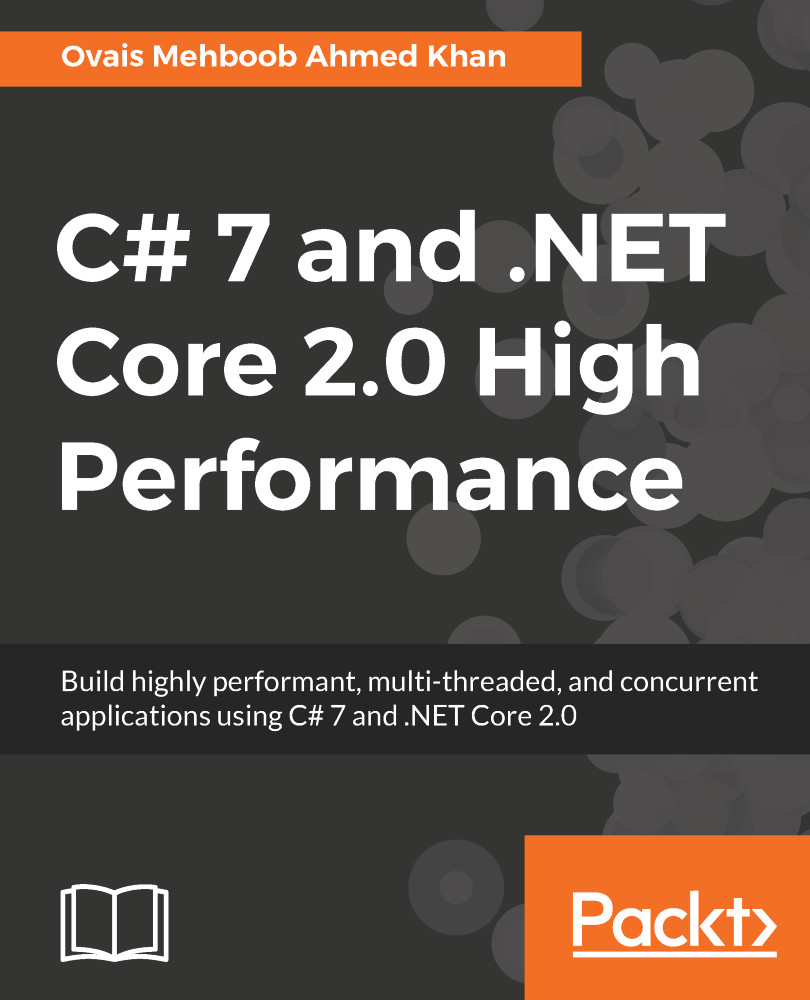
C# 7 and .NET Core 2.0 High Performance

C# 7 and .NET Core 2.0 High Performance

By : Mehboob Ahmed Khan
2.3 (6)
close
close
C# 7 and .NET Core 2.0 High Performance

C# 7 and .NET Core 2.0 High Performance

2.3 (6)
By: Mehboob Ahmed Khan

Overview of this book

While writing an application, performance is paramount. Performance tuning for realworld applications often involves activities geared toward fnding bottlenecks; however, this cannot solve the dreaded problem of slower code. If you want to improve the speed of your code and optimize an application's performance, then this book is for you. C# 7 and .NET Core 2.0 High Performance begins with an introduction to the new features of what?explaining how they help in improving an application's performance. Learn to identify the bottlenecks in writing programs and highlight common performance pitfalls, and learn strategies to detect and resolve these issues early. You will explore multithreading and asynchronous programming with .NET Core and learn the importance and effcient use of data structures. This is followed with memory management techniques and design guidelines to increase an application’s performance. Gradually, the book will show you the importance of microservices architecture for building highly performant applications and implementing resiliency and security in .NET Core. After reading this book, you will learn how to structure and build scalable, optimized, and robust applications in C#7 and .NET.
Table of Contents (11 chapters)
close
close
5
Designing Guidelines for .NET Core Application Performance

Memory Management Techniques in .NET Core

Memory management significantly affects the performance of any application. When the application is run, .NET CLR (Common Language Runtime) allocates many objects in memory, and they stay there until they are not needed, until new objects are created and are allocated space, or until the GC runs (as it does occasionally) to release unused objects and make more space available for other objects. Most of the job is done by the GC itself, which runs intelligently and frees up space for the objects by removing those that are not needed. However, there are certain practices that can help any application to avoid performance issues and run smoothly.

In Chapter 2, Understanding .NET Core Internals and Measuring Performance, we already learned about how garbage collection works and how generations are maintained in .NET. In this chapter, we will...

Visually different images
CONTINUE READING
83
Tech Concepts
36
Programming languages
73
Tech Tools
Icon Unlimited access to the largest independent learning library in tech of over 8,000 expert-authored tech books and videos.
Icon Innovative learning tools, including AI book assistants, code context explainers, and text-to-speech.
Icon 50+ new titles added per month and exclusive early access to books as they are being written.
C# 7 and .NET Core 2.0 High Performance
notes
bookmark Notes and Bookmarks search Search in title playlist Add to playlist font-size Font size

Change the font size

margin-width Margin width

Change margin width

day-mode Day/Sepia/Night Modes

Change background colour

Close icon Search
Country selected

Close icon Your notes and bookmarks

Confirmation

Modal Close icon
claim successful

Buy this book with your credits?

Modal Close icon
Are you sure you want to buy this book with one of your credits?
Close
YES, BUY

Submit Your Feedback

Modal Close icon
Modal Close icon
Modal Close icon