
Sign In Start Free Trial
Account

Add to playlist

Create a Playlist

Modal Close icon
You need to login to use this feature.
  • Book Overview & Buying Functional Kotlin
  • Table Of Contents Toc
Functional Kotlin

Functional Kotlin

3 (1)
close
close
Functional Kotlin

Functional Kotlin

3 (1)

Overview of this book

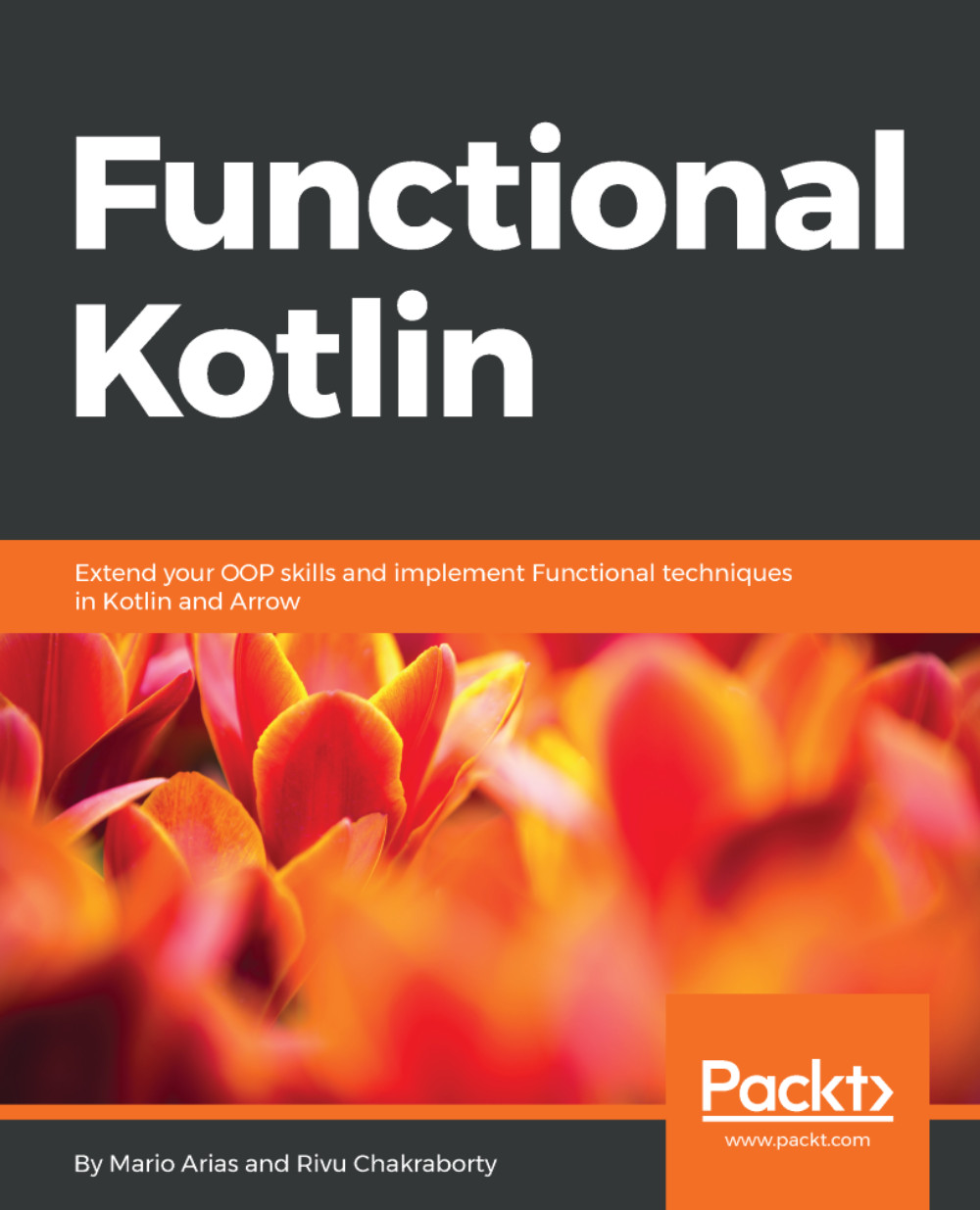
Functional programming makes your application faster, improves performance, and increases your productivity. Kotlin supports many of the popular and advanced functional features of functional languages. This book will cover the A-Z of functional programming in Kotlin. This book bridges the language gap for Kotlin developers by showing you how to create and consume functional constructs in Kotlin. We also bridge the domain gap by showing how functional constructs can be applied in business scenarios. We’ll take you through lambdas, pattern matching, immutability, and help you develop a deep understanding of the concepts and practices of functional programming. If you want learn to address problems using Recursion, Koltin has support for it as well. You’ll also learn how to use the funKtionale library to perform currying and lazy programming and more. Finally, you’ll learn functional design patterns and techniques that will make you a better programmer.By the end of the book, you will be more confident in your functional programming skills and will be able to apply them while programming in Kotlin.
Table of Contents (16 chapters)
close
close

Objects

We already covered object expressions, but there is more on objects. Objects are natural singletons (by natural, I mean to come as language features and not as behavior pattern implementations, as in other languages). A singleton is a type that has just one and only one instance and every object in Kotlin is a singleton. That opens a lot of interesting patterns (and also some bad practices). Objects as singletons are useful for coordinating actions across the system, but can also be dangerous if they are used to keep global state.

Object expressions don't need to extend any type:

fun main(args: Array<String>) {
val expression = object {
val property = ""

fun method(): Int {
println("from an object expressions")
return 42
}
}

val i = "${expression.method()} ${expression.property}"
println(i)
}

In this case, the expression value is an object that doesn't have any specific type. We can access its properties and functions.

There is one restriction—object expressions without type can be used only locally, inside a method, or privately, inside a class:

class Outer {
val internal = object {
val property = ""
}
}

fun main(args: Array<String>) {
val outer = Outer()

println(outer.internal.property) // Compilation error: Unresolved reference: property
}

In this case, the property value can't be accessed.

Object declarations

An object can also have a name. This kind of object is called an object declaration:

object Oven {
fun process(product: Bakeable) {
println(product.bake())
}
}

fun main(args: Array<String>) {
val myAlmondCupcake = Cupcake("Almond")
Oven.process(myAlmondCupcake)
}

Objects are singletons; you don't need to instantiate Oven to use it. Objects also can extend other types:

interface Oven {
fun process(product: Bakeable)
}

object ElectricOven: Oven {
override fun process(product: Bakeable) {
println(product.bake())
}
}

fun main(args: Array<String>) {
val myAlmondCupcake = Cupcake("Almond")
ElectricOven.process(myAlmondCupcake)
}

Companion objects

Objects declared inside a class/interface can be marked as companion objects. Observe the use of companion objects in the following code:

class Cupcake(flavour: String) : BakeryGood(flavour), Bakeable {
override fun name(): String {
return "cupcake"
}

companion object {
fun almond(): Cupcake {
return Cupcake("almond")
}

fun cheese(): Cupcake {
return Cupcake("cheese")
}
}
}

Now, methods inside the companion object can be used directly, using the class name without instantiating it:

fun main(args: Array<String>) {
val myBlueberryCupcake: BakeryGood = Cupcake("Blueberry")
val myAlmondCupcake = Cupcake.almond()
val myCheeseCupcake = Cupcake.cheese()
val myCaramelCupcake = Cupcake("Caramel")
}

Companion object's methods can't be used from instances:

fun main(args: Array<String>) {
val myAlmondCupcake = Cupcake.almond()
val myCheeseCupcake = myAlmondCupcake.cheese() //Compilation error: Unresolved reference: cheese
}

Companion objects can be used outside the class as values with the name Companion:

fun main(args: Array<String>) {
val factory: Cupcake.Companion = Cupcake.Companion
}

Alternatively, a Companion object can have a name:

class Cupcake(flavour: String) : BakeryGood(flavour), Bakeable {
override fun name(): String {
return "cupcake"
}

companion object Factory {
fun almond(): Cupcake {
return Cupcake("almond")
}

fun cheese(): Cupcake {
return Cupcake("cheese")
}
}
}

fun main(args: Array<String>) {
val factory: Cupcake.Factory = Cupcake.Factory
}

They can also be used without a name, as shown in the following code:

fun main(args: Array<String>) {
val factory: Cupcake.Factory = Cupcake
}

Don't be confused by this syntax. The Cupcake value without parenthesis is the companion object; Cupcake() is an instance.

Visually different images
CONTINUE READING
83
Tech Concepts
36
Programming languages
73
Tech Tools
Icon Unlimited access to the largest independent learning library in tech of over 8,000 expert-authored tech books and videos.
Icon Innovative learning tools, including AI book assistants, code context explainers, and text-to-speech.
Icon 50+ new titles added per month and exclusive early access to books as they are being written.
Functional Kotlin
notes
bookmark Notes and Bookmarks search Search in title playlist Add to playlist download Download options font-size Font size

Change the font size

margin-width Margin width

Change margin width

day-mode Day/Sepia/Night Modes

Change background colour

Close icon Search
Country selected

Close icon Your notes and bookmarks

Confirmation

Modal Close icon
claim successful

Buy this book with your credits?

Modal Close icon
Are you sure you want to buy this book with one of your credits?
Close
YES, BUY

Submit Your Feedback

Modal Close icon
Modal Close icon
Modal Close icon