
Sign In Start Free Trial
Account

Add to playlist

Create a Playlist

Modal Close icon
You need to login to use this feature.
  • Book Overview & Buying Functional Kotlin
  • Table Of Contents Toc
Functional Kotlin

Functional Kotlin

3 (1)
close
close
Functional Kotlin

Functional Kotlin

3 (1)

Overview of this book

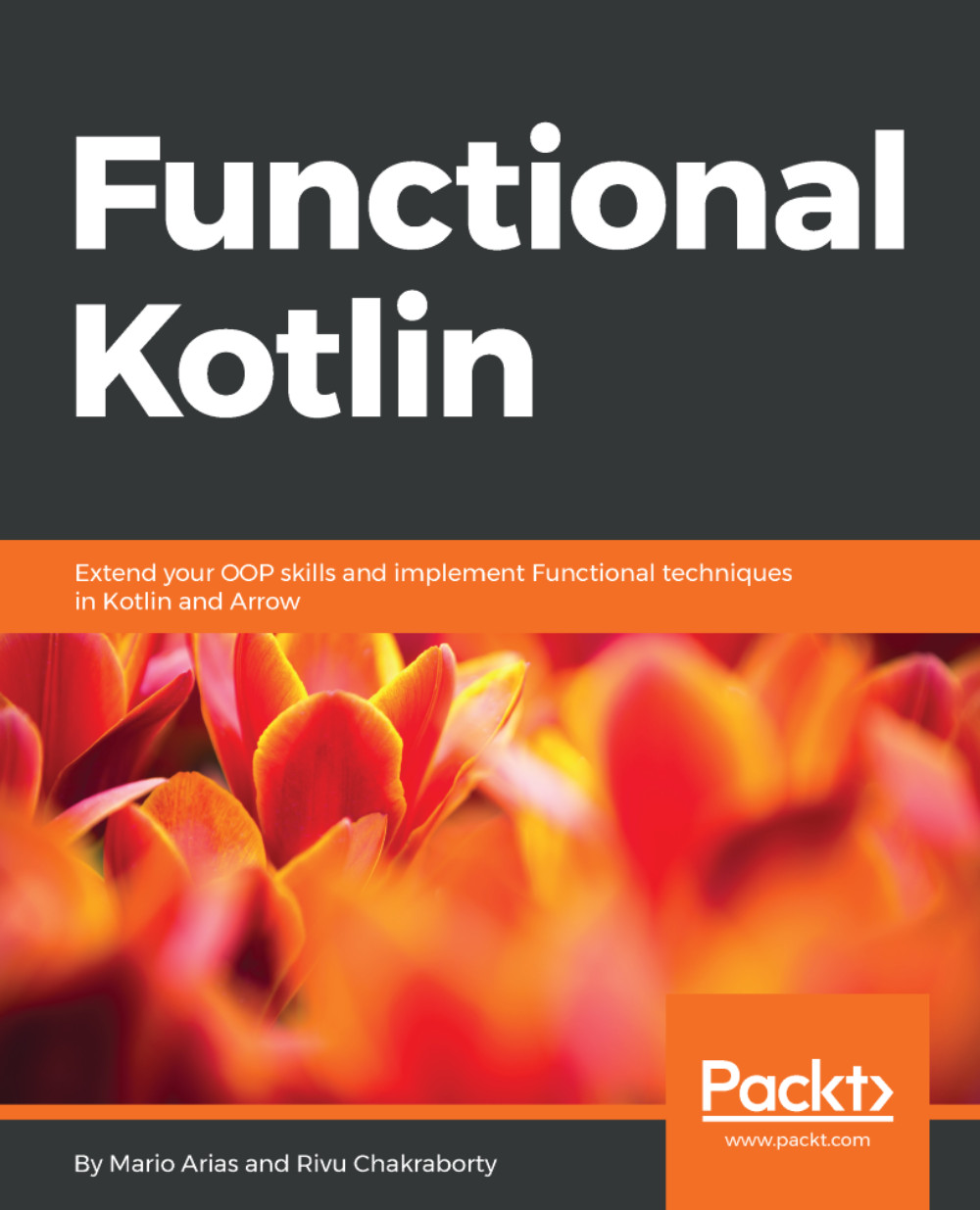
Functional programming makes your application faster, improves performance, and increases your productivity. Kotlin supports many of the popular and advanced functional features of functional languages. This book will cover the A-Z of functional programming in Kotlin. This book bridges the language gap for Kotlin developers by showing you how to create and consume functional constructs in Kotlin. We also bridge the domain gap by showing how functional constructs can be applied in business scenarios. We’ll take you through lambdas, pattern matching, immutability, and help you develop a deep understanding of the concepts and practices of functional programming. If you want learn to address problems using Recursion, Koltin has support for it as well. You’ll also learn how to use the funKtionale library to perform currying and lazy programming and more. Finally, you’ll learn functional design patterns and techniques that will make you a better programmer.By the end of the book, you will be more confident in your functional programming skills and will be able to apply them while programming in Kotlin.
Table of Contents (16 chapters)
close
close

Generics

This section is just a short introduction to generics; later, we'll cover it in detail.

Generic programming is a style programming that focuses on creating algorithms (and collaterally, data structures) that work on general problems.

The Kotlin way to support generic programming is using type parameters. In a few words, we wrote our code with type parameters and, later on, we pass those types as parameters when we use them. 

Let's take, for example, our Oven interface:

interface Oven {
fun process(product: Bakeable)
}

An oven is a machine, so we could generalize it more:

interface Machine<T> {
fun process(product: T)
}

The Machine<T> interface defines a type parameter T and a method process(T).

Now, we can extend it with Oven:

interface Oven: Machine<Bakeable>

Now, Oven is extending Machine with the Bakeable type parameter, so the process method now takes Bakeable as a parameter.

CONTINUE READING
83
Tech Concepts
36
Programming languages
73
Tech Tools
Icon Unlimited access to the largest independent learning library in tech of over 8,000 expert-authored tech books and videos.
Icon Innovative learning tools, including AI book assistants, code context explainers, and text-to-speech.
Icon 50+ new titles added per month and exclusive early access to books as they are being written.
Functional Kotlin
notes
bookmark Notes and Bookmarks search Search in title playlist Add to playlist download Download options font-size Font size

Change the font size

margin-width Margin width

Change margin width

day-mode Day/Sepia/Night Modes

Change background colour

Close icon Search
Country selected

Close icon Your notes and bookmarks

Confirmation

Modal Close icon
claim successful

Buy this book with your credits?

Modal Close icon
Are you sure you want to buy this book with one of your credits?
Close
YES, BUY

Submit Your Feedback

Modal Close icon
Modal Close icon
Modal Close icon