
Sign In Start Free Trial
Account

Add to playlist

Create a Playlist

Modal Close icon
You need to login to use this feature.
  • Book Overview & Buying C++ Reactive Programming
  • Table Of Contents Toc
  • Feedback & Rating feedback
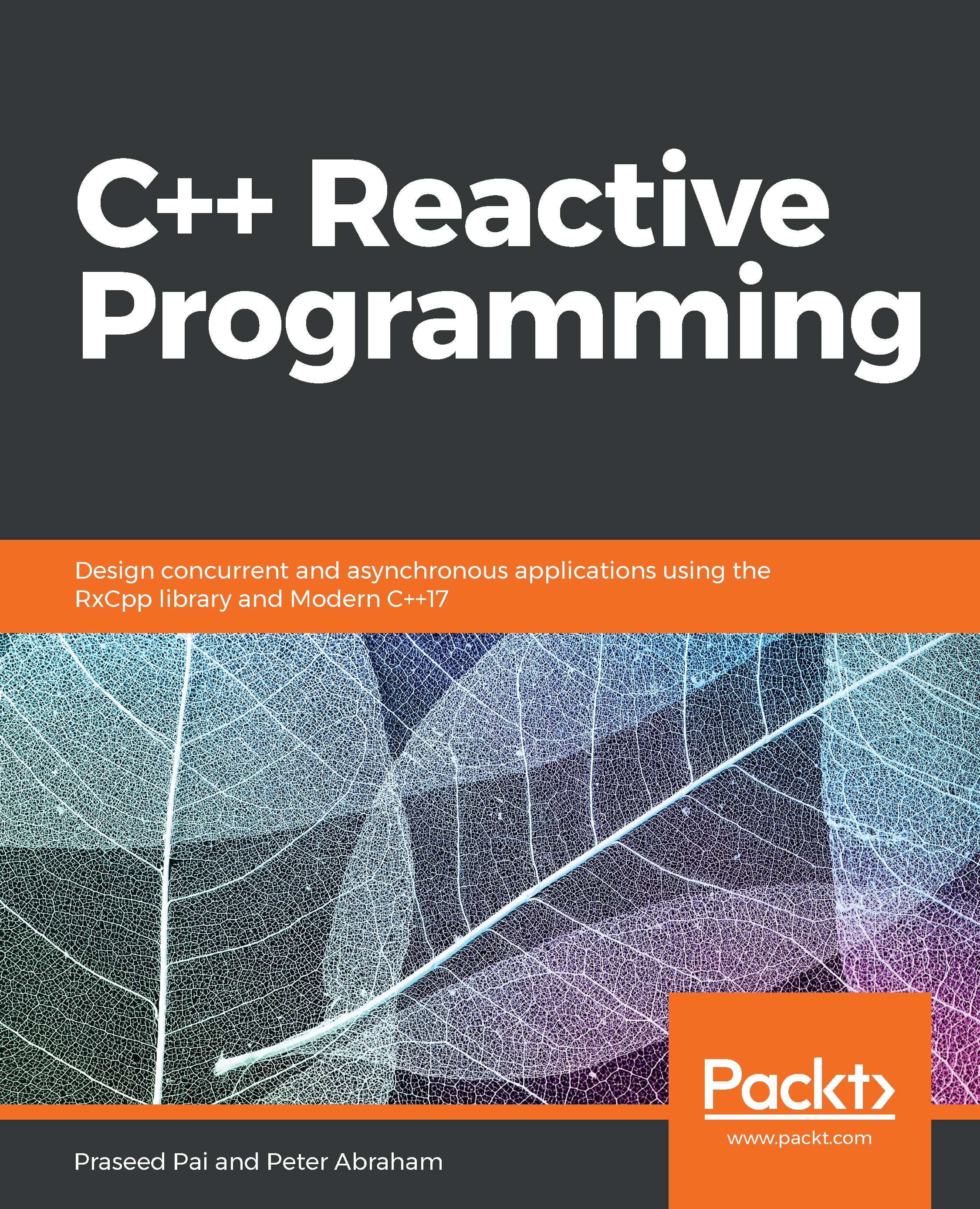
C++ Reactive Programming

C++ Reactive Programming

By : Praseed Pai, Abraham
3 (8)
close
close
C++ Reactive Programming

C++ Reactive Programming

3 (8)
By: Praseed Pai, Abraham

Overview of this book

Reactive programming is an effective way to build highly responsive applications with an easy-to-maintain code base. This book covers the essential functional reactive concepts that will help you build highly concurrent, event-driven, and asynchronous applications in a simpler and less error-prone way. C++ Reactive Programming begins with a discussion on how event processing was undertaken by different programming systems earlier. After a brisk introduction to modern C++ (C++17), you’ll be taken through language-level concurrency and the lock-free programming model to set the stage for our foray into the Functional Programming model. Following this, you’ll be introduced to RxCpp and its programming model. You’ll be able to gain deep insights into the RxCpp library, which facilitates reactive programming. You’ll learn how to deal with reactive programming using Qt/C++ (for the desktop) and C++ microservices for the Web. By the end of the book, you will be well versed with advanced reactive programming concepts in modern C++ (C++17).
Table of Contents (15 chapters)
close
close

Reactive Programming Model – Overview and History

The X Windows system, Microsoft Windows, and IBM OS/2 Presentation Manager made GUI programming popular on the PC platform. This was a major shift from the character mode user interface and batch process style programming models that existed before them. Responding to events became a major concern for software developers worldwide and platform vendors resorted to the creation of low-level C-based APIs that relied on function pointers and callbacks to enable programmers to handle the events. The programming models were mostly based on the co-operative multithreaded model, and with the advent of better microprocessors, most platforms began to support pre-emptive multithreading. Handling events (and other asynchronous tasks) became more complex and responding to events in the traditional way became less scalable. Even though excellent C++-based GUI toolkits made their appearance, event handling was done mostly using message IDs, function pointer based dispatches, and other low-level techniques. A prominent compiler vendor even tried adding language extensions to the C++ language to enable better Windows programming. Handling events, asynchrony, and associated issues require a fresh look at the problem. Luckily, the Modern C++ standard has support for Functional Programming, language-level concurrency (with a memory model), and better memory management techniques to enable programmers to work with asynchronous data streams (by treating events as streams). This is achieved using a programming model called reactive programming. To put things in perspective, this chapter will outline the following topics:

  • Event-driven programming model and how it has been implemented in various platforms.
  • What is reactive programming?
  • Different models of reactive programming.
  • Some simple programs to make conceptual understanding better.
  • The philosophy of our book.
Visually different images
CONTINUE READING
83
Tech Concepts
36
Programming languages
73
Tech Tools
Icon Unlimited access to the largest independent learning library in tech of over 8,000 expert-authored tech books and videos.
Icon Innovative learning tools, including AI book assistants, code context explainers, and text-to-speech.
Icon 50+ new titles added per month and exclusive early access to books as they are being written.
C++ Reactive Programming
notes
bookmark Notes and Bookmarks search Search in title playlist Add to playlist download Download options font-size Font size

Change the font size

margin-width Margin width

Change margin width

day-mode Day/Sepia/Night Modes

Change background colour

Close icon Search
Country selected

Close icon Your notes and bookmarks

Confirmation

Modal Close icon
claim successful

Buy this book with your credits?

Modal Close icon
Are you sure you want to buy this book with one of your credits?
Close
YES, BUY

Submit Your Feedback

Modal Close icon
Modal Close icon
Modal Close icon
