
Sign In Start Free Trial
Account

Add to playlist

Create a Playlist

Modal Close icon
You need to login to use this feature.
  • Book Overview & Buying C++ Reactive Programming
  • Table Of Contents Toc
  • Feedback & Rating feedback
C++ Reactive Programming

C++ Reactive Programming

By : Praseed Pai, Abraham
3 (8)
close
close
C++ Reactive Programming

C++ Reactive Programming

3 (8)
By: Praseed Pai, Abraham

Overview of this book

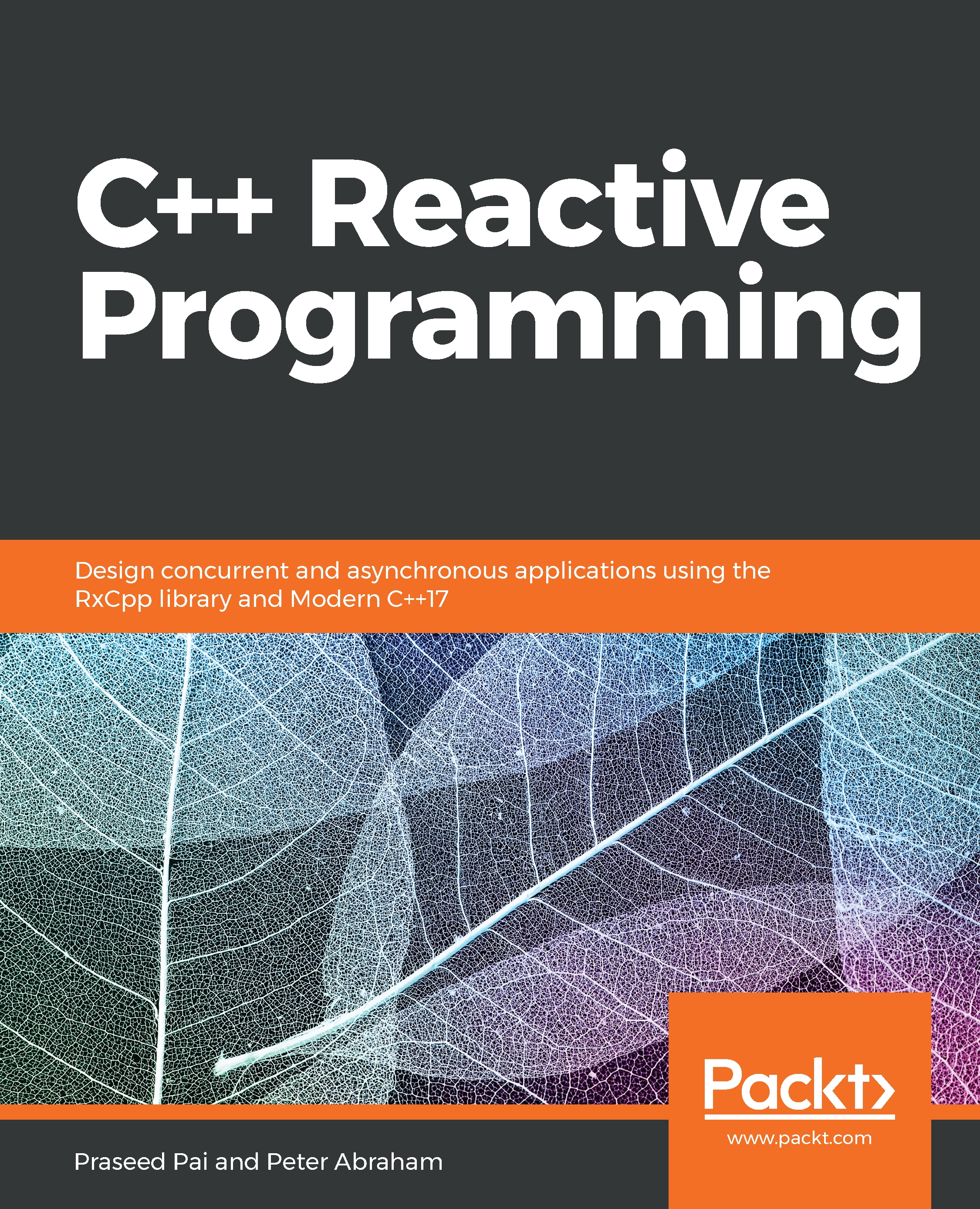
Reactive programming is an effective way to build highly responsive applications with an easy-to-maintain code base. This book covers the essential functional reactive concepts that will help you build highly concurrent, event-driven, and asynchronous applications in a simpler and less error-prone way. C++ Reactive Programming begins with a discussion on how event processing was undertaken by different programming systems earlier. After a brisk introduction to modern C++ (C++17), you’ll be taken through language-level concurrency and the lock-free programming model to set the stage for our foray into the Functional Programming model. Following this, you’ll be introduced to RxCpp and its programming model. You’ll be able to gain deep insights into the RxCpp library, which facilitates reactive programming. You’ll learn how to deal with reactive programming using Qt/C++ (for the desktop) and C++ microservices for the Web. By the end of the book, you will be well versed with advanced reactive programming concepts in modern C++ (C++17).
Table of Contents (15 chapters)
close
close

RxCpp error and exception handling Operators

In a real-world scenario, no system is perfect. As we discussed in the previous section, resilience is one of the qualities of a reactive system. How a system handles errors and exceptions decides the future of that system. Early detection and the seamless handling of errors makes a system consistent and responsive. Compared to imperative programming approaches, the reactive programming model helps the user to handle errors separately, as and when the system detects an error or throws an exception.

In this section, we will take a look at how to handle exceptions and errors by using the RxCpp library. There are a variety of RxCpp Operators that can be used to react to on_error notifications from Observables. For instance, we might:

  • Handle the error by exiting from the sequence gracefully
  • Ignore the error and switch over to a backup...
Visually different images
CONTINUE READING
83
Tech Concepts
36
Programming languages
73
Tech Tools
Icon Unlimited access to the largest independent learning library in tech of over 8,000 expert-authored tech books and videos.
Icon Innovative learning tools, including AI book assistants, code context explainers, and text-to-speech.
Icon 50+ new titles added per month and exclusive early access to books as they are being written.
C++ Reactive Programming
notes
bookmark Notes and Bookmarks search Search in title playlist Add to playlist download Download options font-size Font size

Change the font size

margin-width Margin width

Change margin width

day-mode Day/Sepia/Night Modes

Change background colour

Close icon Search
Country selected

Close icon Your notes and bookmarks

Confirmation

Modal Close icon
claim successful

Buy this book with your credits?

Modal Close icon
Are you sure you want to buy this book with one of your credits?
Close
YES, BUY

Submit Your Feedback

Modal Close icon
Modal Close icon
Modal Close icon