
Sign In Start Free Trial
Account

Add to playlist

Create a Playlist

Modal Close icon
You need to login to use this feature.
  • Book Overview & Buying Hands-On Reactive Programming with Reactor
  • Table Of Contents Toc
Hands-On Reactive Programming with Reactor

Hands-On Reactive Programming with Reactor

By : Rahul Sharma
1 (3)
close
close
Hands-On Reactive Programming with Reactor

Hands-On Reactive Programming with Reactor

1 (3)
By: Rahul Sharma

Overview of this book

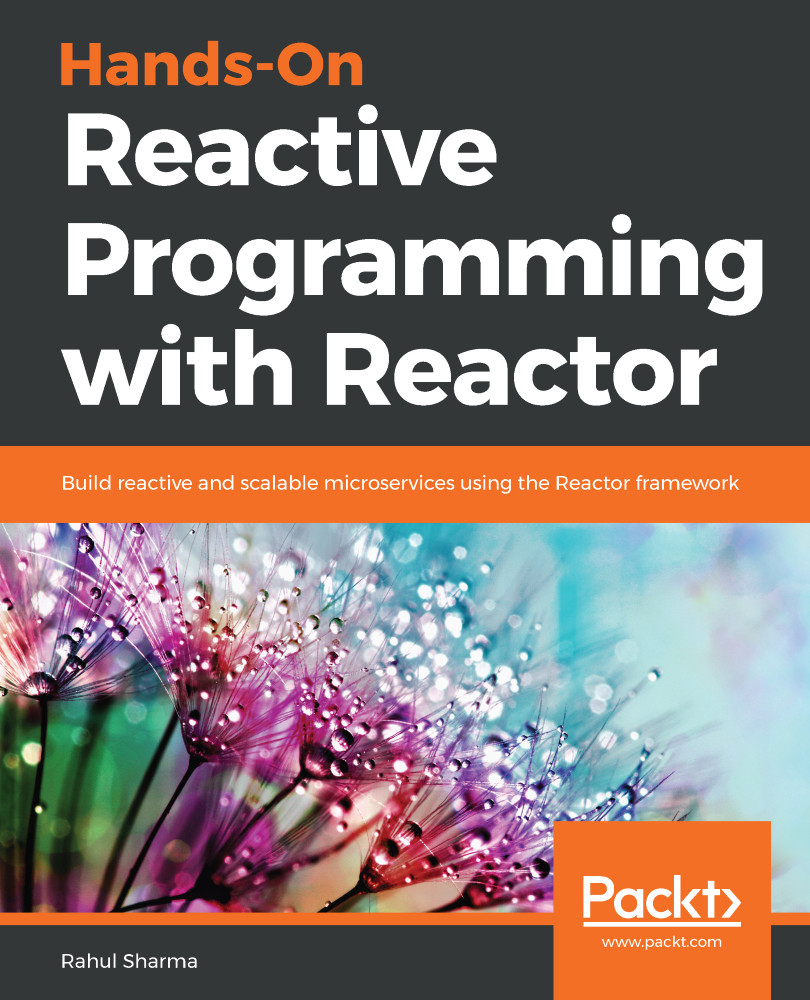
Reactor is an implementation of the Java 9 Reactive Streams specification, an API for asynchronous data processing. This specification is based on a reactive programming paradigm, enabling developers to build enterprise-grade, robust applications with reduced complexity and in less time. Hands-On Reactive Programming with Reactor shows you how Reactor works, as well as how to use it to develop reactive applications in Java. The book begins with the fundamentals of Reactor and the role it plays in building effective applications. You will learn how to build fully non-blocking applications and will later be guided by the Publisher and Subscriber APIs. You will gain an understanding how to use two reactive composable APIs, Flux and Mono, which are used extensively to implement Reactive Extensions. All of these components are combined using various operations to build a complete solution. In addition to this, you will get to grips with the Flow API and understand backpressure in order to control overruns. You will also study the use of Spring WebFlux, an extension of the Reactor framework for building microservices. By the end of the book, you will have gained enough confidence to build reactive and scalable microservices.
Table of Contents (13 chapters)
close
close

Chapter 5: SpringWebFlux for Microservices

  1. How can we configure the SpringWebFlux project?

SpringWebFlux can be configured in two ways :

  • Using annotations: SpringWebFlux supports SpringWebMVC annotations. This is the easiest way of configuring SpringWebFlux.
  • Using functional endpoints: This model allows us to build Java 8 functions as web endpoints. The application can be configured as a set of routes, handlers, and filters.
  1. Which MethodParameter annotations are supported by SpringWebFlux?
  • @PathVariable: This annotation is used to access values for URI template variables
  • @RequestParam: This annotation is used to determine values passed as query parameters
  • @RequestHeader: This annotation is used to determine values passed in request headers
  • @RequestBody: This annotation is used to determine values passed in the request body
  • @CookieValue: This annotation is used to determine...
CONTINUE READING
83
Tech Concepts
36
Programming languages
73
Tech Tools
Icon Unlimited access to the largest independent learning library in tech of over 8,000 expert-authored tech books and videos.
Icon Innovative learning tools, including AI book assistants, code context explainers, and text-to-speech.
Icon 50+ new titles added per month and exclusive early access to books as they are being written.
Hands-On Reactive Programming with Reactor
notes
bookmark Notes and Bookmarks search Search in title playlist Add to playlist download Download options font-size Font size

Change the font size

margin-width Margin width

Change margin width

day-mode Day/Sepia/Night Modes

Change background colour

Close icon Search
Country selected

Close icon Your notes and bookmarks

Confirmation

Modal Close icon
claim successful

Buy this book with your credits?

Modal Close icon
Are you sure you want to buy this book with one of your credits?
Close
YES, BUY

Submit Your Feedback

Modal Close icon
Modal Close icon
Modal Close icon