
Sign In Start Free Trial
Account

Add to playlist

Create a Playlist

Modal Close icon
You need to login to use this feature.
  • Book Overview & Buying Mastering Swift 5
  • Table Of Contents Toc
  • Feedback & Rating feedback
Mastering Swift 5

Mastering Swift 5 - Fifth Edition

By : Jon Hoffman
3.8 (29)
close
close
Mastering Swift 5

Mastering Swift 5

3.8 (29)
By: Jon Hoffman

Overview of this book

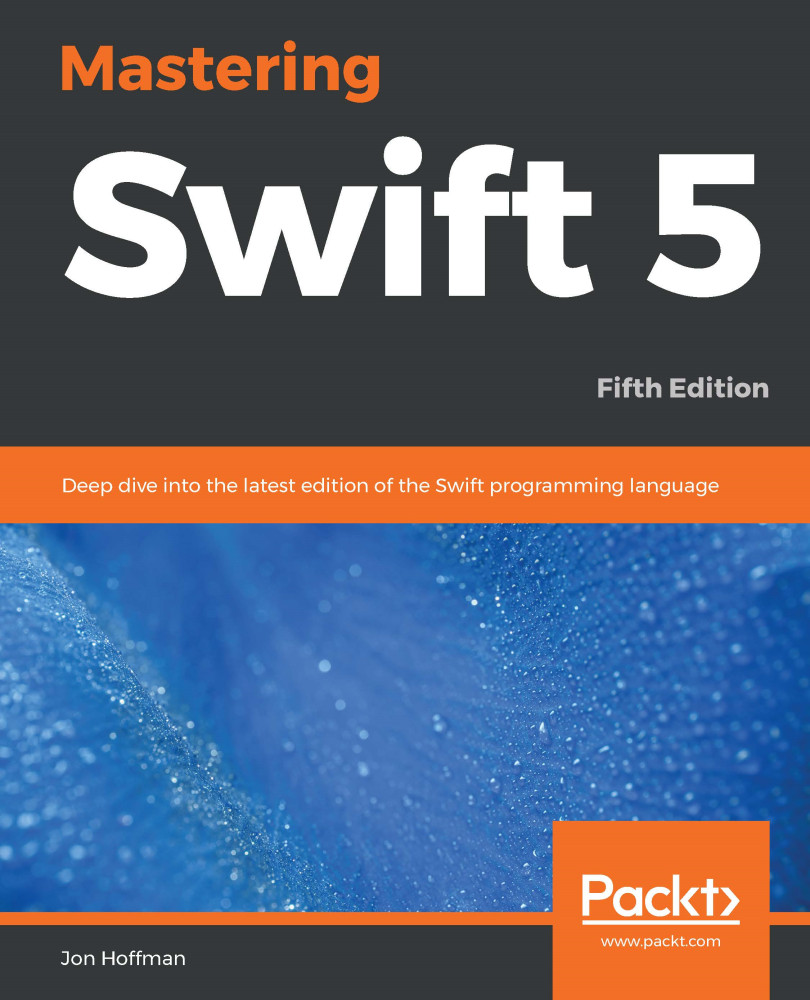
Over the years, the Mastering Swift book has established itself amongst developers as a popular choice as an in-depth and practical guide to the Swift programming language. The latest edition is fully updated and revised to cover the new version: Swift 5. Inside this book, you'll find the key features of Swift 5 easily explained with complete sets of examples. From the basics of the language to popular features such as concurrency, generics, and memory management, this definitive guide will help you develop your expertise and mastery of the Swift language. Mastering Swift 5, Fifth Edition will give you an in-depth knowledge of some of the most sophisticated elements in Swift development, including protocol extensions, error handling, and closures. It will guide you on how to use and apply them in your own projects. Later, you'll see how to leverage the power of protocol-oriented programming to write flexible and easier-to-manage code. You will also see how to add the copy-on-write feature to your custom value types and how to avoid memory management issues caused by strong reference cycles.
Table of Contents (20 chapters)
close
close

Defining a parameter's default values

We can define default values for any parameter by using the equals to operator (=) within the function definition when we declare the parameters. The following example shows how to declare a function with a parameter's default values:

func sayHello(name: String, greeting: String = "Bonjour") {  
  print("\(greeting) \(name)") 
} 

In the function declaration, we have defined one parameter without a default value (name:String) and one parameter with a default value (greeting: String = "Bonjour"). When a parameter has a default value declared, we are able to call the function with or without setting a value for that parameter. The following example shows how to call the sayHello() function without setting the greeting parameter, and also how to call it when you do set the greeting parameter:

sayHello(name...
Visually different images
CONTINUE READING
83
Tech Concepts
36
Programming languages
73
Tech Tools
Icon Unlimited access to the largest independent learning library in tech of over 8,000 expert-authored tech books and videos.
Icon Innovative learning tools, including AI book assistants, code context explainers, and text-to-speech.
Icon 50+ new titles added per month and exclusive early access to books as they are being written.
Mastering Swift 5
notes
bookmark Notes and Bookmarks search Search in title playlist Add to playlist download Download options font-size Font size

Change the font size

margin-width Margin width

Change margin width

day-mode Day/Sepia/Night Modes

Change background colour

Close icon Search
Country selected

Close icon Your notes and bookmarks

Confirmation

Modal Close icon
claim successful

Buy this book with your credits?

Modal Close icon
Are you sure you want to buy this book with one of your credits?
Close
YES, BUY

Submit Your Feedback

Modal Close icon
Modal Close icon
Modal Close icon