
Sign In Start Free Trial
Account

Add to playlist

Create a Playlist

Modal Close icon
You need to login to use this feature.
  • Book Overview & Buying Mastering Concurrency in Python
  • Table Of Contents Toc
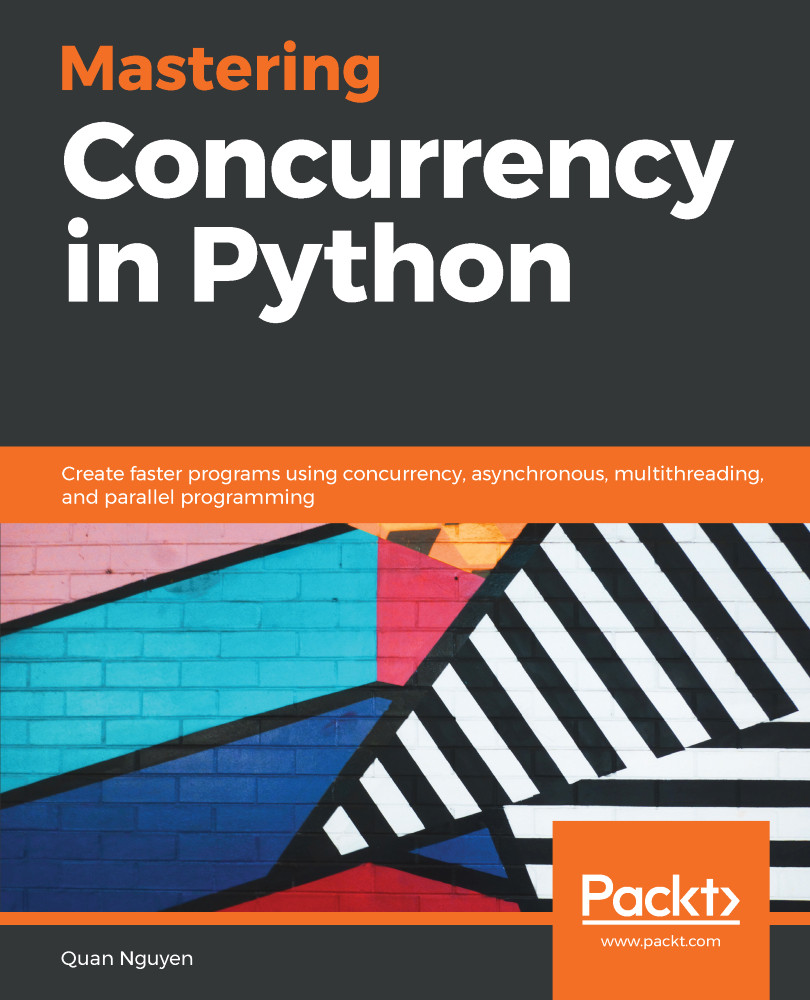
Mastering Concurrency in Python

Mastering Concurrency in Python

By : Quan Nguyen
1 (1)
close
close
Mastering Concurrency in Python

Mastering Concurrency in Python

1 (1)
By: Quan Nguyen

Overview of this book

Python is one of the most popular programming languages, with numerous libraries and frameworks that facilitate high-performance computing. Concurrency and parallelism in Python are essential when it comes to multiprocessing and multithreading; they behave differently, but their common aim is to reduce the execution time. This book serves as a comprehensive introduction to various advanced concepts in concurrent engineering and programming. Mastering Concurrency in Python starts by introducing the concepts and principles in concurrency, right from Amdahl's Law to multithreading programming, followed by elucidating multiprocessing programming, web scraping, and asynchronous I/O, together with common problems that engineers and programmers face in concurrent programming. Next, the book covers a number of advanced concepts in Python concurrency and how they interact with the Python ecosystem, including the Global Interpreter Lock (GIL). Finally, you'll learn how to solve real-world concurrency problems through examples. By the end of the book, you will have gained extensive theoretical knowledge of concurrency and the ways in which concurrency is supported by the Python language
Table of Contents (22 chapters)
close
close

Chapter 2

What is Amdahl's law? What problem does Amdahl's law look to solve?

Amdahl's law provides an estimate of the theoretical speedup in latency of the execution of a task at fixed workload that can be expected of a system whose resources are improved.

Explain the formula of Amdahl's Law, along with its components.

The formula for Amdahl's Law is as follows:

In the preceding formula, the following applies:

  • S is the theoretical speedup in consideration.
  • B is the portion of the whole task that is inherently sequential.
  • j is the number of processors being utilized.

According to Amdahl's Law, would speedup increase indefinitely as resources in the system improved?

No; as the number of processors becomes larger, the efficiency gained through the improvement decreases.

What is the relationship between Amdahl's Law and the law of diminishing...

CONTINUE READING
83
Tech Concepts
36
Programming languages
73
Tech Tools
Icon Unlimited access to the largest independent learning library in tech of over 8,000 expert-authored tech books and videos.
Icon Innovative learning tools, including AI book assistants, code context explainers, and text-to-speech.
Icon 50+ new titles added per month and exclusive early access to books as they are being written.
Mastering Concurrency in Python
notes
bookmark Notes and Bookmarks search Search in title playlist Add to playlist download Download options font-size Font size

Change the font size

margin-width Margin width

Change margin width

day-mode Day/Sepia/Night Modes

Change background colour

Close icon Search
Country selected

Close icon Your notes and bookmarks

Confirmation

Modal Close icon
claim successful

Buy this book with your credits?

Modal Close icon
Are you sure you want to buy this book with one of your credits?
Close
YES, BUY

Submit Your Feedback

Modal Close icon
Modal Close icon
Modal Close icon