
Sign In Start Free Trial
Account

Add to playlist

Create a Playlist

Modal Close icon
You need to login to use this feature.
  • Book Overview & Buying Mastering TypeScript 3
  • Table Of Contents Toc
  • Feedback & Rating feedback
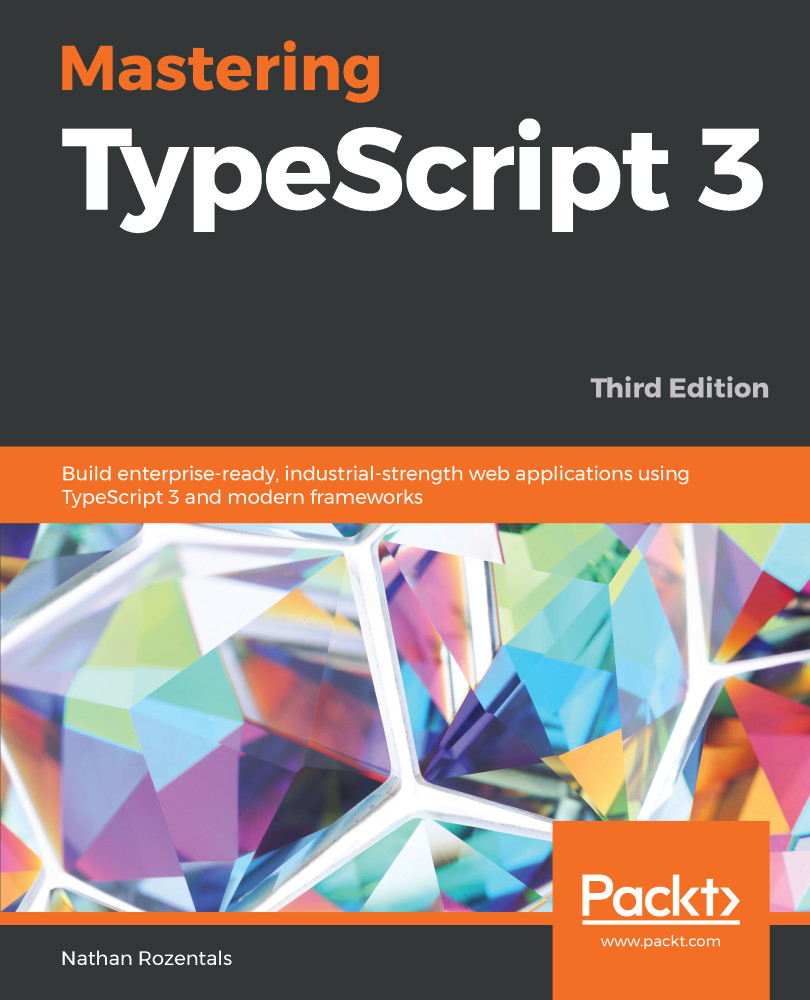
Mastering TypeScript 3

Mastering TypeScript 3 - Third Edition

By : Nathan Rozentals
3 (1)
close
close
Mastering TypeScript 3

Mastering TypeScript 3

3 (1)
By: Nathan Rozentals

Overview of this book

TypeScript is both a language and a set of tools to generate JavaScript. It was designed by Anders Hejlsberg at Microsoft to help developers write enterprise-scale JavaScript. Starting with an introduction to the TypeScript language, before moving on to basic concepts, each section builds on previous knowledge in an incremental and easy-to-understand way. Advanced and powerful language features are all covered, including asynchronous programming techniques, decorators, and generics. This book explores many modern JavaScript and TypeScript frameworks side by side in order for the reader to learn their respective strengths and weaknesses. It will also thoroughly explore unit and integration testing for each framework. Best-of-breed applications utilize well-known design patterns in order to be scalable, maintainable, and testable. This book explores some of these object-oriented techniques and patterns, and shows real-world implementations. By the end of the book, you will have built a comprehensive, end-to-end web application to show how TypeScript language features, design patterns, and industry best practices can be brought together in a real-world scenario.
Table of Contents (16 chapters)
close
close
Lock Free Chapter
1
TypeScript Tools and Framework Options

Types, Variables, and Function Techniques

TypeScript introduces strong typing to JavaScript through a simple syntax, referred to by Anders Hejlsberg as syntactic sugar. This sugar is what assigns a type to a variable. This strong typing syntax, which is officially called type annotation, is used wherever a variable is used. In other words, we can use type annotation in a variable declaration, a function parameter, or to describe the return type of a function itself.

As we discussed in Chapter 1, TypeScript Tools and Framework Options, there are many benefits to enforcing types in a development language. These include better error checking, the ability for an IDE to provide more intelligent code suggestions, and the ability to introduce object-oriented techniques into the coding experience.

The TypeScript language uses several basic types, such as number and boolean, and...

Visually different images
CONTINUE READING
83
Tech Concepts
36
Programming languages
73
Tech Tools
Icon Unlimited access to the largest independent learning library in tech of over 8,000 expert-authored tech books and videos.
Icon Innovative learning tools, including AI book assistants, code context explainers, and text-to-speech.
Icon 50+ new titles added per month and exclusive early access to books as they are being written.
Mastering TypeScript 3
notes
bookmark Notes and Bookmarks search Search in title playlist Add to playlist download Download options font-size Font size

Change the font size

margin-width Margin width

Change margin width

day-mode Day/Sepia/Night Modes

Change background colour

Close icon Search
Country selected

Close icon Your notes and bookmarks

Confirmation

Modal Close icon
claim successful

Buy this book with your credits?

Modal Close icon
Are you sure you want to buy this book with one of your credits?
Close
YES, BUY

Submit Your Feedback

Modal Close icon
Modal Close icon
Modal Close icon