
Sign In Start Free Trial
Account

Add to playlist

Create a Playlist

Modal Close icon
You need to login to use this feature.
  • Book Overview & Buying 40 Algorithms Every Programmer Should Know
  • Table Of Contents Toc
  • Feedback & Rating feedback
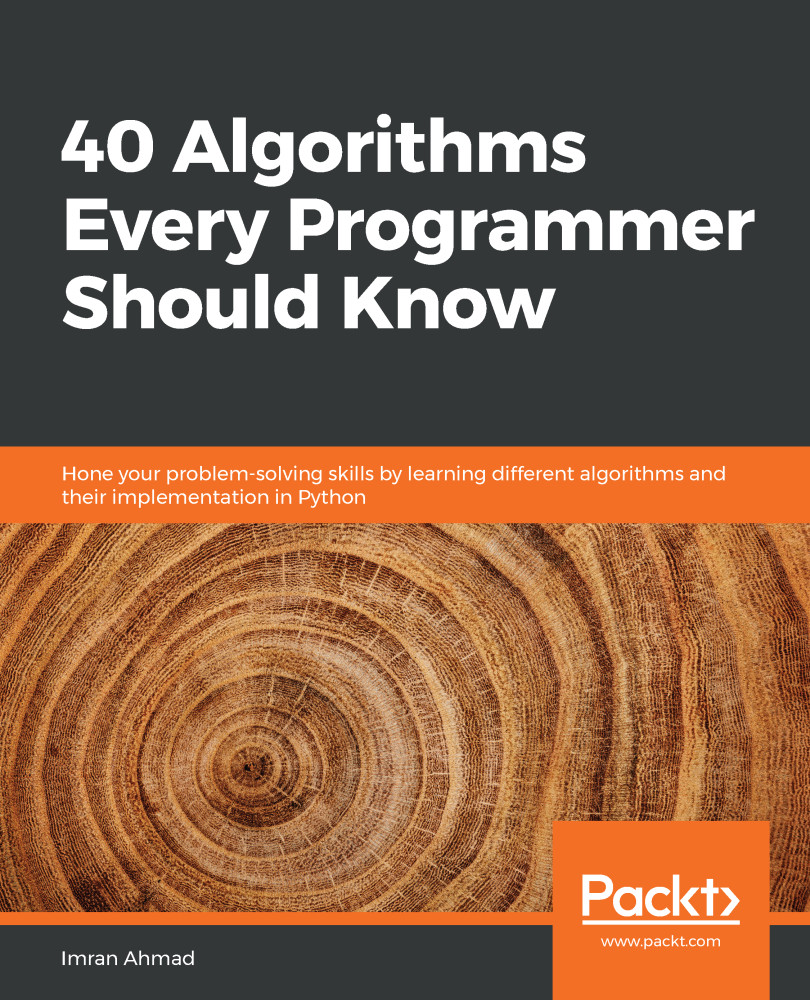
40 Algorithms Every Programmer Should Know

40 Algorithms Every Programmer Should Know

By : Imran Ahmad
close
close
40 Algorithms Every Programmer Should Know

40 Algorithms Every Programmer Should Know

By: Imran Ahmad

Overview of this book

Algorithms have always played an important role in both the science and practice of computing. Beyond traditional computing, the ability to use algorithms to solve real-world problems is an important skill that any developer or programmer must have. This book will help you not only to develop the skills to select and use an algorithm to solve real-world problems but also to understand how it works. You’ll start with an introduction to algorithms and discover various algorithm design techniques, before exploring how to implement different types of algorithms, such as searching and sorting, with the help of practical examples. As you advance to a more complex set of algorithms, you'll learn about linear programming, page ranking, and graphs, and even work with machine learning algorithms, understanding the math and logic behind them. Further on, case studies such as weather prediction, tweet clustering, and movie recommendation engines will show you how to apply these algorithms optimally. Finally, you’ll become well versed in techniques that enable parallel processing, giving you the ability to use these algorithms for compute-intensive tasks. By the end of this book, you'll have become adept at solving real-world computational problems by using a wide range of algorithms.
Table of Contents (19 chapters)
close
close
1
Section 1: Fundamentals and Core Algorithms
7
Section 2: Machine Learning Algorithms
13
Section 3: Advanced Topics

Understanding linear programming

Many real-world problems involve maximizing or minimizing an objective, with some given constraints. One approach is to specify the objective as a linear function of some variables. We also formulate the constraints on resources as equalities or inequalities on those variables. This approach is called the linear programming problem. The basic algorithm behind linear programming was developed by George Dantzig at the University of California at Berkeley in the early 1940s. Dantzig used this concept to experiment with logistical supply-and-capacity planning for troops while working for the US Air Force.

At the end of the Second World War, Dantzig started working for the Pentagon and matured his algorithm into a technique that he named linear programming. It was used for military combat planning.

Today, it is used to solve important real-world problems that relate to minimizing or maximizing a variable based on certain constraints. Some examples...

Visually different images
CONTINUE READING
83
Tech Concepts
36
Programming languages
73
Tech Tools
Icon Unlimited access to the largest independent learning library in tech of over 8,000 expert-authored tech books and videos.
Icon Innovative learning tools, including AI book assistants, code context explainers, and text-to-speech.
Icon 50+ new titles added per month and exclusive early access to books as they are being written.
40 Algorithms Every Programmer Should Know
notes
bookmark Notes and Bookmarks search Search in title playlist Add to playlist download Download options font-size Font size

Change the font size

margin-width Margin width

Change margin width

day-mode Day/Sepia/Night Modes

Change background colour

Close icon Search
Country selected

Close icon Your notes and bookmarks

Confirmation

Modal Close icon
claim successful

Buy this book with your credits?

Modal Close icon
Are you sure you want to buy this book with one of your credits?
Close
YES, BUY

Submit Your Feedback

Modal Close icon
Modal Close icon
Modal Close icon