

Sign In Start Free Trial
Account

Add to playlist

Create a Playlist

Modal Close icon
You need to login to use this feature.
  • Book Overview & Buying Hands-On High Performance with Go
  • Table Of Contents Toc
  • Feedback & Rating feedback
Hands-On High Performance with Go

Hands-On High Performance with Go

By : Strecansky
3.6 (5)
close
close
Hands-On High Performance with Go

Hands-On High Performance with Go

3.6 (5)
By: Strecansky

Overview of this book

Go is an easy-to-write language that is popular among developers thanks to its features such as concurrency, portability, and ability to reduce complexity. This Golang book will teach you how to construct idiomatic Go code that is reusable and highly performant. Starting with an introduction to performance concepts, you’ll understand the ideology behind Go’s performance. You’ll then learn how to effectively implement Go data structures and algorithms along with exploring data manipulation and organization to write programs for scalable software. This book covers channels and goroutines for parallelism and concurrency to write high-performance code for distributed systems. As you advance, you’ll learn how to manage memory effectively. You’ll explore the compute unified device architecture (CUDA) application programming interface (API), use containers to build Go code, and work with the Go build cache for quicker compilation. You’ll also get to grips with profiling and tracing Go code for detecting bottlenecks in your system. Finally, you’ll evaluate clusters and job queues for performance optimization and monitor the application for performance regression. By the end of this Go programming book, you’ll be able to improve existing code and fulfill customer requirements by writing efficient programs.
Table of Contents (20 chapters)
close
close
1
Section 1: Learning about Performance in Go
7
Section 2: Applying Performance Concepts in Go
13
Section 3: Deploying, Monitoring, and Iterating on Go Programs with Performance in Mind

Introducing matrices

Matrices are two-dimensional arrays, categorized by rows and columns. They are important in graphics manipulation and AI; namely, image recognition. Matrices are commonly used for graphics since the rows and columns that reside within a matrix can correspond to the row and column arrangement of pixels on a screen, as well as because we can have the matrix values correspond to a particular color. Matrices are also frequently used for digital sound processing as digital audio signals are filtered and compressed using Fourier transforms, and matrices help with performing these actions.

Matrices are usually denoted with an M × N naming scheme, where M is the number of rows in the matrix and N is the number of columns in the matrix, as shown in the following image:
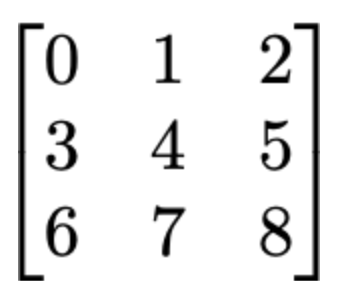
The preceding image, for example, is a 3 x 3 matrix. An M x N matrix is one of the core tenants...

Visually different images
CONTINUE READING
83
Tech Concepts
36
Programming languages
73
Tech Tools
Icon Unlimited access to the largest independent learning library in tech of over 8,000 expert-authored tech books and videos.
Icon Innovative learning tools, including AI book assistants, code context explainers, and text-to-speech.
Icon 50+ new titles added per month and exclusive early access to books as they are being written.
Hands-On High Performance with Go
notes
bookmark Notes and Bookmarks search Search in title playlist Add to playlist download Download options font-size Font size

Change the font size

margin-width Margin width

Change margin width

day-mode Day/Sepia/Night Modes

Change background colour

Close icon Search
Country selected

Close icon Your notes and bookmarks

Confirmation

Modal Close icon
claim successful

Buy this book with your credits?

Modal Close icon
Are you sure you want to buy this book with one of your credits?
Close
YES, BUY

Submit Your Feedback

Modal Close icon
Modal Close icon
Modal Close icon