Sign In Start Free Trial
Account

Add to playlist

Create a Playlist

Modal Close icon
You need to login to use this feature.
  • Book Overview & Buying Dancing with Python
  • Table Of Contents Toc
Dancing with Python

Dancing with Python

By : Robert S. Sutor
5 (7)
close
close
Dancing with Python

Dancing with Python

5 (7)
By: Robert S. Sutor

Overview of this book

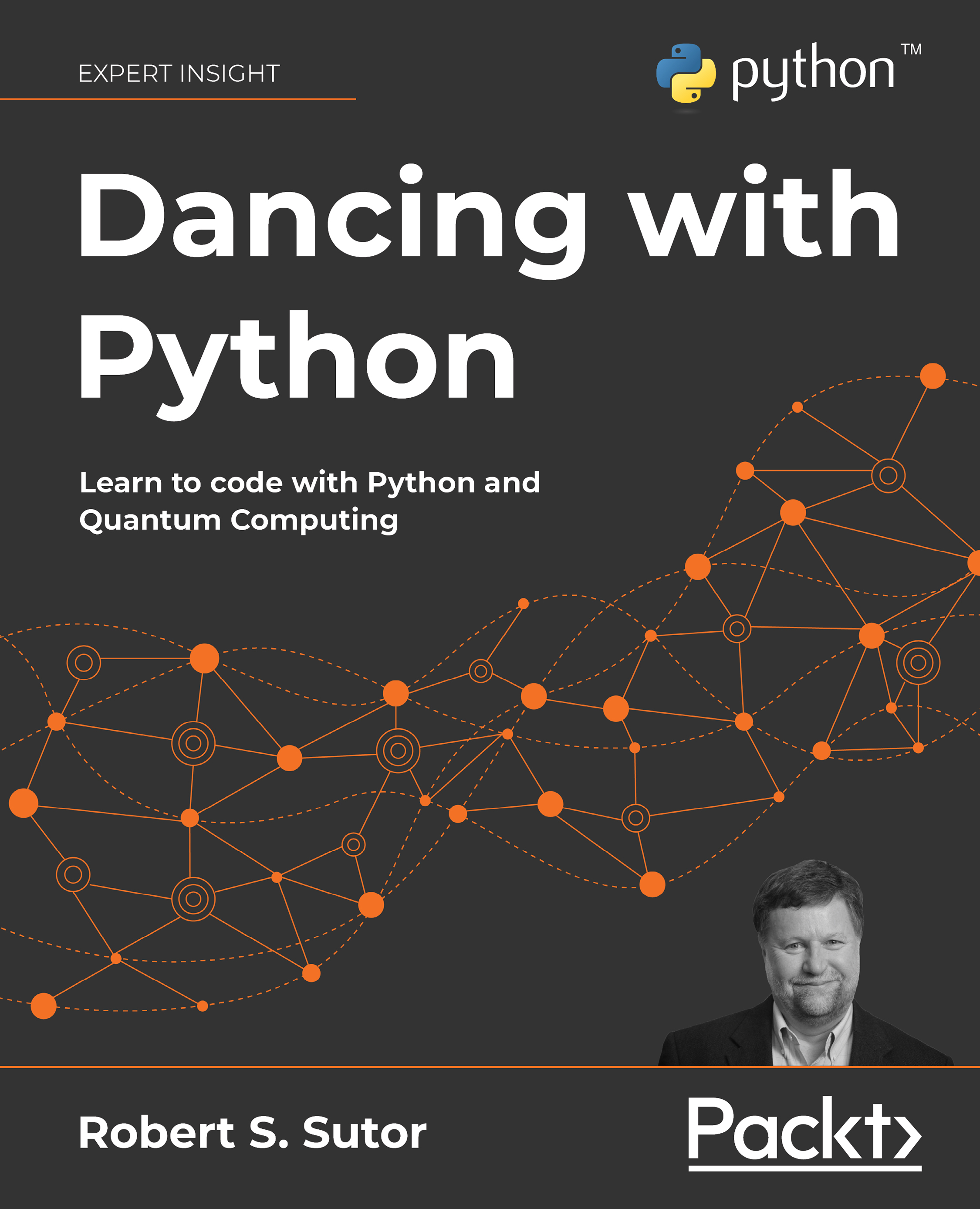
Dancing with Python helps you learn Python and quantum computing in a practical way. It will help you explore how to work with numbers, strings, collections, iterators, and files. The book goes beyond functions and classes and teaches you to use Python and Qiskit to create gates and circuits for classical and quantum computing. Learn how quantum extends traditional techniques using the Grover Search Algorithm and the code that implements it. Dive into some advanced and widely used applications of Python and revisit strings with more sophisticated tools, such as regular expressions and basic natural language processing (NLP). The final chapters introduce you to data analysis, visualizations, and supervised and unsupervised machine learning. By the end of the book, you will be proficient in programming the latest and most powerful quantum computers, the Pythonic way.
Table of Contents (29 chapters)
close
close
2
Part I: Getting to Know Python
10
PART II: Algorithms and Circuits
14
PART III: Advanced Features and Libraries
19
References
20
Other Books You May Enjoy
1
Appendices
4
Appendix C: The Complete UniPoly Class
5
Appendix D: The Complete Guitar Class Hierarchy
7
Appendix F: Production Notes

What does this book cover?

Given the wide use of Python and the wide variety of learning and reference materials, I have chosen to structure this book into three main parts. I give you the information you need as you need it.

Before jumping into those, however, we together explore what coders do, how they think about using programming languages, and what they expect from the tools they use. That chapter,

is not specific to Python and is occasionally philosophical about the art and engineering of writing code.

After that introduction, the rest of the book proceeds in the following way.

Part I. Getting to Know Python

Being a full-featured programming language, Python implements the features described in the first chapter mentioned above. In this part, we learn how to write basic expressions including numbers and textual strings, collect objects together using data structures such as lists, and explore Python’s core and extended mathematical facilities.

We then jump into defining functions to organize and make our code reusable, introduce object-oriented coding through classes, and finally interact with information within the computing environment via files.

  • 2. Working with Expressions
  • 3. Collecting Things Together
  • 4. Stringing You Along
  • 5. Computing and Calculating
  • 6. Defining and Using Functions
  • 7. Organizing Objects into Classes
  • 8. Working with Files

The Python modules we introduce in this part include abc, cmath, collections, datetime, enum, fractions, functools, glob, json, math, os, pickle, random, shutil, sympy, and time.

Part II. Algorithms and Circuits

Now that we understand Python’s core features, we’re ready to explore how to make it useful to solve problems. Although many books only speak about functions and classes, we enlarge our discussion to include gates and circuits for classical and quantum computing. It’s then a good time to see how we can test our code and make it run faster.

We then look at traditional problems and see how we can attack them classically. Quantum computing’s reason for existence and development is that it might solve some of those problems significantly faster. We explore the how and why of that, and I point you to further reading on the topic.

The Python modules we introduce in this part include coverage, pytest, qiskit, time, timeit, and wrapt.

Part III. Advanced Features and Libraries

In the final part, we address some heavy-duty but frequent applications of Python. Though we worked with text as strings earlier in the book, we revisit it with more sophisticated tools such as regular expressions and natural language processing (NLP).

The final three chapters focus on data: how to bring it into an application and manipulate it, how to visualize what it represents, and how to gain insights from it through machine learning. Machine learning itself is worth a book or two (or three or ten), so I introduce the key concepts and tools, and you can then jump off into more sophisticated Python and AI applications.

The Python modules we introduce in this part include flashtext, matplotlib, nltk, pandas, pillow, pytorch, re, scikit-learn, spacy, string, and textblob.

CONTINUE READING
83
Tech Concepts
36
Programming languages
73
Tech Tools
Icon Unlimited access to the largest independent learning library in tech of over 8,000 expert-authored tech books and videos.
Icon Innovative learning tools, including AI book assistants, code context explainers, and text-to-speech.
Icon 50+ new titles added per month and exclusive early access to books as they are being written.
Dancing with Python
notes
bookmark Notes and Bookmarks search Search in title playlist Add to playlist download Download options font-size Font size

Change the font size

margin-width Margin width

Change margin width

day-mode Day/Sepia/Night Modes

Change background colour

Close icon Search
Country selected

Close icon Your notes and bookmarks

Confirmation

Modal Close icon
claim successful

Buy this book with your credits?

Modal Close icon
Are you sure you want to buy this book with one of your credits?
Close
YES, BUY

Submit Your Feedback

Modal Close icon
Modal Close icon
Modal Close icon