Sign In Start Free Trial
Account

Add to playlist

Create a Playlist

Modal Close icon
You need to login to use this feature.
  • Book Overview & Buying Template Metaprogramming with C++
  • Table Of Contents Toc
  • Feedback & Rating feedback
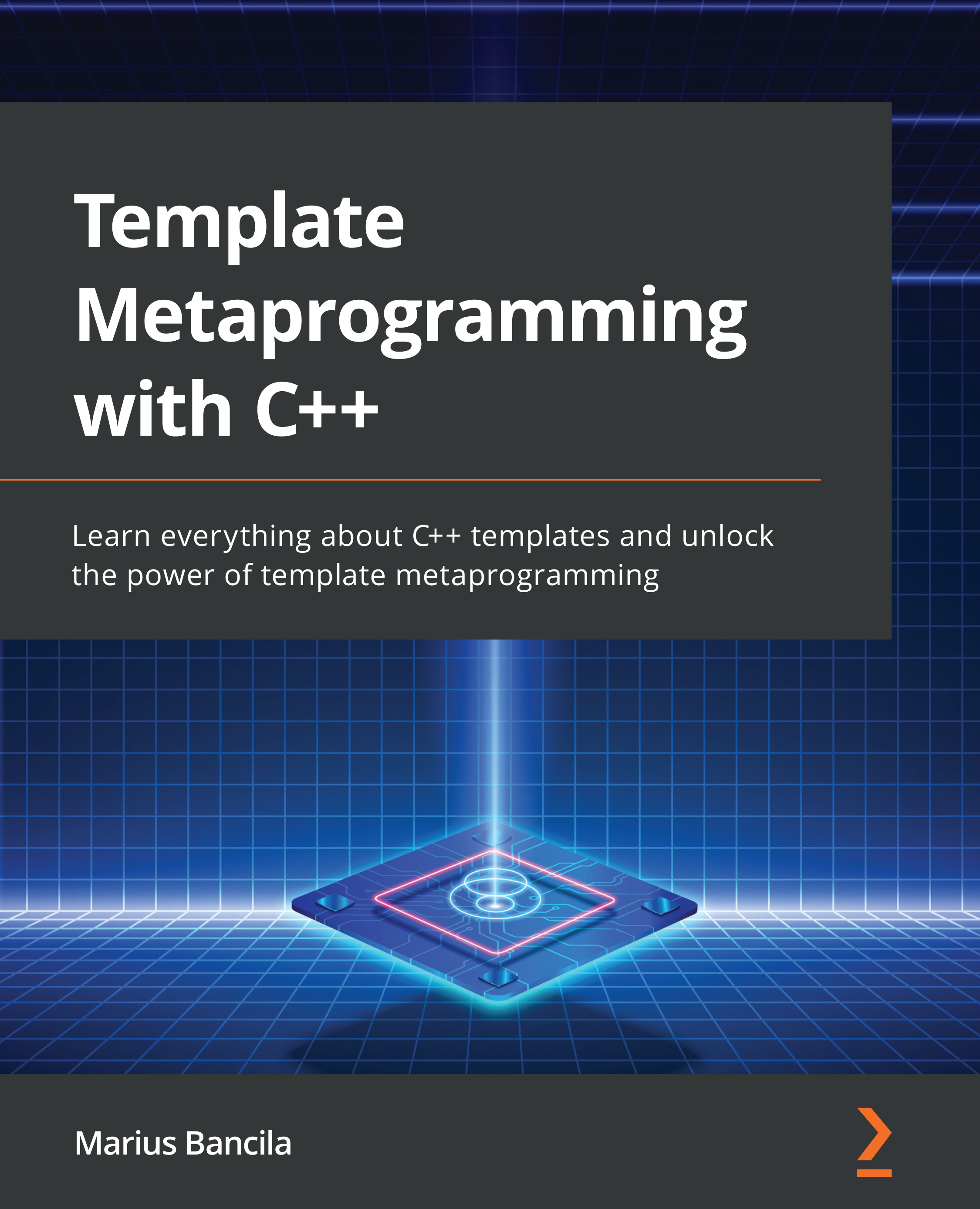
Template Metaprogramming with C++

Template Metaprogramming with C++

By : Marius Bancila
4.6 (13)
close
close
Template Metaprogramming with C++

Template Metaprogramming with C++

4.6 (13)
By: Marius Bancila

Overview of this book

Learn how the metaprogramming technique enables you to create data structures and functions that allow computation to happen at compile time. With this book, you'll realize how templates help you avoid writing duplicate code and are key to creating generic libraries, such as the standard library or Boost, that can be used in a multitude of programs. The introductory chapters of this book will give you insights into the fundamentals of templates and metaprogramming. You'll then move on to practice writing complex templates and exploring advanced concepts such as template recursion, template argument deduction, forwarding references, type traits, and conditional compilation. Along the way, you'll learn how to write variadic templates and how to provide requirements to the template arguments with C++20 constraints and concepts. Finally, you'll apply your knowledge of C++ metaprogramming templates to implement various metaprogramming patterns and techniques. By the end of this book, you'll have learned how to write effective templates and implement metaprogramming in your everyday programming journey.
Table of Contents (16 chapters)
close
close
1
Part 1: Core Template Concepts
5
Part 2: Advanced Template Features
9
Part 3: Applied Templates
1
Appendix: Closing Notes

Chapter 6: Concepts and Constraints

The C++20 standard provides a series of significant improvements to template metaprogramming with concepts and constraints. A constraint is a modern way to define requirements on template parameters. A concept is a set of named constraints. Concepts provide several benefits to the traditional way of writing templates, mainly improved readability of code, better diagnostics, and reduced compilation times.

In this chapter, we will address the following topics:

  • Understanding the need for concepts
  • Defining concepts
  • Exploring requires expressions
  • Composing constraints
  • Learning about the ordering of templates with constraints
  • Constraining non-template member functions
  • Constraining class templates
  • Constraining variable templates and template aliases
  • Learning more ways to specify constraints
  • Using concepts to constrain auto parameters
  • Exploring the standard concepts library

By the end of this chapter...

Visually different images
CONTINUE READING
83
Tech Concepts
36
Programming languages
73
Tech Tools
Icon Unlimited access to the largest independent learning library in tech of over 8,000 expert-authored tech books and videos.
Icon Innovative learning tools, including AI book assistants, code context explainers, and text-to-speech.
Icon 50+ new titles added per month and exclusive early access to books as they are being written.
Template Metaprogramming with C++
notes
bookmark Notes and Bookmarks search Search in title playlist Add to playlist download Download options font-size Font size

Change the font size

margin-width Margin width

Change margin width

day-mode Day/Sepia/Night Modes

Change background colour

Close icon Search
Country selected

Close icon Your notes and bookmarks

Confirmation

Modal Close icon
claim successful

Buy this book with your credits?

Modal Close icon
Are you sure you want to buy this book with one of your credits?
Close
YES, BUY

Submit Your Feedback

Modal Close icon
Modal Close icon
Modal Close icon