


-
Book Overview & Buying
-
Table Of Contents

-
Feedback & Rating

C++ Memory Management
By :


C++ Memory Management
By:
Overview of this book
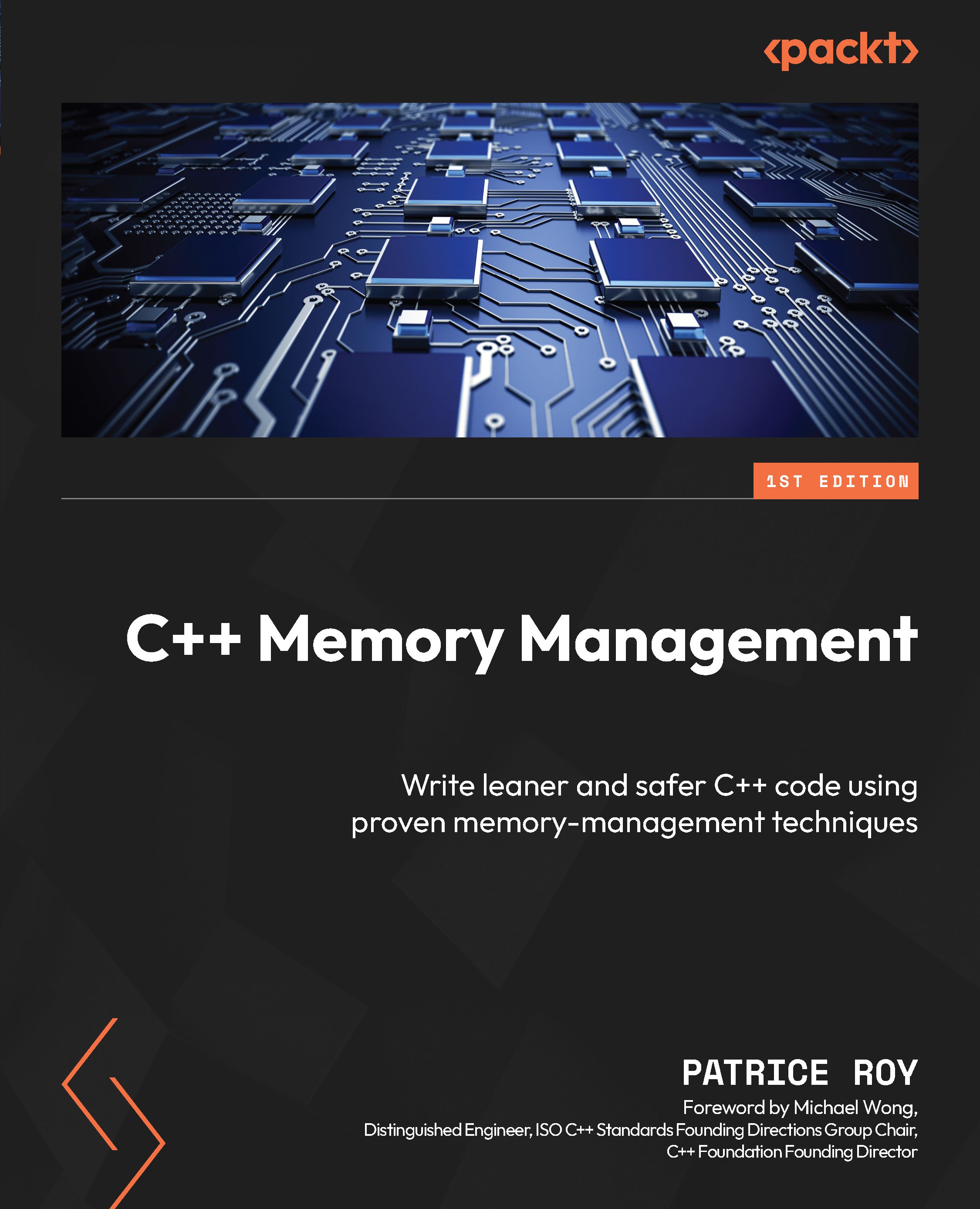
Memory management in C++ isn't one-size-fits-all; real-time systems, games, and embedded applications each present unique memory constraints. This book delivers targeted solutions for each domain.
Written by ISO C++ Standards Committee member, Patrice Roy, this guide covers fundamental concepts of object lifetime and memory organization to help you write simpler and safer programs. You’ll learn how to control memory allocation mechanisms, create custom containers and allocators, and adapt allocation operators to suit your specific requirements, making your programs smaller, faster, safer, and more predictable.
From core principles to modern facilities that simplify your work, you’ll master memory management mechanics, build tailored memory solutions for your application needs, and measure their impact on your program’s behavior.
By the end of this book, you’ll be able to write secure programs that handle memory optimally for your application domain. You will also have a strong grasp of both high-level abstractions for safer programs and low-level abstractions that allow detailed customization.
Table of Contents (23 chapters)
Preface


Chapter 1: Objects, Pointers, and References
Chapter 2: Things to Be Careful With
Chapter 3: Casts and cv-qualifications
Part 2: Implicit Memory Management Techniques
Chapter 4: Using Destructors
Chapter 5: Using Standard Smart Pointers
Chapter 6: Writing Smart Pointers
Part 3: Taking Control (of Memory Management Mechanisms)
Chapter 7: Overloading Memory Allocation Operators

Chapter 8: Writing a Naïve Leak Detector
Chapter 9: Atypical Allocation Mechanisms
Chapter 10: Arena-Based Memory Management and Other Optimizations
Chapter 11: Deferred Reclamation
Part 4: Writing Generic Containers (and a Bit More)
Chapter 12: Writing Generic Containers with Explicit Memory Management
Chapter 13: Writing Generic Containers with Implicit Memory Management
Chapter 14: Writing Generic Containers with Allocator Support
Chapter 15: Contemporary Issues
Annexure: Things You Should Know
Index
Customer Reviews
 Quick tip: Enhance your coding experience with the AI Code...


