


-
Book Overview & Buying
-
Table Of Contents

Systems Programming with Zig
By :


Systems Programming with Zig
By:
Overview of this book
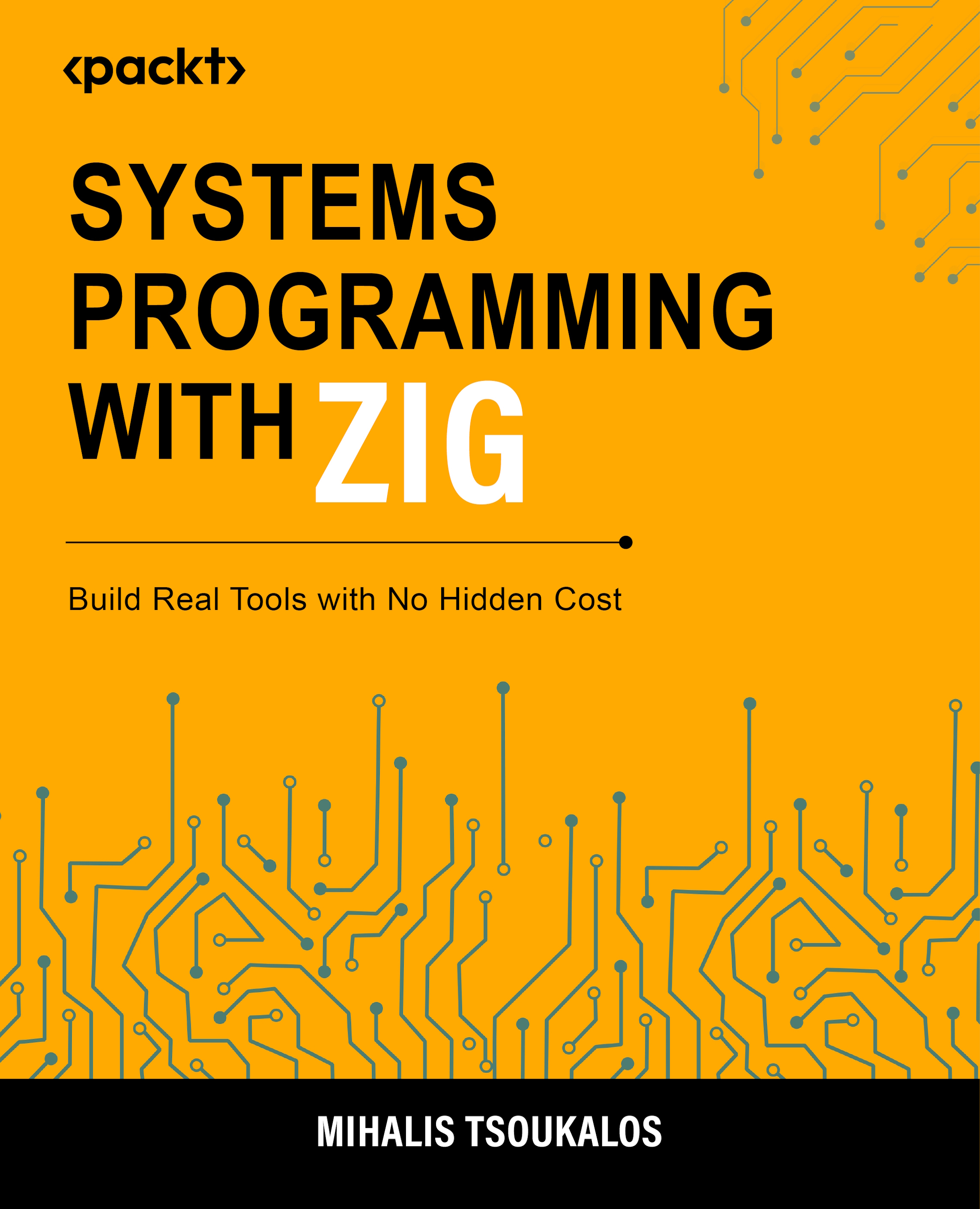
Build reliable systems software with Zig through a project-driven approach focused on practical engineering challenges. Guided by UNIX systems engineer & bestselling author Mihalis Tsoukalos, you will learn modern systems programming techniques while creating production-ready applications, UNIX tools, & network services.
This book takes you from essential UNIX tooling and build infrastructure to advanced topics such as direct memory access, binary formats, filesystem monitoring, networking, concurrency, asynchronous I/O, & database integration. Through hands-on projects, you will create command-line utilities, TCP and UDP services, HTTP applications, file indexing tools, cache servers, & a domain-specific language interpreter that combines memory management, comptime metaprogramming, parsing, evaluation, & error handling.
Each chapter demonstrates how Zig features solve practical systems programming problems. You will work with memory management, process control, synchronization primitives, event-driven architectures, SQLite integration, protocol design, & performance-focused data structures while learning the reasoning behind key engineering decisions.
By the end of this book, you will be able to build efficient and maintainable systems software in Zig & confidently apply the language to production projects.
Table of Contents (18 chapters)
Preface


Chapter 1: Building Essential UNIX Tools
Chapter 2: Systems Infrastructure: Builds, Testing, and Distribution

Chapter 3: Direct Memory Access and Binary Formats
Chapter 4: Processing Streams, Buffers, and Data Encoding
Part 2: Systems Programming in Practice
Chapter 5: Navigating Directories and Filesystem Events
Chapter 6: Programming the Network Stack
Chapter 7: Managing Threads, Processes, and Signals
Chapter 8: Orchestrating Concurrency and Synchronization
Chapter 9: Implementing Asynchronous I/O
Chapter 10: Building a High-Performance In-Memory Cache Server
Chapter 11: Persisting Structured Data with SQLite3
Chapter 12: Developing a Domain-Specific Language
Chapter 13: Unlock Your Exclusive Benefits
Other Books You May Enjoy
Index


