Sign In Start Free Trial
Account

Add to playlist

Create a Playlist

Modal Close icon
You need to login to use this feature.
  • Book Overview & Buying Python Object-Oriented Programming
  • Table Of Contents Toc
Python Object-Oriented Programming

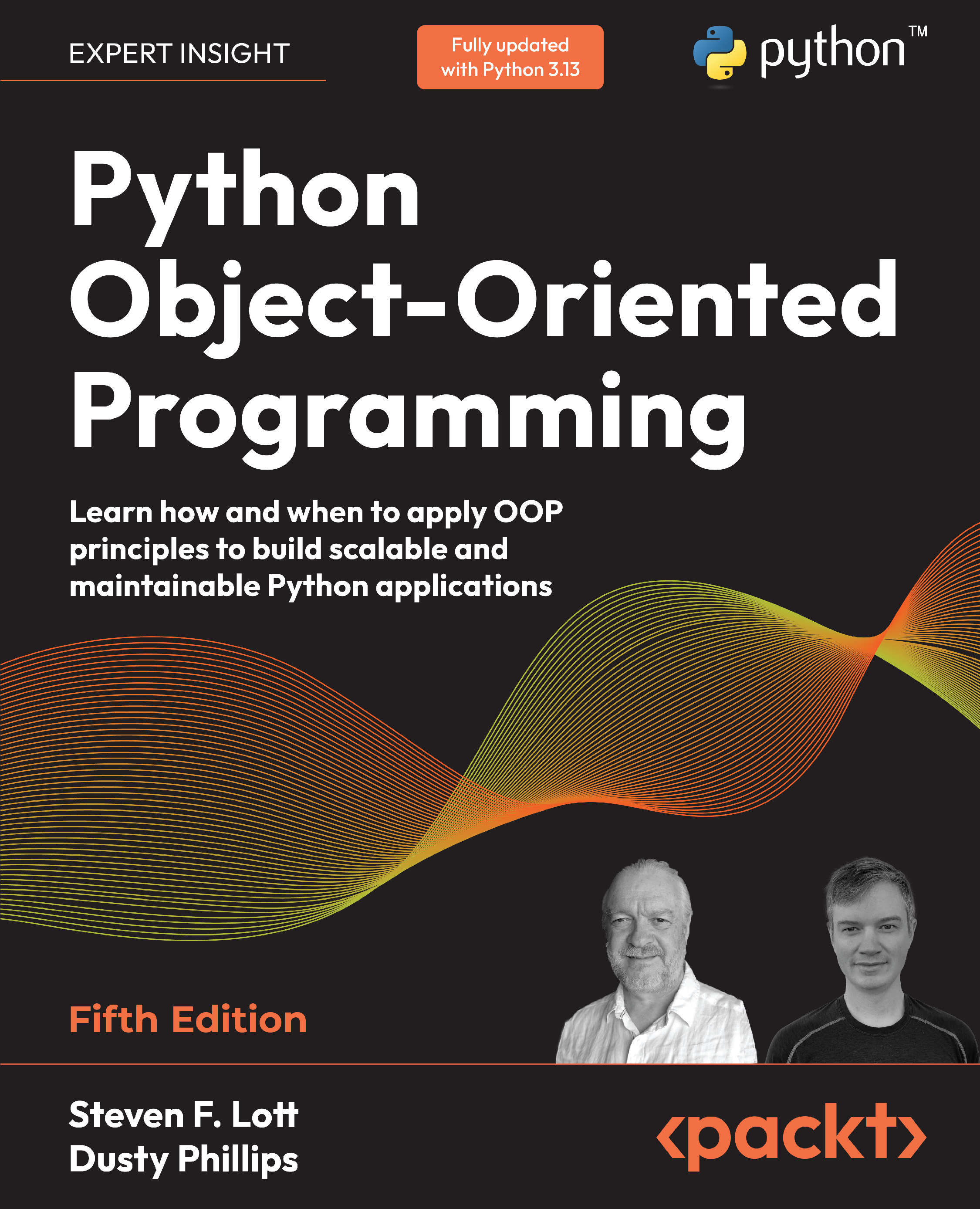
Python Object-Oriented Programming - Fifth Edition

By : Steven F. Lott, Dusty Phillips
close
close
Python Object-Oriented Programming

Python Object-Oriented Programming

By: Steven F. Lott, Dusty Phillips

Overview of this book

Learn to write effective, maintainable, and scalable Python applications by mastering object-oriented programming with this updated fifth edition. Whether you’re transitioning from scripting to structured development or refining your OOP skills, this book offers a clear, practical path forward. You’ll explore Python’s approach to OOP, from class creation and inheritance to polymorphism and abstraction, while discovering how to make smarter decisions about when and how to use these tools. You’ll apply what you learn through hands-on examples and exercises. Updated for Python 3.13, this edition simplifies complex topics such as abstract base classes, testing with unittest and pytest, and async programming with asyncio. It introduces a new chapter on Python’s type hinting ecosystem—crucial for modern Python development. Written by long-time Python experts Steven Lott and Dusty Phillips, this edition emphasizes clarity, testability, and professional software engineering practices. It helps you move beyond scripting to building well-structured, production-ready Python systems. By the end of this book, you’ll be confident in applying OOP principles, design patterns, type hints, and concurrency tools to create robust and maintainable Python applications.
Table of Contents (17 chapters)
close
close
16
Index

1.7 Collaboration among objects

We’ve addressed two important ingredients that are part of object-oriented programming: class and responsibility. We classify objects based on their internal state and their behavior. We also strive to define a clear, focused responsibility for each class.

The remaining ingredient is collaboration. Once we decompose a problem into separate classes, the final application’s behavior will emerge from collaboration among objects of those classes. The final application — like a good sauce — is a blend of ingredients that complement each other.

There are a variety of ways to think about collaboration among classes. We’ll defer the details of different kinds of collaboration until  Chapter 3. Here, we’ll introduce two useful concepts:

  • Composition

  • Inheritance

When we think about following the Interface Segregation Principle, we often decompose something complicated into a group of simpler things. In many cases, we can design a model of the original (complicated) thing as a composition of the simpler things. We’ve already seen how composition works when talking about cars. A fossil-fueled car is composed of an engine, transmission, starter, headlights, and windshield, among numerous other parts. Each of these can be further decomposed into the active, stateful component. The headlight subsystem, for example, is off, on, or bright. A control changes the state of this system. There may be an automated sensor to turn lights on at night, and dim the bright lights when there’s oncoming traffic.

Decomposition exposes a potential problem. What if we have several things with common aspects? We have headlights, interior lights, and an entertainment system, all of which use fuses. Do we want to repeat the depends on a fuse aspect all over the class hierarchy? That sounds like a lot of copy-and-pasting, and potential nightmares when there are implementation changes.

To avoid repetition, we can use inheritance. It’s helpful to think of inheritance as an is a” relationship. We can extract a feature, such as protected by a fuse. Each of the electrical components within an automobile is a component protected by a fuse: the headlight system is a component protected by a fuse; the entertainment system is a component protected by a fuse.

We’ll do this be defining a base class: Fused. Then, we’ll define subclasses that extend this base class. Many folks use the term superclass instead of base class. The UML diagram often shows the base class at the top of the figure. The class is, however, foundational, and the other classes build on it.

The Liskov Substitution Principle (and the Open/Closed Principle) provides guidelines for inheritance. We need to be sure that each subclass has the same interface as the base class: the idea is that any subclass can replace the superclass.

When thinking about headlights and the entertainment system both having fuses, this can seem a little odd. We don’t turn on the stereo when driving at night. (Well, maybe we do, but it doesn’t help us see the pavement.)

The subclasses don’t all do the same thing. They merely have a consistent interface. The headlights and the entertainment system both have an interface (a pair of wires) to the fuse and to the electrical ground. This interface fits the Liskov Substitution Principle.

When we add running lights to the headlight system, we are consistent with Liskov Substitution because the running lights use the same fuse. The use of long, flexible wires leaves the car’s systems open to extension. The use of a tightly sealed headlamp fixture makes the lights closed to modification: if we want to make a change, we have to replace the whole fixture; we can’t just push in a new bulb.

Now that we’ve started looking at object-oriented design, we’ll take a quick look at some legacy software that didn’t follow object-oriented design principles. We can start thinking about ways to refactor it from a mess of statements to some easier-to-understand class definitions.

CONTINUE READING
83
Tech Concepts
36
Programming languages
73
Tech Tools
Icon Unlimited access to the largest independent learning library in tech of over 8,000 expert-authored tech books and videos.
Icon Innovative learning tools, including AI book assistants, code context explainers, and text-to-speech.
Icon 50+ new titles added per month and exclusive early access to books as they are being written.
Python Object-Oriented Programming
notes
bookmark Notes and Bookmarks search Search in title playlist Add to playlist download Download options font-size Font size

Change the font size

margin-width Margin width

Change margin width

day-mode Day/Sepia/Night Modes

Change background colour

Close icon Search
Country selected

Close icon Your notes and bookmarks

Confirmation

Modal Close icon
claim successful

Buy this book with your credits?

Modal Close icon
Are you sure you want to buy this book with one of your credits?
Close
YES, BUY

Submit Your Feedback

Modal Close icon
Modal Close icon
Modal Close icon