


-
Book Overview & Buying
-
Table Of Contents

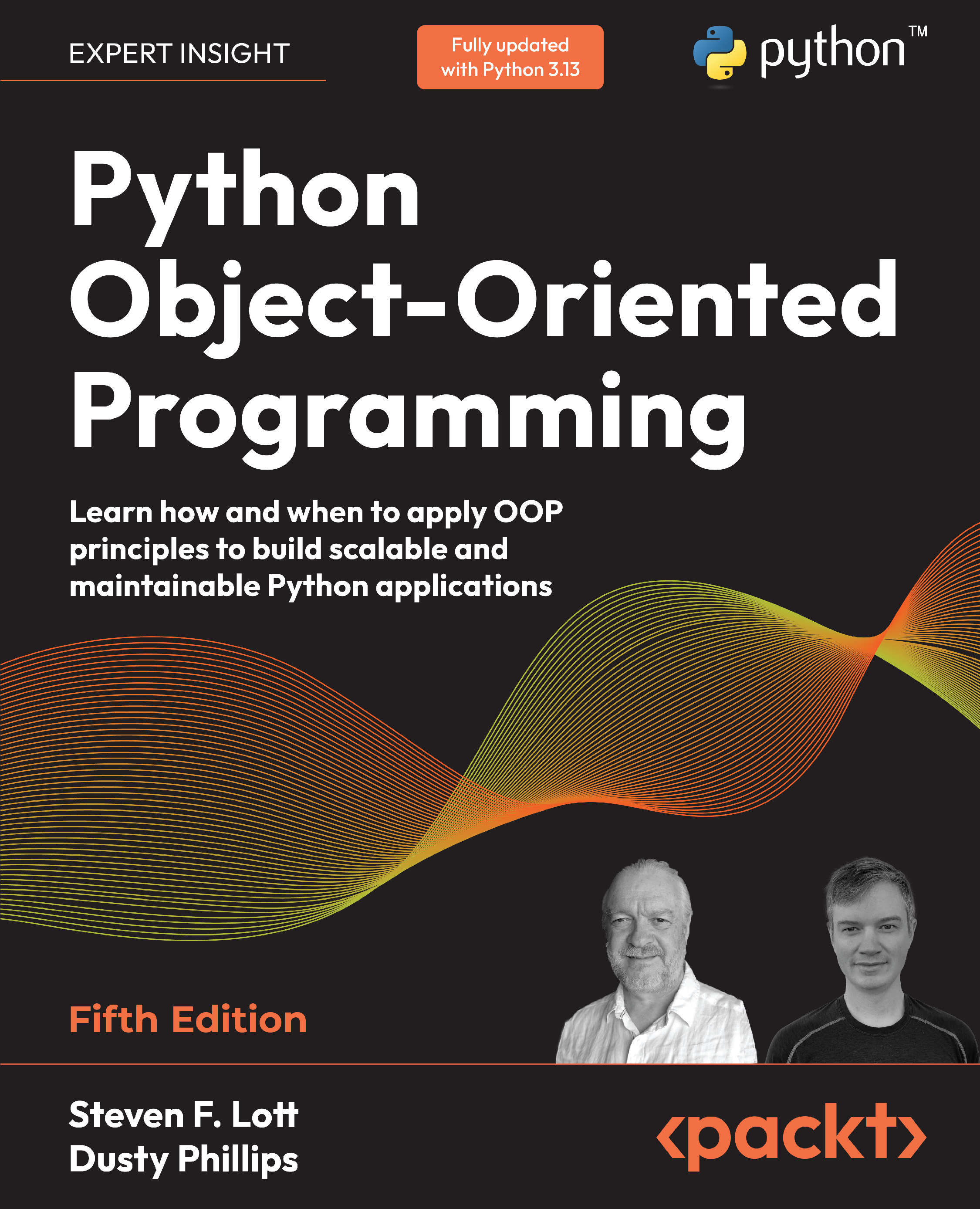
Python Object-Oriented Programming - Fifth Edition
By :


Python Object-Oriented Programming
By:
Overview of this book
Learn to write effective, maintainable, and scalable Python applications by mastering object-oriented programming with this updated fifth edition. Whether you’re transitioning from scripting to structured development or refining your OOP skills, this book offers a clear, practical path forward.
You’ll explore Python’s approach to OOP, from class creation and inheritance to polymorphism and abstraction, while discovering how to make smarter decisions about when and how to use these tools. You’ll apply what you learn through hands-on examples and exercises.
Updated for Python 3.13, this edition simplifies complex topics such as abstract base classes, testing with unittest and pytest, and async programming with asyncio. It introduces a new chapter on Python’s type hinting ecosystem—crucial for modern Python development.
Written by long-time Python experts Steven Lott and Dusty Phillips, this edition emphasizes clarity, testability, and professional software engineering practices. It helps you move beyond scripting to building well-structured, production-ready Python systems.
By the end of this book, you’ll be confident in applying OOP principles, design patterns, type hints, and concurrency tools to create robust and maintainable Python applications.
Table of Contents (17 chapters)
Preface


 Free Chapter
Chapter 1 Object-Oriented Design
Chapter 2 Objects in Python
Chapter 3 When Objects Are Alike
Chapter 4 Expecting the Unexpected
Chapter 5 When to Use Object-Oriented Programming
Chapter 6 Abstract Base Classes and Operator Overloading
Chapter 7 Python Type Hints
Chapter 8 Python Data Structures
Chapter 9 The Intersection of Object-Oriented and Functional Programming
Chapter 10 The Iterator Pattern
Chapter 11 Common Design Patterns
Chapter 12 Advanced Design Patterns
Chapter 13 Testing Object-Oriented Programs
Chapter 14 Concurrency

Other Books You May Enjoy
Index


