
Sign In Start Free Trial
Account

Add to playlist

Create a Playlist

Modal Close icon
You need to login to use this feature.
  • Book Overview & Buying Mastering Go
  • Table Of Contents Toc
Mastering Go

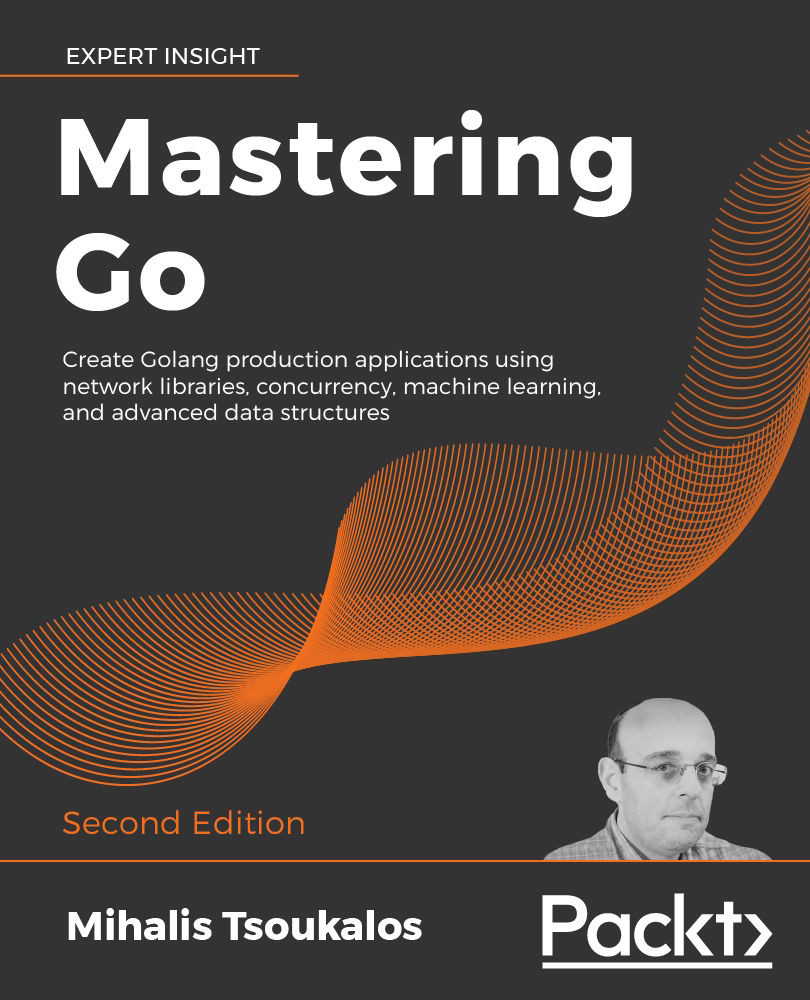
Mastering Go - Second Edition

By : Mihalis Tsoukalos
4.1 (33)
close
close
Mastering Go

Mastering Go

4.1 (33)
By: Mihalis Tsoukalos

Overview of this book

Often referred to (incorrectly) as Golang, Go is the high-performance systems language of the future. Mastering Go, Second Edition helps you become a productive expert Go programmer, building and improving on the groundbreaking first edition. Mastering Go, Second Edition shows how to put Go to work on real production systems. For programmers who already know the Go language basics, this book provides examples, patterns, and clear explanations to help you deeply understand Go’s capabilities and apply them in your programming work. The book covers the nuances of Go, with in-depth guides on types and structures, packages, concurrency, network programming, compiler design, optimization, and more. Each chapter ends with exercises and resources to fully embed your new knowledge. This second edition includes a completely new chapter on machine learning in Go, guiding you from the foundation statistics techniques through simple regression and clustering to classification, neural networks, and anomaly detection. Other chapters are expanded to cover using Go with Docker and Kubernetes, Git, WebAssembly, JSON, and more. If you take the Go programming language seriously, the second edition of this book is an essential guide on expert techniques.
Table of Contents (15 chapters)
close
close

A concurrent TCP server

In this section, you will learn how to develop a concurrent TCP server using goroutines. For each incoming connection to the TCP server, the program will start a new goroutine to handle that request. This allows it to accept more requests, which means that a concurrent TCP server can serve multiple clients simultaneously.

The job of the TCP concurrent server is to accept a positive integer and return a natural number from the Fibonacci sequence. If there is an error in the input, the return value will be -1. As the calculation of numbers in the Fibonacci sequence can be slow, we are going to use an algorithm that was first presented in Chapter 11, Code Testing, Optimization, and Profiling, and was included in benchmarkMe.go. Additionally, this time, the algorithm used will be explained a little more.

The name of the program is fiboTCP.go, and its code is...

CONTINUE READING
83
Tech Concepts
36
Programming languages
73
Tech Tools
Icon Unlimited access to the largest independent learning library in tech of over 8,000 expert-authored tech books and videos.
Icon Innovative learning tools, including AI book assistants, code context explainers, and text-to-speech.
Icon 50+ new titles added per month and exclusive early access to books as they are being written.
Mastering Go
notes
bookmark Notes and Bookmarks search Search in title playlist Add to playlist download Download options font-size Font size

Change the font size

margin-width Margin width

Change margin width

day-mode Day/Sepia/Night Modes

Change background colour

Close icon Search
Country selected

Close icon Your notes and bookmarks

Confirmation

Modal Close icon
claim successful

Buy this book with your credits?

Modal Close icon
Are you sure you want to buy this book with one of your credits?
Close
YES, BUY

Submit Your Feedback

Modal Close icon
Modal Close icon
Modal Close icon