
Sign In Start Free Trial
Account

Add to playlist

Create a Playlist

Modal Close icon
You need to login to use this feature.
  • Book Overview & Buying Binary Analysis Cookbook
  • Table Of Contents Toc
Binary Analysis Cookbook

Binary Analysis Cookbook

By : Michael Born
5 (1)
close
close
Binary Analysis Cookbook

Binary Analysis Cookbook

5 (1)
By: Michael Born

Overview of this book

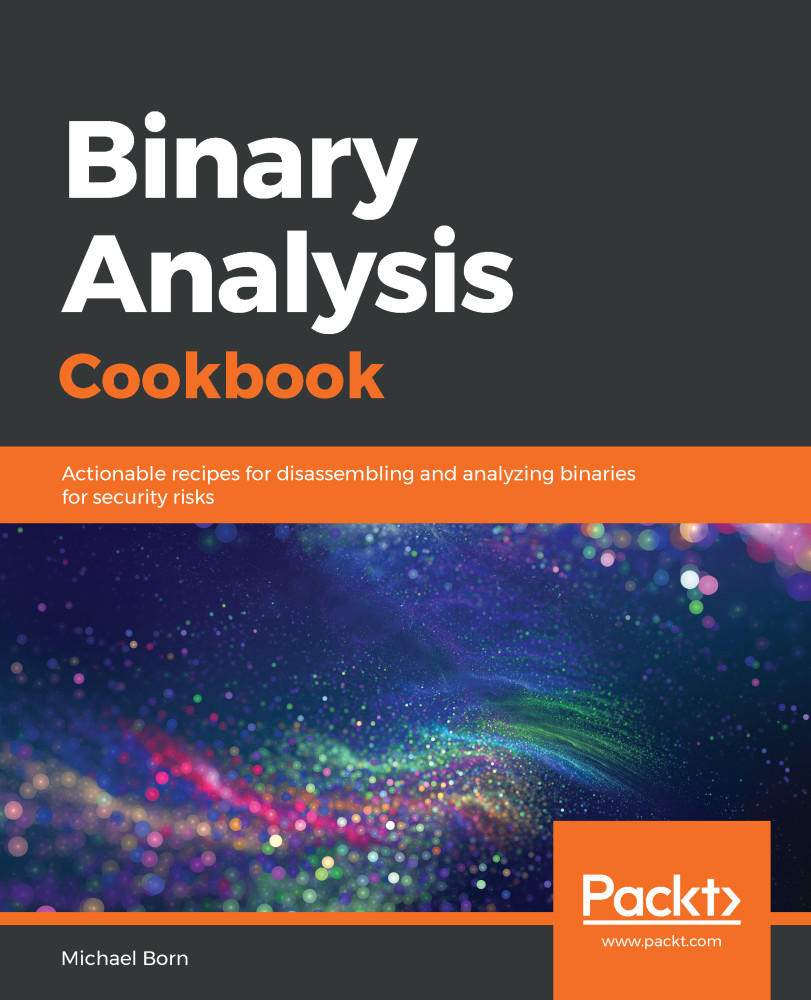
Binary analysis is the process of examining a binary program to determine information security actions. It is a complex, constantly evolving, and challenging topic that crosses over into several domains of information technology and security. This binary analysis book is designed to help you get started with the basics, before gradually advancing to challenging topics. Using a recipe-based approach, this book guides you through building a lab of virtual machines and installing tools to analyze binaries effectively. You'll begin by learning about the IA32 and ELF32 as well as IA64 and ELF64 specifications. The book will then guide you in developing a methodology and exploring a variety of tools for Linux binary analysis. As you advance, you'll learn how to analyze malicious 32-bit and 64-bit binaries and identify vulnerabilities. You'll even examine obfuscation and anti-analysis techniques, analyze polymorphed malicious binaries, and get a high-level overview of dynamic taint analysis and binary instrumentation concepts. By the end of the book, you'll have gained comprehensive insights into binary analysis concepts and have developed the foundational skills to confidently delve into the realm of binary analysis.
Table of Contents (12 chapters)
close
close

Differences between Intel and AT&T syntax

When working with 32-bit assembly on our Ubuntu virtual machines, we will encounter two primary syntaxes. The default configuration of our tools follows the AT&T syntax format, but we will use the Intel syntax throughout each recipe in this book. In later chapters, we will include recipes for configuring some of our tools to display the Intel syntax.

This recipe will walk us through the subtle differences between AT&T syntax, the default, and the Intel syntax, the format we will use going forward. Don't worry about some of the tools that are used in this recipe just yet as we will cover them in detail in Chapter 5, Linux Tools for Binary Analysis.

Getting ready

To...

CONTINUE READING
83
Tech Concepts
36
Programming languages
73
Tech Tools
Icon Unlimited access to the largest independent learning library in tech of over 8,000 expert-authored tech books and videos.
Icon Innovative learning tools, including AI book assistants, code context explainers, and text-to-speech.
Icon 50+ new titles added per month and exclusive early access to books as they are being written.
Binary Analysis Cookbook
notes
bookmark Notes and Bookmarks search Search in title playlist Add to playlist download Download options font-size Font size

Change the font size

margin-width Margin width

Change margin width

day-mode Day/Sepia/Night Modes

Change background colour

Close icon Search
Country selected

Close icon Your notes and bookmarks

Confirmation

Modal Close icon
claim successful

Buy this book with your credits?

Modal Close icon
Are you sure you want to buy this book with one of your credits?
Close
YES, BUY

Submit Your Feedback

Modal Close icon
Modal Close icon
Modal Close icon