


-
Book Overview & Buying
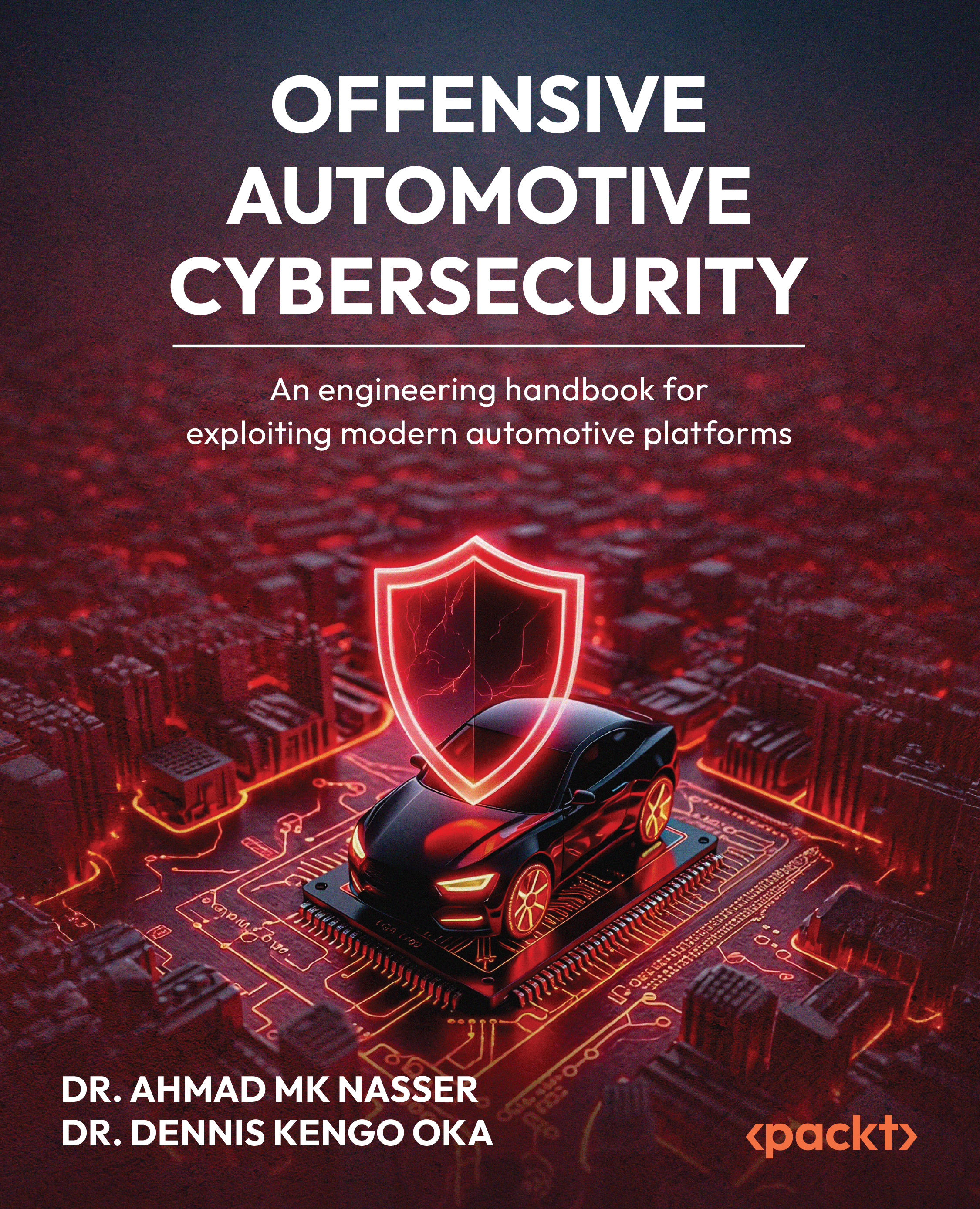
-
Table Of Contents

Offensive Automotive Cybersecurity
By :


Offensive Automotive Cybersecurity
By:
Overview of this book
Offensive Automotive Cybersecurity is your practical guide to understanding how modern automotive vulnerabilities are exploited—so you can build resilient defenses against proven attack methods.
As vehicles evolve into software-defined systems, their expanding attack surface increases exposure to sophisticated threats. This book examines the entire connected vehicle ecosystem—from cloud backends and wireless protocols to in-vehicle networks, HPCs, ECUs, and physical sensors—through an offensive security lens.
Through a blend of theory and reviewing practical examples, you will learn to execute the full penetration testing lifecycle, encompassing active and passive reconnaissance, firmware reverse engineering, and the construction of complex attack chains. The book provides hands-on insights into exploiting memory corruption bugs in HPCs, abusing diagnostic protocols, and leveraging hardware-level vulnerabilities such as fault injection and side-channel leakage. These techniques are brought to life through detailed real-world case studies, including remote takeovers and exploits of well-known vehicle platforms.
By the end of this book, you’ll be able to think like an adversary, uncover hidden risks before attackers do, apply secure-by-design principles, and implement layered defenses to reduce exploitable weaknesses.
Table of Contents (17 chapters)
Preface


 Free Chapter
Part 1: Reviewing the Basics and the Fundamentals of Offensive Security
Chapter 1: Offensive Security Basics
Chapter 2: Penetration Testing Phases
Chapter 3: Building the Tool Arsenal
Part 2: Attacking the External Interfaces and Vehicle Networks
Chapter 4: Attacking the Vehicle Backend
Chapter 5: Attacking the Wireless Vehicle Systems
Chapter 6: Attacking the In-Vehicle Communications

Part 3: Busting the Myth of the Deeper Architecture Layers Security
Chapter 7: Attacking MCU-Based Embedded ECUs
Chapter 8: Attacking the High-Performance ECUs
Chapter 9: Attacking Vehicle Sensors and AI/ML
Chapter 10: A Path Forward
Chapter 11: Unlock Your Exclusive Benefits
Other Books You May Enjoy
Index


