Sign In Start Free Trial
Account

Add to playlist

Create a Playlist

Modal Close icon
You need to login to use this feature.
  • Book Overview & Buying MEAN Web Development
  • Table Of Contents Toc
MEAN Web Development

MEAN Web Development

By : Haviv
4.5 (58)
close
close
MEAN Web Development

MEAN Web Development

4.5 (58)
By: Haviv

Overview of this book

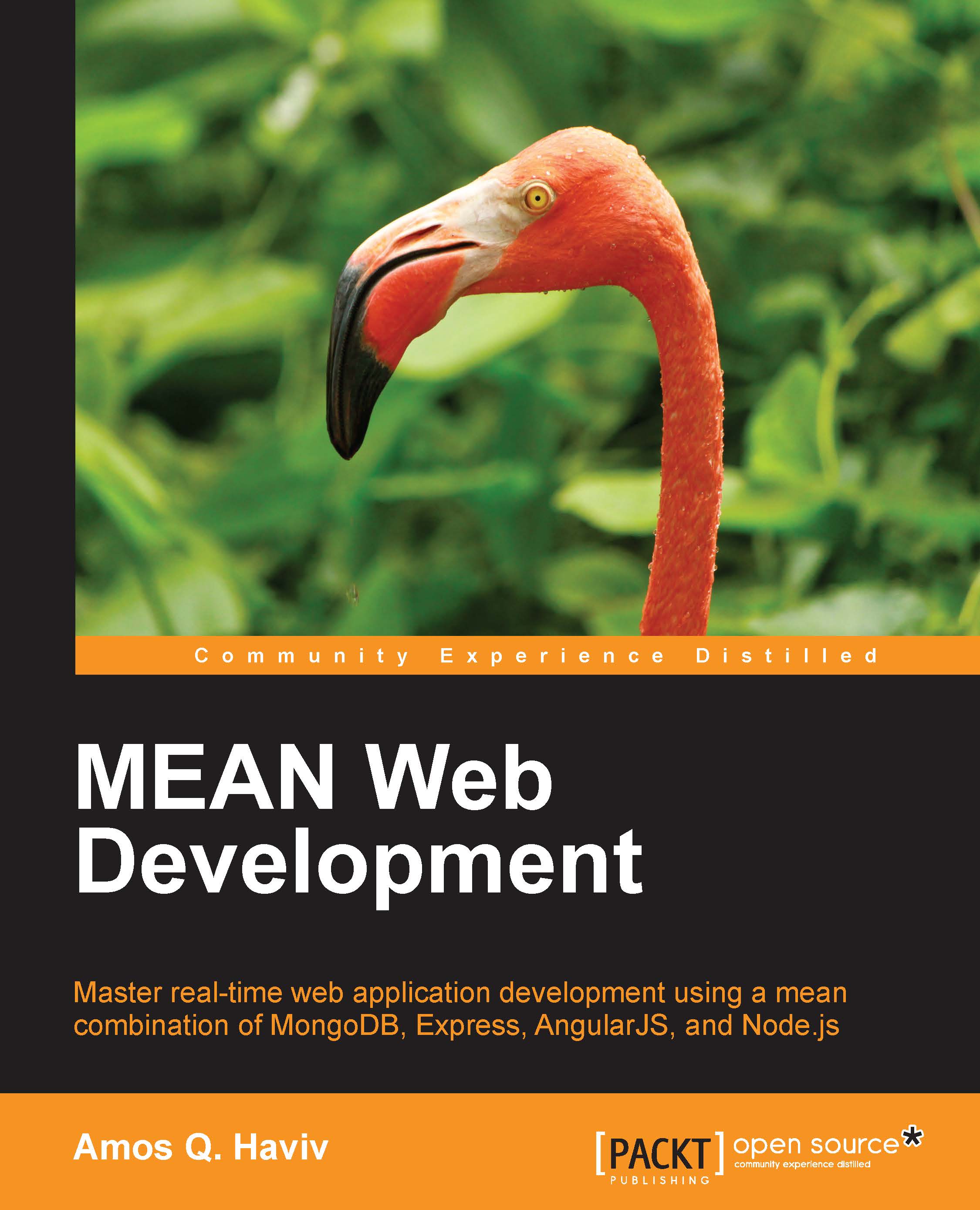
The MEAN stack is a collection of the most popular modern tools for web development; it comprises MongoDB, Express, AngularJS, and Node.js. Starting with MEAN core frameworks, this project-based guide will explain the key concepts of each framework, how to set them up properly, and how to use popular modules to connect it all together. By following the real-world examples shown in this tutorial, you will scaffold your MEAN application architecture, add an authentication layer, and develop an MVC structure to support your project development. Finally, you will walk through the different tools and frameworks that will help expedite your daily development cycles. Watch how your application development grows by learning from the only guide that is solely orientated towards building a full, end-to-end, real-time application using the MEAN stack!
Table of Contents (13 chapters)
close
close
12
Index

Preface

Back in the spring of 1995, web browsers were very different from present day web browsers. It had been 4 years since the release of World Wide Web (the first internet browser written by Tim Berners-Lee), 2 years since the initial release of Mosaic, and Internet Explorer 1.0 was a few months months away from release. The World Wide Web began to show signs of popularity, and though some of the big companies showed interest in the field, the main disruptor back then was a small company named Netscape.

Netscape's already popular browser Netscape Navigator, was in the works for its second version, when the client engineering team and co-founder Marc Anderseen decided that Navigator 2.0 should embed a programming language. The task was assigned to a software engineer named Branden Eich, who completed it in 10 days between May 6 and May 15, 1995, naming the language Mocha, then LiveScript, and eventually JavaScript.

Netscape Navigator 2.0 was released in September 1995 and transformed the way we perceived the web browser. By August 1996, Internet Explorer 3.0 introduced its own implementation of JavaScript, and in November of that year, Netscape had announced that they had submitted JavaScript to ECMA for standardization. In June 1997, the ECMA-262 specification was published, making JavaScript the de facto standard programming language for the Web.

For years, JavaScript was denigrated by many as the programming language for amateurs. JavaScript's architecture, fragmented implementation, and original "amateur" audience made professional programmers dismiss it. But then AJAX was introduced, and when Google released their Gmail and Google Maps applications in the mid-2000s, it suddenly became clear that AJAX technology could transform websites into web applications. This inspired the new generation of web developers to take JavaScript development to next level.

What began with the first generation of utility libraries, such as jQuery and Prototype, soon got boosted by Google's next great contribution, the Chrome browser and its V8 JavaScript engine, released in end of 2008. The V8 engine, with its JIT compiling capabilities, greatly enhanced JavaScript performance. This led to a new era in JavaScript development.

2009 was JavaScript's annus mirabilis; suddenly, platforms such as Node.js enabled developers to run JavaScript on the server, databases such as MongoDB popularized and simplified the use of JSON storage, and frameworks such as AngularJS started making use of the powerful new browsers. Almost 20 years after its original debut, JavaScript is now everywhere. What used to be an "amateur" programming language, capable of executing small scripts, is now one of the most popular programming languages in the world. The rise of open source collaboration tools, along with the devoted involvement of talented engineers, created one of the richest communities in the world, and the seeds planted by many contributors are now flourishing in a burst of sheer creativity.

The practical implications are enormous. What was once a fragmented team of developers, each an expert in his own domain, can now become a homogeneous team capable of developing leaner, more agile software together using a single language across all layers.

There are many full-stack JavaScript frameworks out there, some built by great teams, some address important issues, but none of them are as open and modular as the MEAN stack. The idea is simple, we'll take MongoDB as the database, Express as the web framework, AngularJS as the frontend framework, and Node.js as the platform, and combine them together in a modular approach that will ensure the flexibility needed in modern software development. MEAN's approach relies on the communities around each of the open source modules keeping it updated and stable, ensuring that if one of the modules becomes useless, we can just seamlessly replace it with a better-suited one.

I would like to welcome you to the JavaScript revolution and assure you I will do my best to help you become a full-stack JavaScript developer.

In this book, we'll help you set up your environment and explain how to connect the different MEAN components together using the best modules. You'll be introduced to the best practices of maintaining your code clear and simple and how to avoid common pitfalls. We'll walk through building your authentication layer and adding your first entity. You'll learn how to leverage JavaScript nonblocking architecture in building real-time communication between your server and client applications. Finally, we'll show you how to cover your code with the proper tests and what tools to use to automate your development process.

CONTINUE READING
83
Tech Concepts
36
Programming languages
73
Tech Tools
Icon Unlimited access to the largest independent learning library in tech of over 8,000 expert-authored tech books and videos.
Icon Innovative learning tools, including AI book assistants, code context explainers, and text-to-speech.
Icon 50+ new titles added per month and exclusive early access to books as they are being written.
MEAN Web Development
notes
bookmark Notes and Bookmarks search Search in title playlist Add to playlist download Download options font-size Font size

Change the font size

margin-width Margin width

Change margin width

day-mode Day/Sepia/Night Modes

Change background colour

Close icon Search
Country selected

Close icon Your notes and bookmarks

Confirmation

Modal Close icon
claim successful

Buy this book with your credits?

Modal Close icon
Are you sure you want to buy this book with one of your credits?
Close
YES, BUY

Submit Your Feedback

Modal Close icon
Modal Close icon
Modal Close icon