Sign In Start Free Trial
Account

Add to playlist

Create a Playlist

Modal Close icon
You need to login to use this feature.
  • Book Overview & Buying Learning Material Design
  • Table Of Contents Toc
  • Feedback & Rating feedback
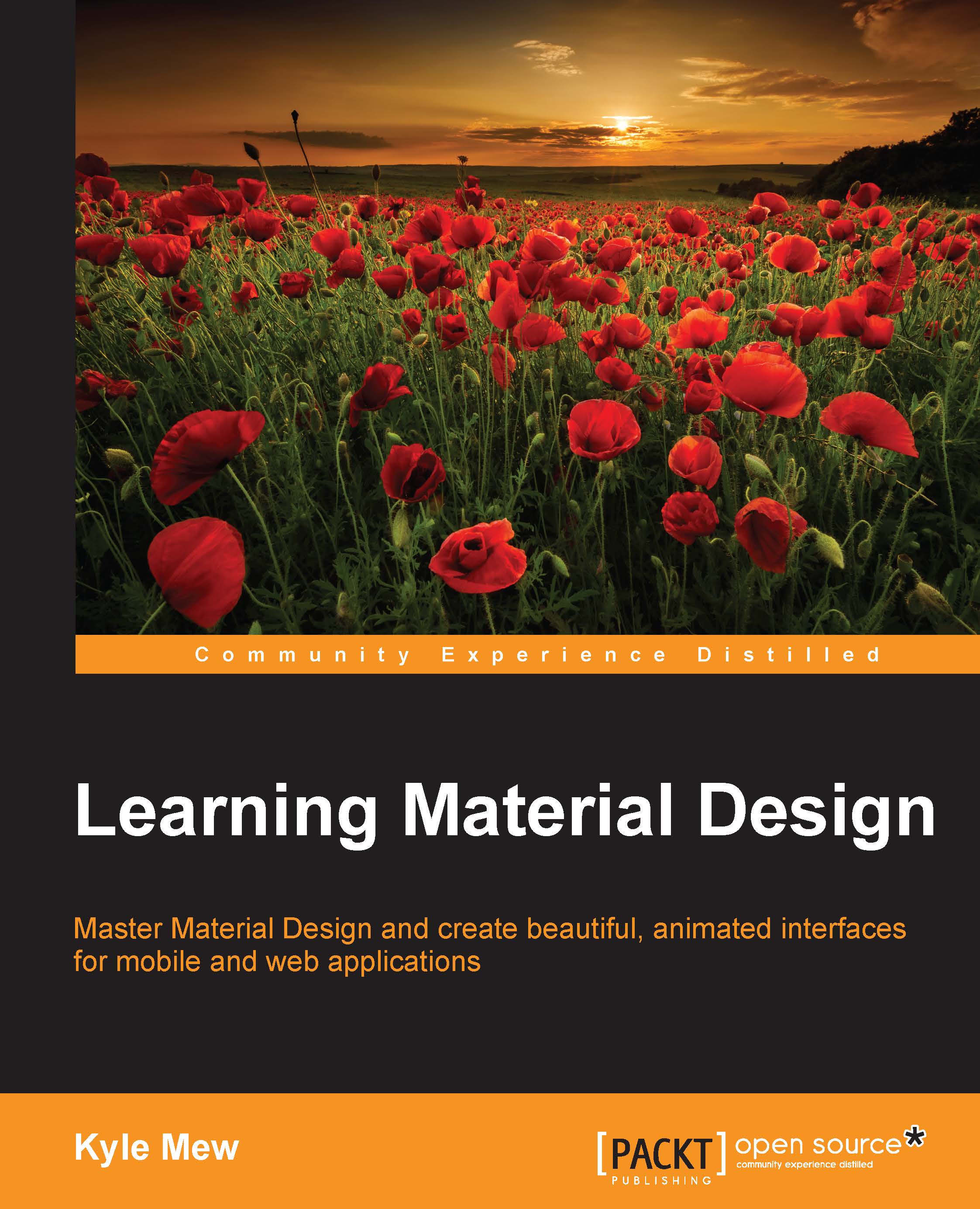
Learning Material Design

Learning Material Design

By : Mew, Nadir Belhaj
2 (1)
close
close
Learning Material Design

Learning Material Design

2 (1)
By: Mew, Nadir Belhaj

Overview of this book

Google's Material Design language has taken the web development and design worlds by storm. Now available on many more platforms than Android, Material Design uses color, light, and movements to not only generate beautiful interfaces, but to provide intuitive navigation for the user. Learning Material Design will teach you the fundamental theories of Material Design using code samples to put these theories into practice. Focusing primarily on Android Studio, you’ll create mobile interfaces using the most widely used and powerful material components, such as sliding drawers and floating action buttons. Each section will introduce the relevant Java classes and APIs required to implement these components. With the rules regarding structure, layout, iconography, and typography covered, we then move into animation and transition, possibly Material Design's most powerful concept, allowing complex hierarchies to be displayed simply and stylishly. With all the basic technologies and concepts mastered, the book concludes by showing you how these skills can be applied to other platforms, in particular web apps, using the powerful Polymer library.
Table of Contents (12 chapters)
close
close

Summary

Dialogs and menus form an integral part of any application, in particular on mobile platforms where space is limited. As always, the material approach is to keep these clean and simple, in content as well as appearance. We have seen what the guidelines are and how they can be applied with XML, as well as seeing how these interfaces connect to and are controlled by our Java code.

Dialogs and menus are elements of most applications and are by no means peculiar to Material Design and this chapter has covered only the visual aspects. There are of course many screen components that are specific to Material Design such as the floating action button and navigation drawer, many of which are catered to in a support library of their own, the design library.

In the next chapter, we will explore the way users navigate around an Android app. This will involve creating a sliding navigation drawer and the use of fragments to display alternative content. We will also cover ratios and designing for...

Visually different images
CONTINUE READING
83
Tech Concepts
36
Programming languages
73
Tech Tools
Icon Unlimited access to the largest independent learning library in tech of over 8,000 expert-authored tech books and videos.
Icon Innovative learning tools, including AI book assistants, code context explainers, and text-to-speech.
Icon 50+ new titles added per month and exclusive early access to books as they are being written.
Learning Material Design
notes
bookmark Notes and Bookmarks search Search in title playlist Add to playlist font-size Font size

Change the font size

margin-width Margin width

Change margin width

day-mode Day/Sepia/Night Modes

Change background colour

Close icon Search
Country selected

Close icon Your notes and bookmarks

Confirmation

Modal Close icon
claim successful

Buy this book with your credits?

Modal Close icon
Are you sure you want to buy this book with one of your credits?
Close
YES, BUY

Submit Your Feedback

Modal Close icon
Modal Close icon
Modal Close icon