
Sign In Start Free Trial
Account

Add to playlist

Create a Playlist

Modal Close icon
You need to login to use this feature.
  • Book Overview & Buying Mastering ASP.NET Web API
  • Table Of Contents Toc
Mastering ASP.NET Web API

Mastering ASP.NET Web API

By : Pattankar
2.8 (4)
close
close
Mastering ASP.NET Web API

Mastering ASP.NET Web API

2.8 (4)
By: Pattankar

Overview of this book

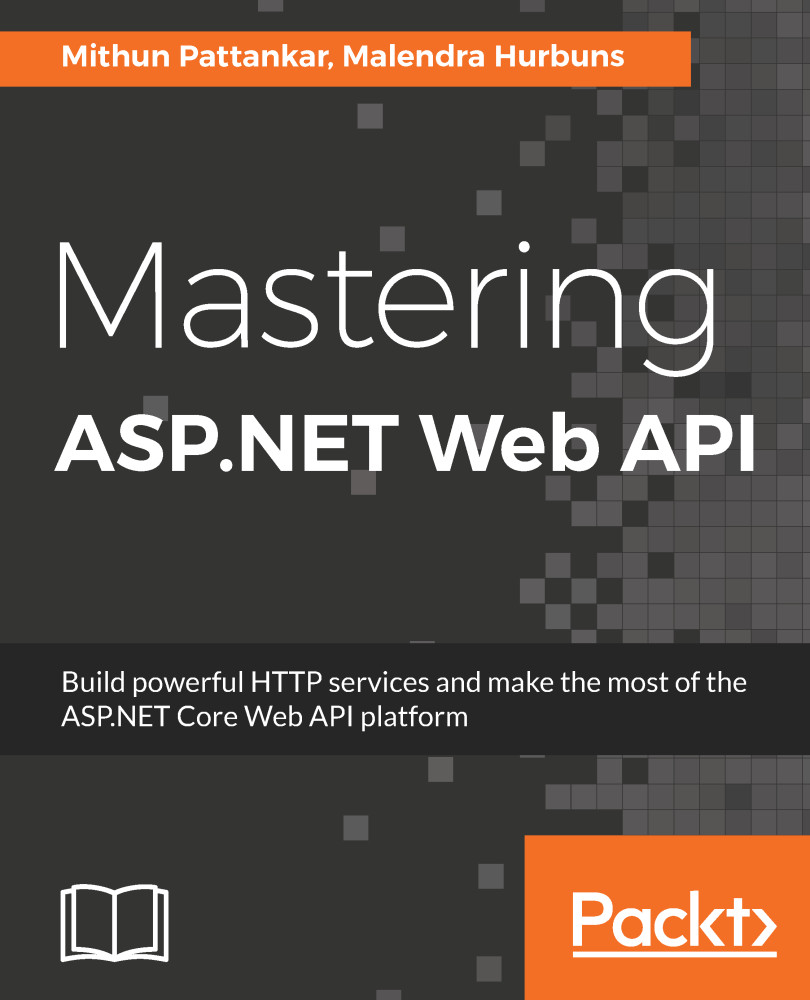
Microsoft has unified their main web development platforms. This unification will help develop web applications using various pieces of the ASP.NET platform that can be deployed on both Windows and LINUX. With ASP.NET Core (Web API), it will become easier than ever to build secure HTTP services that can be used from any client. Mastering ASP.NET Web API starts with the building blocks of the ASP.NET Core, then gradually moves on to implementing various HTTP routing strategies in the Web API. We then focus on the key components of building applications that employ the Web API, such as Kestrel, Middleware, Filters, Logging, Security, and Entity Framework.Readers will be introduced to take the TDD approach to write test cases along with the new Visual Studio 2017 live unit testing feature. They will also be introduced to integrate with the database using ORMs. Finally, we explore how the Web API can be consumed in a browser as well as by mobile applications by utilizing Angular 4, Ionic and ReactJS. By the end of this book, you will be able to apply best practices to develop complex Web API, consume them in frontend applications and deploy these applications to a modern hosting infrastructure.
Table of Contents (14 chapters)
close
close

Summary

We looked at the definition of REST and how REST is derived. When you look at the REST architecture, you should be able to depict it in three categories, as explained by Roy T. Fielding. One, the process view, describes how data flows from the client to the several components. Two, the connector view is specific to the exchanging of messages between components specific to resources and resource identification. Three, the data view of how the data that we referred to as representations is transmitted from the server to the client. It is very important to have a good understanding of the REST principles and that REST was applied to HTTP 1.0 in order to derive HTTP 1.1.

HTTP is a living example of the REST principles. Actions such as GET and POST are stateless, which is a principle of REST. The examples show how to construct an HTTP request and what the server sends back...

CONTINUE READING
83
Tech Concepts
36
Programming languages
73
Tech Tools
Icon Unlimited access to the largest independent learning library in tech of over 8,000 expert-authored tech books and videos.
Icon Innovative learning tools, including AI book assistants, code context explainers, and text-to-speech.
Icon 50+ new titles added per month and exclusive early access to books as they are being written.
Mastering ASP.NET Web API
notes
bookmark Notes and Bookmarks search Search in title playlist Add to playlist download Download options font-size Font size

Change the font size

margin-width Margin width

Change margin width

day-mode Day/Sepia/Night Modes

Change background colour

Close icon Search
Country selected

Close icon Your notes and bookmarks

Confirmation

Modal Close icon
claim successful

Buy this book with your credits?

Modal Close icon
Are you sure you want to buy this book with one of your credits?
Close
YES, BUY

Submit Your Feedback

Modal Close icon
Modal Close icon
Modal Close icon