Sign In Start Free Trial
Account

Add to playlist

Create a Playlist

Modal Close icon
You need to login to use this feature.
  • Book Overview & Buying Mastering Django: Core
  • Table Of Contents Toc
Mastering Django: Core

Mastering Django: Core

By : Nigel George
close
close
Mastering Django: Core

Mastering Django: Core

By: Nigel George

Overview of this book

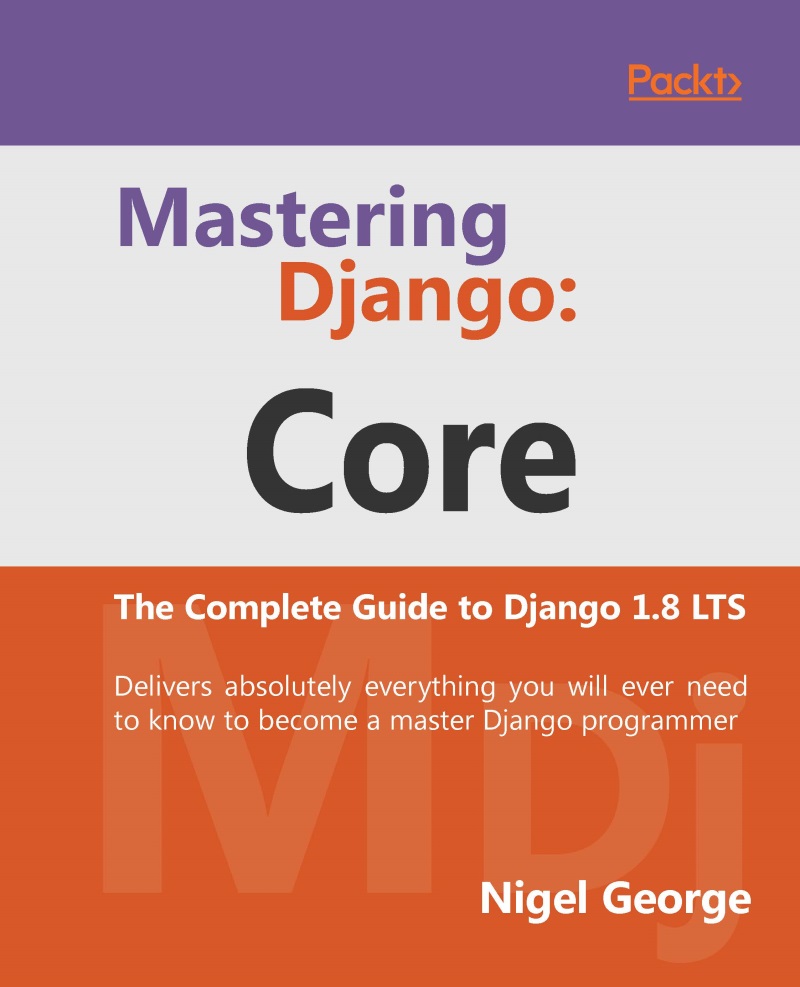
Mastering Django: Core is a completely revised and updated version of the original Django Book, written by Adrian Holovaty and Jacob Kaplan-Moss - the creators of Django. The main goal of this book is to make you a Django expert. By reading this book, you’ll learn the skills needed to develop powerful websites quickly, with code that is clean and easy to maintain. This book is also a programmer’s manual that provides complete coverage of the current Long Term Support (LTS) version of Django. For developers creating applications for commercial and business critical deployments, Mastering Django: Core provides a complete, up-to-date resource for Django 1.8LTS with a stable code-base, security fixes and support out to 2018.
Table of Contents (29 chapters)
close
close
Lock Free Chapter
1
1. Introduction to Django and Getting Started

DJANGO_SETTINGS_MODULE

When you use Django, you have to tell it which settings you're using. Do this by using an environment variable, DJANGO_SETTINGS_MODULE. The value of DJANGO_SETTINGS_MODULE should be in Python path syntax, for example, mysite.settings.

The django-admin utility

When using django-admin, you can either set the environment variable once, or explicitly pass in the settings module each time you run the utility. Example (Unix Bash shell):

export DJANGO_SETTINGS_MODULE=mysite.settings 
django-admin runserver

Example (Windows shell):

set DJANGO_SETTINGS_MODULE=mysite.settings 
django-admin runserver

Use the --settings command-line argument to specify the settings manually:

django-admin runserver --settings=mysite.settings

On the server (mod_wsgi)

In your live server environment, you'll need to tell your WSGI application what settings file to use. Do that with os.environ:

import os
os.environ['DJANGO_SETTINGS_MODULE'] = 'mysite.settings'

Read Chapter 13...

CONTINUE READING
83
Tech Concepts
36
Programming languages
73
Tech Tools
Icon Unlimited access to the largest independent learning library in tech of over 8,000 expert-authored tech books and videos.
Icon Innovative learning tools, including AI book assistants, code context explainers, and text-to-speech.
Icon 50+ new titles added per month and exclusive early access to books as they are being written.
Mastering Django: Core
notes
bookmark Notes and Bookmarks search Search in title playlist Add to playlist font-size Font size

Change the font size

margin-width Margin width

Change margin width

day-mode Day/Sepia/Night Modes

Change background colour

Close icon Search
Country selected

Close icon Your notes and bookmarks

Confirmation

Modal Close icon
claim successful

Buy this book with your credits?

Modal Close icon
Are you sure you want to buy this book with one of your credits?
Close
YES, BUY

Submit Your Feedback

Modal Close icon
Modal Close icon
Modal Close icon