Sign In Start Free Trial
Account

Add to playlist

Create a Playlist

Modal Close icon
You need to login to use this feature.
  • Book Overview & Buying Vue.js 2 and Bootstrap 4 Web Development
  • Table Of Contents Toc
  • Feedback & Rating feedback
Vue.js 2 and Bootstrap 4 Web Development

Vue.js 2 and Bootstrap 4 Web Development

By : Olga Filipova
3.7 (3)
close
close
Vue.js 2 and Bootstrap 4 Web Development

Vue.js 2 and Bootstrap 4 Web Development

3.7 (3)
By: Olga Filipova

Overview of this book

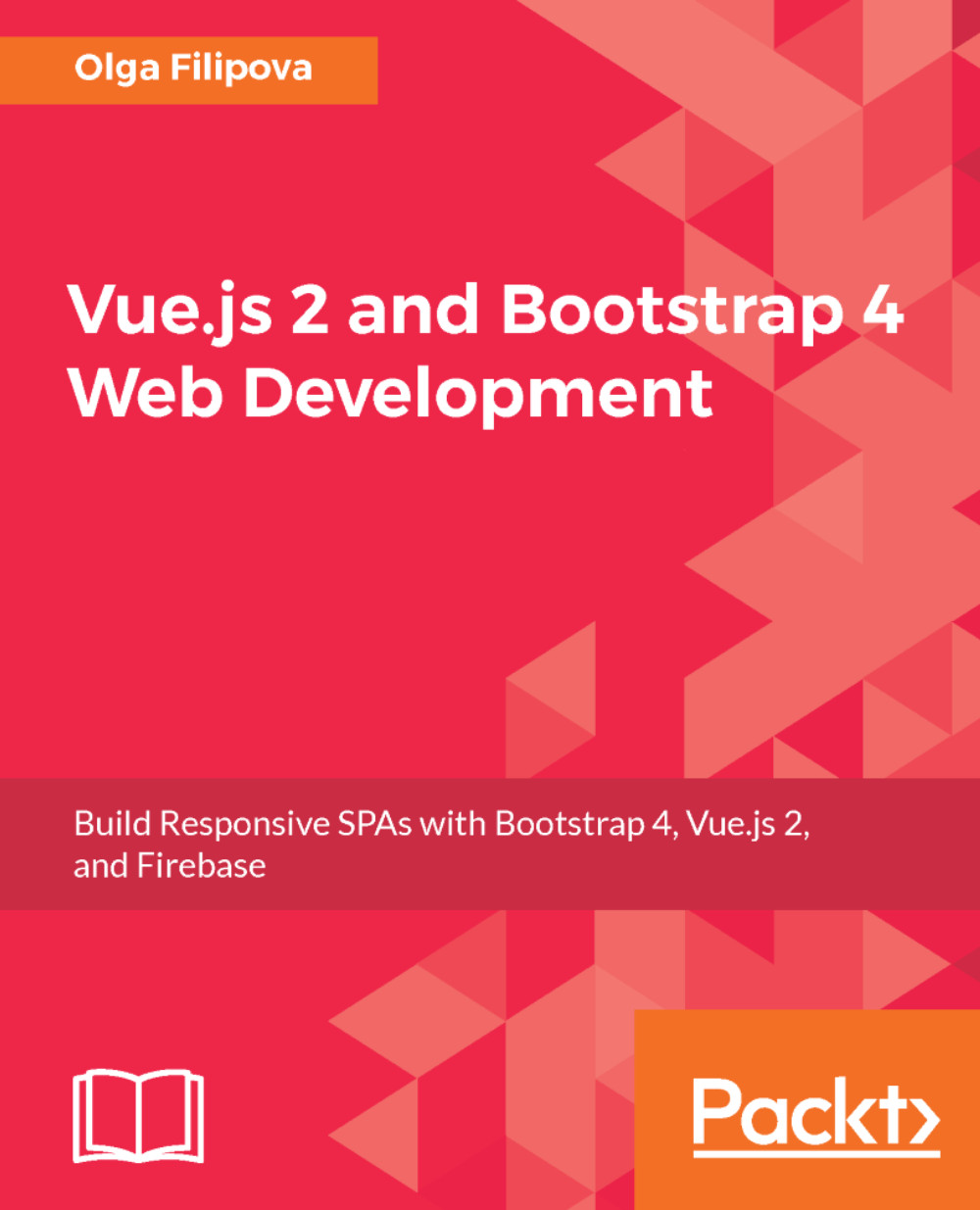
In this book, we will build a full stack web application right from scratch up to its deployment. We will start by building a small introduction application and then proceed to the creation of a fully functional, dynamic responsive web application called ProFitOro. In this application, we will build a Pomodoro timer combined with office workouts. Besides the Pomodoro timer and ProFitOro workouts will enable authentication and collaborative content management. We will explore topics such as Vue reactive data binding, reusable components, routing, and Vuex store along with its state, actions, mutations, and getters. We will create Vue applications using both webpack and Nuxt.js templates while exploring cool hot Nuxt.js features such as code splitting and server-side rendering. We will use Jest to test this application, and we will even revive some trigonometry from our secondary school! While developing the app, you will go through the new grid system of Bootstrap 4 along with Vue.js’ directives. We will connect Vuex store to the Firebase real-time database, data storage, and authentication APIs and use this data later inside the application’s reactive components. Finally, we will quickly deploy our application using the Firebase hosting mechanism.
Table of Contents (12 chapters)
close
close
11
Index

Setting up a Vuex store

Before starting with real data from the database, let's set up the Vuex store for our ProFitOro. We will use it to manage the Pomodoro timer configuration, user settings, such as the username, and a profile picture URL. We will also use it to store and retrieve the application's usage statistics.

From Chapter 2, Hello User Explained, you already know how the Vuex store works. We must define data that will represent the application's state and then we must provide all the needed getters to get the data and all the needed mutations to update the data. Once all this is set, we will be able to access this data from the components.

After the application's store is ready and set up, we can connect it to the real-time database and slightly adjust the getters and mutations to operate the real data.

First of all, we need to tell our application that it will use the Vuex store. To do that, let's add the npm dependency for vuex:

npm install vuex --save...
Visually different images
CONTINUE READING
83
Tech Concepts
36
Programming languages
73
Tech Tools
Icon Unlimited access to the largest independent learning library in tech of over 8,000 expert-authored tech books and videos.
Icon Innovative learning tools, including AI book assistants, code context explainers, and text-to-speech.
Icon 50+ new titles added per month and exclusive early access to books as they are being written.
Vue.js 2 and Bootstrap 4 Web Development
notes
bookmark Notes and Bookmarks search Search in title playlist Add to playlist download Download options font-size Font size

Change the font size

margin-width Margin width

Change margin width

day-mode Day/Sepia/Night Modes

Change background colour

Close icon Search
Country selected

Close icon Your notes and bookmarks

Confirmation

Modal Close icon
claim successful

Buy this book with your credits?

Modal Close icon
Are you sure you want to buy this book with one of your credits?
Close
YES, BUY

Submit Your Feedback

Modal Close icon
Modal Close icon
Modal Close icon