Sign In Start Free Trial
Account

Add to playlist

Create a Playlist

Modal Close icon
You need to login to use this feature.
  • Book Overview & Buying An Atypical ASP.NET Core 5 Design Patterns Guide
  • Table Of Contents Toc
An Atypical ASP.NET Core 5 Design Patterns Guide

An Atypical ASP.NET Core 5 Design Patterns Guide

By : Marcotte
3.5 (11)
close
close
An Atypical ASP.NET Core 5 Design Patterns Guide

An Atypical ASP.NET Core 5 Design Patterns Guide

3.5 (11)
By: Marcotte

Overview of this book

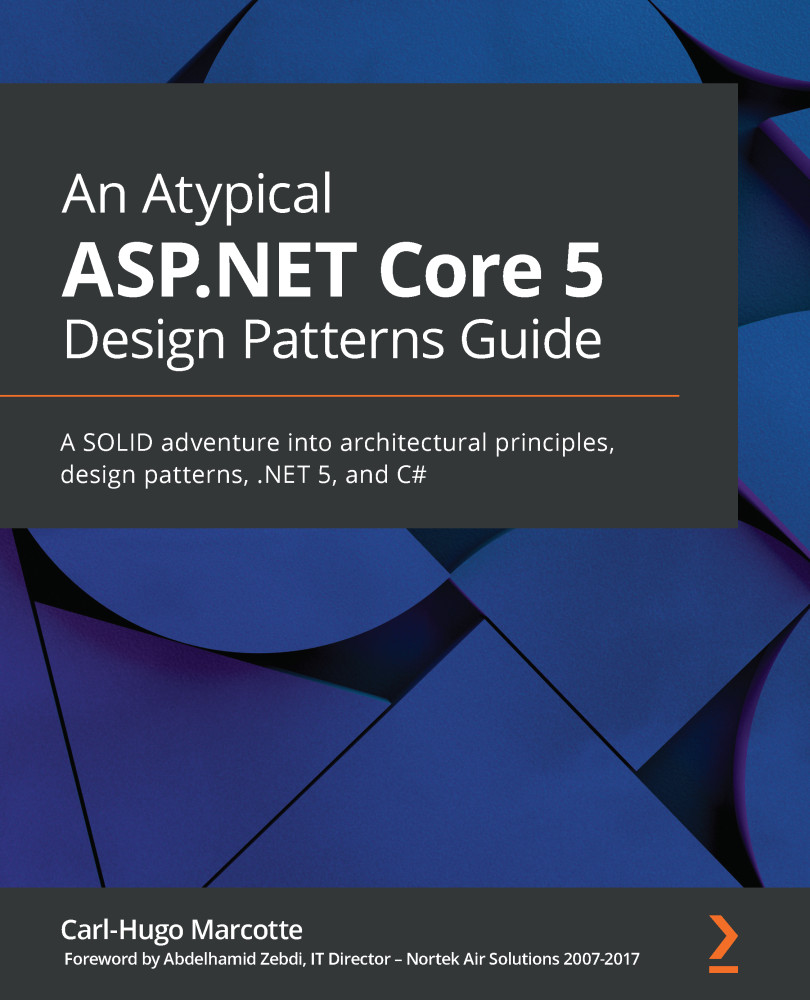
Design patterns are a set of solutions to many of the common problems occurring in software development. Knowledge of these design patterns helps developers and professionals to craft software solutions of any scale. ASP.NET Core 5 Design Patterns starts by exploring basic design patterns, architectural principles, dependency injection, and other ASP.NET Core mechanisms. You’ll explore the component scale as you discover patterns oriented toward small chunks of the software, and then move to application-scale patterns and techniques to understand higher-level patterns and how to structure the application as a whole. The book covers a range of significant GoF (Gangs of Four) design patterns such as strategy, singleton, decorator, facade, and composite. The chapters are organized based on scale and topics, allowing you to start small and build on a strong base, the same way that you would develop a program. With the help of use cases, the book will show you how to combine design patterns to display alternate usage and help you feel comfortable working with a variety of design patterns. Finally, you’ll advance to the client side to connect the dots and make ASP.NET Core a viable full-stack alternative. By the end of the book, you’ll be able to mix and match design patterns and have learned how to think about architecture and how it works.
Table of Contents (27 chapters)
close
close
1
Section 1: Principles and Methodologies
5
Section 2: Designing for ASP.NET Core
11
Section 3: Designing at Component Scale
15
Section 4: Designing at Application Scale
21
Section 5: Designing the Client Side
25
Acronyms Lexicon

Chapter 1: Introduction to .NET

The goal behind this book is not to create yet another design pattern book, but instead, it organizes the chapters cohesively based on scale and topics, allowing you to start small with strong bases and build slowly on top, in just the same way that you would build a program.

Instead of writing a guide that covers a few ways of applying a design pattern, we explore the thinking process behind the systems that we are designing from a software engineer's point of view.

This is not a magic recipe book, and from experience, there is no magic recipe when designing software; there is only your logic, knowledge, experience, and analytical skills. From that last sentence, let's define experience according to your past successes and failures. And don't worry, you will fail during your career, but don't get discouraged by it. The faster you fail, the faster you can recover and learn, leading to successful products. Many techniques covered in this book should help you achieve that goal. Everyone has failed and made mistakes; you won't be the first, and you certainly won't be the last.

The high-level plan looks like this:

  • We start by exploring basic patterns, architectural principles, and some crucial ASP.NET Core mechanisms.
  • Then we move to the component scale, exploring patterns oriented toward small chunks of the software.
  • Next, we move to application-scale patterns and techniques, where we explore higher-level patterns and how to structure the application as a whole.
  • Afterward, we tackle the client side to connect the dots and make ASP.NET a viable full stack alternative.

Many subjects covered throughout the book could have a book of their own. Once you are done with this book, you should have plenty of ideas about where to continue your journey into software architecture.

Here are a few pointers that I believe are worth naming:

  • The chapters are organized to start with small-scale patterns then get to higher-level ones, making the learning curve easier.
  • Instead of giving you a recipe, the book focuses on the thinking aspect and shows evolutions of some techniques to help you understand why the evolution happened.
  • Many use-cases combine more than one design pattern to illustrate alternate usage, aiming toward the understanding of the patterns and how to use them efficiently, as well as showing that a pattern is not a beast to tame but a tool to use, manipulate, and bend to your will.
  • As in real life, no textbook solution can solve all of our problems, and real problems are always more complicated than as they are explained in textbooks. In this book, my goal is to show you how to mix and match patterns and how to think "architecture" instead of how to follow instructions.

The introduction introduces different concepts that we will be exploring throughout the book, including refreshers on a few notions. We are also covering .NET and its tooling, as well as the technical requirements, such as where the source code is located.

The following topics will be covered in this chapter:

  • What is a design pattern?
  • Anti-patterns and code smells
  • Understanding the web – Request/Response
  • Getting started with .NET
CONTINUE READING
83
Tech Concepts
36
Programming languages
73
Tech Tools
Icon Unlimited access to the largest independent learning library in tech of over 8,000 expert-authored tech books and videos.
Icon Innovative learning tools, including AI book assistants, code context explainers, and text-to-speech.
Icon 50+ new titles added per month and exclusive early access to books as they are being written.
An Atypical ASP.NET Core 5 Design Patterns Guide
notes
bookmark Notes and Bookmarks search Search in title playlist Add to playlist download Download options font-size Font size

Change the font size

margin-width Margin width

Change margin width

day-mode Day/Sepia/Night Modes

Change background colour

Close icon Search
Country selected

Close icon Your notes and bookmarks

Confirmation

Modal Close icon
claim successful

Buy this book with your credits?

Modal Close icon
Are you sure you want to buy this book with one of your credits?
Close
YES, BUY

Submit Your Feedback

Modal Close icon
Modal Close icon
Modal Close icon