
Sign In Start Free Trial
Account

Add to playlist

Create a Playlist

Modal Close icon
You need to login to use this feature.
  • Book Overview & Buying Hands-On RESTful Python Web Services
  • Table Of Contents Toc
  • Feedback & Rating feedback
Hands-On RESTful Python Web Services

Hands-On RESTful Python Web Services - Second Edition

By : Gaston C. Hillar
2.3 (3)
close
close
Hands-On RESTful Python Web Services

Hands-On RESTful Python Web Services

2.3 (3)
By: Gaston C. Hillar

Overview of this book

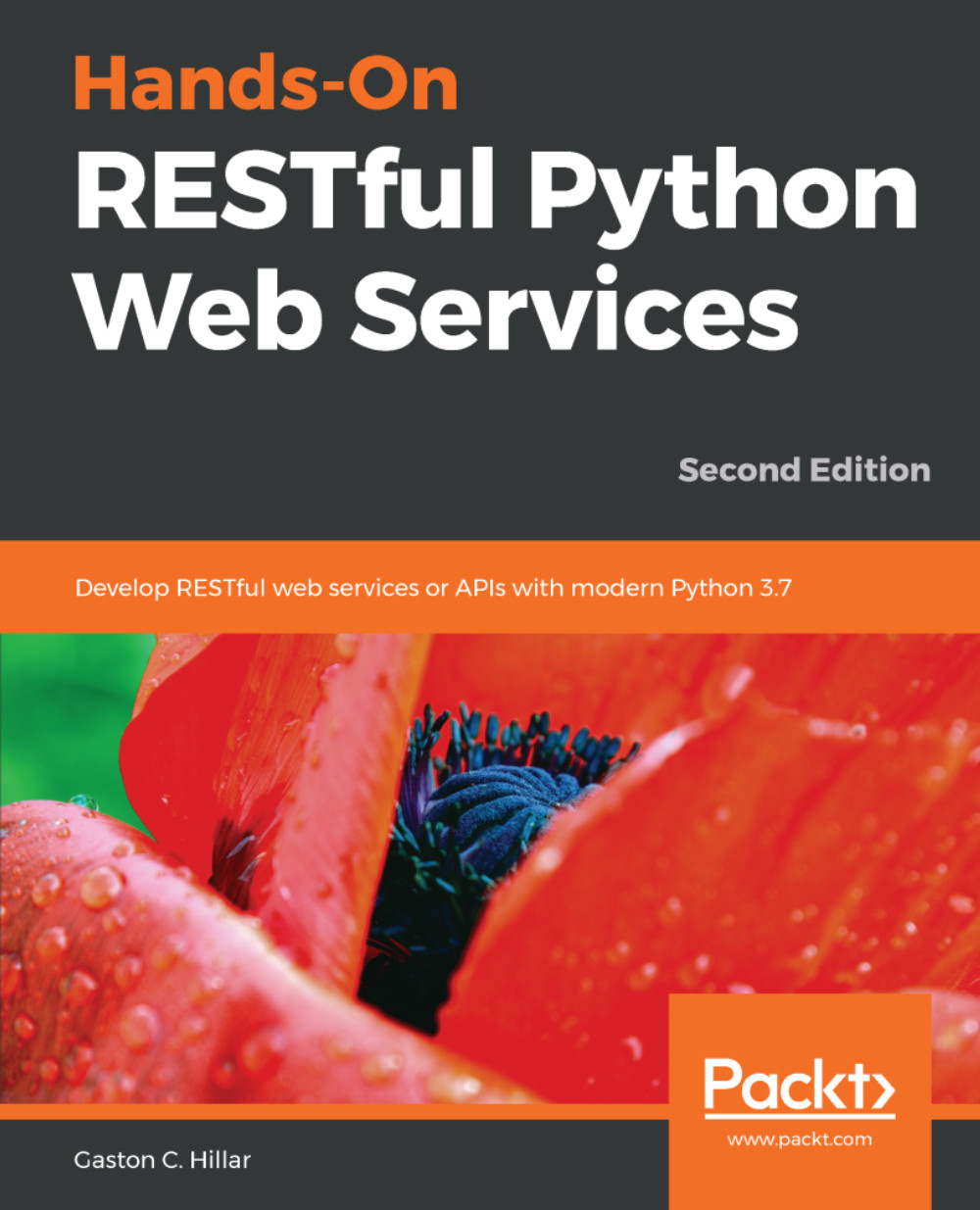
Python is the language of choice for millions of developers worldwide that builds great web services in RESTful architecture. This second edition of Hands-On RESTful Python Web Services will cover the best tools you can use to build engaging web services. This book shows you how to develop RESTful APIs using the most popular Python frameworks and all the necessary stacks with Python, combined with related libraries and tools. You’ll learn to incorporate all new features of Python 3.7, Flask 1.0.2, Django 2.1, Tornado 5.1, and also a new framework, Pyramid. As you advance through the chapters, you will get to grips with each of these frameworks to build various web services, and be shown use cases and best practices covering when to use a particular framework. You’ll then successfully develop RESTful APIs with all frameworks and understand how each framework processes HTTP requests and routes URLs. You’ll also discover best practices for validation, serialization, and deserialization. In the concluding chapters, you will take advantage of specific features available in certain frameworks such as integrated ORMs, built-in authorization and authentication, and work with asynchronous code. At the end of each framework, you will write tests for RESTful APIs and improve code coverage. By the end of the book, you will have gained a deep understanding of the stacks needed to build RESTful web services.
Table of Contents (14 chapters)
close
close

Understanding microservices

In the last few years, many large and complex applications started shifting from a monolithic architecture to a microservices architecture. Instead of working with large and extremely complex web services, the microservices architecture proposes developing a collection of smaller, loosely-coupled services to implement all the features required by complex applications in a way that enables and simplifies continuous delivery.

RESTful APIs are essential pieces of the microservices architecture, and Python is extremely popular when shifting to this architecture. Each microservice can encapsulate a RESTful API that fulfills a specific and limited purpose. The microservice is self-contained, it is easy to maintain, and it helps to support continuous delivery.

As happens with any architecture, there are several ways to implement the microservices architecture. We will learn to encapsulate a RESTful API developed with Flask and Python into a microservice. This way, we will be able to leverage our skills by developing RESTful APIs and using them as the essential pieces to build self-contained and easy-to-maintain microservices.

Visually different images
CONTINUE READING
83
Tech Concepts
36
Programming languages
73
Tech Tools
Icon Unlimited access to the largest independent learning library in tech of over 8,000 expert-authored tech books and videos.
Icon Innovative learning tools, including AI book assistants, code context explainers, and text-to-speech.
Icon 50+ new titles added per month and exclusive early access to books as they are being written.
Hands-On RESTful Python Web Services
notes
bookmark Notes and Bookmarks search Search in title playlist Add to playlist font-size Font size

Change the font size

margin-width Margin width

Change margin width

day-mode Day/Sepia/Night Modes

Change background colour

Close icon Search
Country selected

Close icon Your notes and bookmarks

Confirmation

Modal Close icon
claim successful

Buy this book with your credits?

Modal Close icon
Are you sure you want to buy this book with one of your credits?
Close
YES, BUY

Submit Your Feedback

Modal Close icon
Modal Close icon
Modal Close icon