


-
Book Overview & Buying
-
Table Of Contents

Hands-On RESTful Python Web Services - Second Edition
By :


Hands-On RESTful Python Web Services
By:
Overview of this book
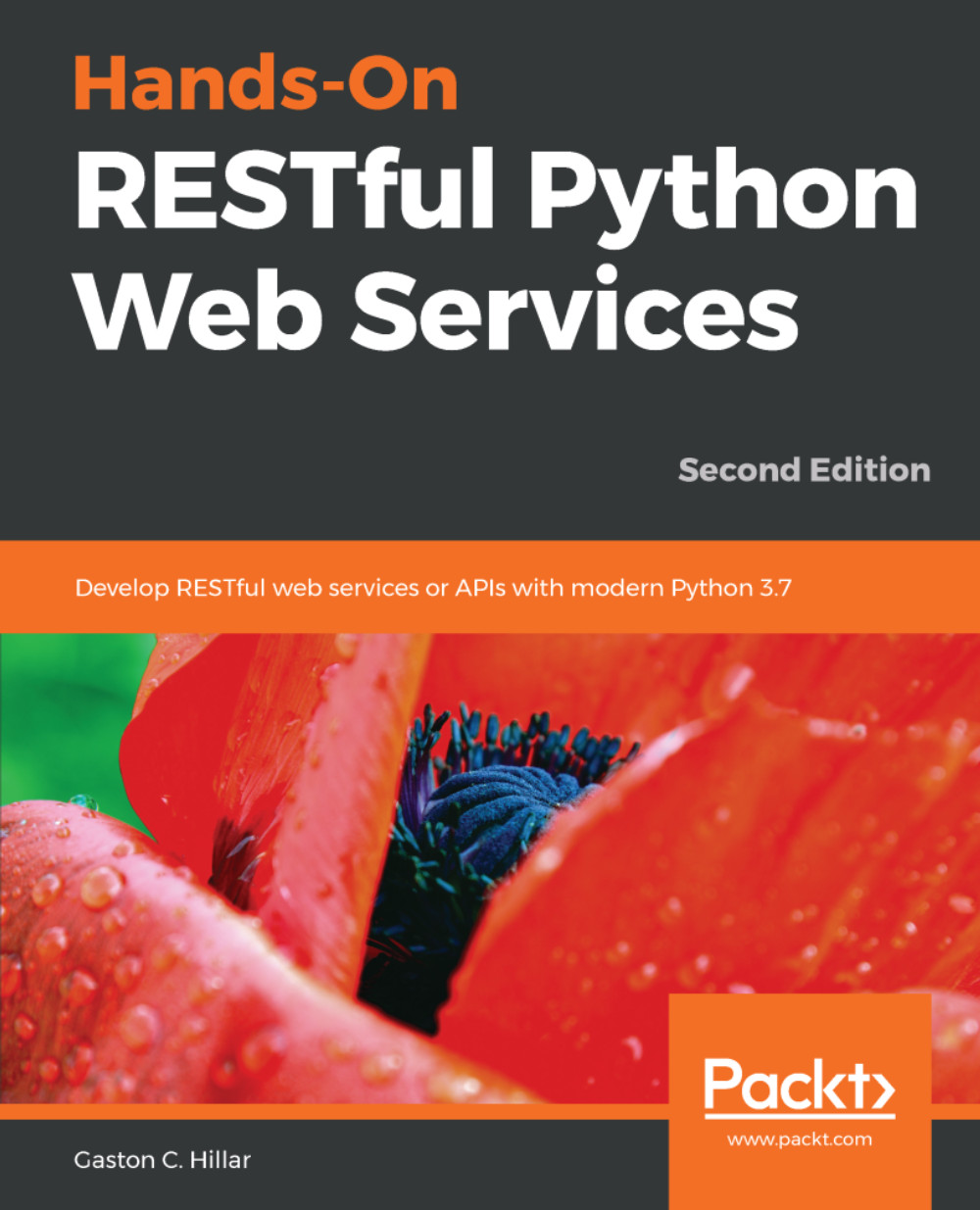
Python is the language of choice for millions of developers worldwide that builds great web services in RESTful architecture. This second edition of Hands-On RESTful Python Web Services will cover the best tools you can use to build engaging web services.
This book shows you how to develop RESTful APIs using the most popular Python frameworks and all the necessary stacks with Python, combined with related libraries and tools. You’ll learn to incorporate all new features of Python 3.7, Flask 1.0.2, Django 2.1, Tornado 5.1, and also a new framework, Pyramid. As you advance through the chapters, you will get to grips with each of these frameworks to build various web services, and be shown use cases and best practices covering when to use a particular framework.
You’ll then successfully develop RESTful APIs with all frameworks and understand how each framework processes HTTP requests and routes URLs. You’ll also discover best practices for validation, serialization, and deserialization. In the concluding chapters, you will take advantage of specific features available in certain frameworks such as integrated ORMs, built-in authorization and authentication, and work with asynchronous code. At the end of each framework, you will write tests for RESTful APIs and improve code coverage.
By the end of the book, you will have gained a deep understanding of the stacks needed to build RESTful web services.
Table of Contents (14 chapters)
Preface


 Free Chapter
Developing RESTful APIs and Microservices with Flask 1.0.2
Working with Models, SQLAlchemy, and Hyperlinked APIs in Flask
Improving Our API and Adding Authentication to it with Flask
Testing and Deploying an API in a Microservice with Flask
Developing RESTful APIs with Django 2.1
Working with Class-Based Views and Hyperlinked APIs in Django 2.1

Improving Our API and Adding Authentication to it with Django
Throttling, Filtering, Testing, and Deploying an API with Django 2.1
Developing RESTful APIs with Pyramid 1.10
Developing RESTful APIs with Tornado 5.1.1
Working with Asynchronous Code, Testing, and Deploying an API with Tornado
Assessment
Other Books You May Enjoy


