
Sign In Start Free Trial
Account

Add to playlist

Create a Playlist

Modal Close icon
You need to login to use this feature.
  • Book Overview & Buying Flask Framework Cookbook
  • Table Of Contents Toc
Flask Framework Cookbook

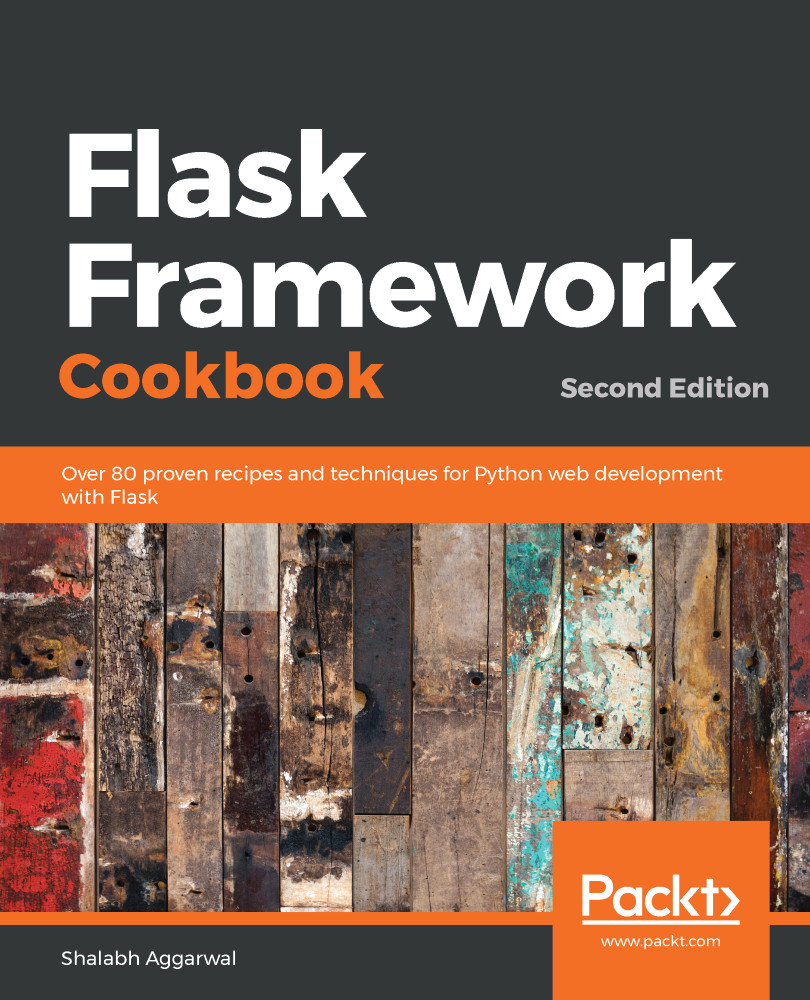
Flask Framework Cookbook - Second Edition

By : Shalabh Aggarwal
3.5 (11)
close
close
Flask Framework Cookbook

Flask Framework Cookbook

3.5 (11)
By: Shalabh Aggarwal

Overview of this book

Flask, the lightweight Python web framework, is popular thanks to its powerful modular design that lets you build scalable web apps. With this recipe-based guide, you’ll explore modern solutions and best practices for Flask web development. Updated to the latest version of Flask and Python 3, this second edition of Flask Framework Cookbook moves away from some of the old and obsolete libraries and introduces new recipes on cutting-edge technologies. You’ll discover different ways of using Flask to create, deploy, and manage microservices. This Flask Python book starts by covering the different configurations that a Flask application can make use of, and then helps you work with templates and learn about the ORM and view layers. You’ll also be able to write an admin interface and get to grips with debugging and logging errors. Finally, you’ll learn a variety of deployment and post-deployment techniques for platforms such as Apache, Tornado, and Heroku. By the end of this book, you’ll have gained all the knowledge you need to confidently write Flask applications and scale them using standard industry practices.
Table of Contents (15 chapters)
close
close

Working with Views

For any web application, it is very important to control how you interact with web requests and the proper responses to be catered for these requests. This chapter takes us through the various methods of handling requests properly and designing them in the best way.

Flask offers several ways of designing and laying out the URL routing for our applications. Also, it gives us the flexibility to keep the architecture of our views as just functions or to create classes, which can be inherited and modified as required. In earlier versions, Flask just had function-based views. Later, however, in version 0.7, inspired by Django, Flask introduced the concept of pluggable views, which allows us to have classes and then write methods in these classes. This also makes the process of building a RESTful API pretty simple. Also, we can always go a level deeper into Werkzeug...

Visually different images
CONTINUE READING
83
Tech Concepts
36
Programming languages
73
Tech Tools
Icon Unlimited access to the largest independent learning library in tech of over 8,000 expert-authored tech books and videos.
Icon Innovative learning tools, including AI book assistants, code context explainers, and text-to-speech.
Icon 50+ new titles added per month and exclusive early access to books as they are being written.
Flask Framework Cookbook
notes
bookmark Notes and Bookmarks search Search in title playlist Add to playlist download Download options font-size Font size

Change the font size

margin-width Margin width

Change margin width

day-mode Day/Sepia/Night Modes

Change background colour

Close icon Search
Country selected

Close icon Your notes and bookmarks

Confirmation

Modal Close icon
claim successful

Buy this book with your credits?

Modal Close icon
Are you sure you want to buy this book with one of your credits?
Close
YES, BUY

Submit Your Feedback

Modal Close icon
Modal Close icon
Modal Close icon