-
Book Overview & Buying
-
Table Of Contents
React Application Architecture for Production..
By :
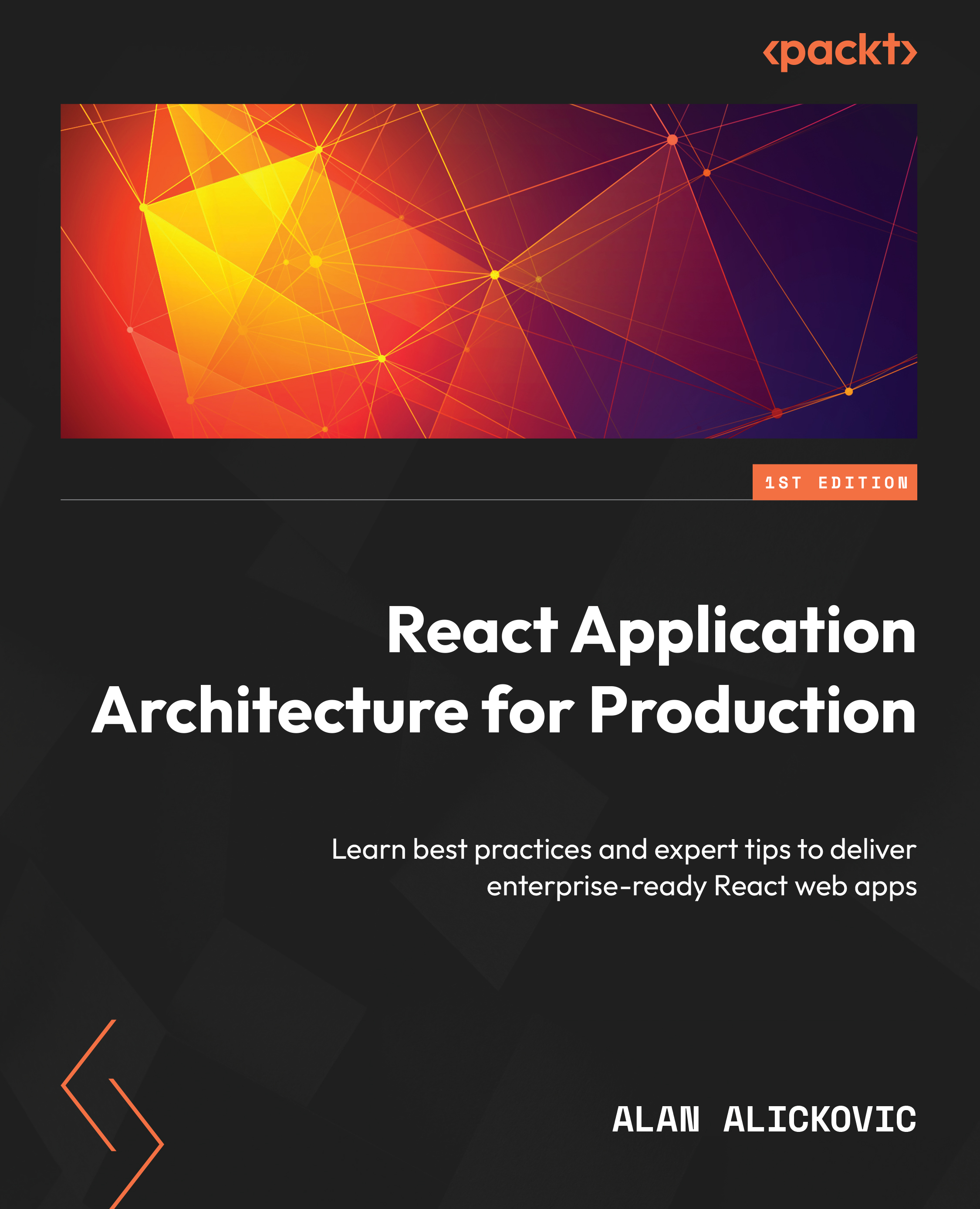
Building large-scale applications in production with React can be overwhelming due to the number of choices and lack of cohesive resources. This hands-on guide is designed to share practices and examples to help address these challenges in building enterprise-ready applications with React.
In this book, we will first discuss the architectural principles behind scalable React applications. Then, we will lay out the foundation of the project with Vite, TypeScript, ESLint, Prettier, and Husky, and organize it with a feature-based folder structure. We will then build reusable, documented components with Shadcn UI and Storybook, and learn how to handle routing and rendering strategies, including pre-rendering, SSR, CSR, and hybrid approaches using React Router in framework mode.
Once the foundations are in place, we will cover how to communicate with APIs in a type-safe way using OpenAPI-generated types, Zod validation, and React Query for server state. We will explore the right state management tools for each use case, covering local state, global state, form state, and URL state before implementing cookie-based authentication, authorization policies, and content security practices.
Finally, we will improve the quality of the application by optimizing performance with memoization, code splitting, and streaming, adding internationalization with react-i18next, ensuring accessibility by following WCAG principles, and writing a comprehensive test suite with Vitest and Playwright. We will finish by setting up a CI/CD pipeline with GitHub Actions and looking at advanced topics such as enforcing the architecture with AI, React Server Components, feature flags, monorepos, and microfrontends.
By the end of the book, you will be able to efficiently build production-ready applications by following industry practices and expert tips.
This book is for intermediate-level web developers who already have a good understanding of JavaScript, React, and web development in general and want to build large-scale React applications effectively. Besides experience with JavaScript and React, some experience with TypeScript will be beneficial.
Chapter 1, Understanding the Architecture of React Applications, explores how to think about applications from an architectural point of view. It starts by covering the importance of good architecture and its benefits. Then, it covers some bad and good practices in React applications. Finally, we will cover the planning of a real React application, an AI Ideas Community Platform, that we will be building throughout the book.
Chapter 2, Setup and Project Structure Overview, covers laying out the foundation of the project with all the tools and setup for the application that we will be building. It will introduce us to tools such as React Router, Vite, TypeScript, ESLint, Prettier, and Husky. Finally, it will cover the feature-based project structure for the project, which improves the codebase organization.
Chapter 3, Building and Documenting Components, introduces us to component design principles and Shadcn UI, a copy-paste component library built on top of Radix UI primitives. We will cover how to set it up and use it to build reusable components that can be used throughout the application to keep the UI consistent. Finally, we will learn about documenting those components with Storybook.
Chapter 4, Routing and Rendering Strategies, dives into React Router in framework mode and different rendering strategies in more depth. First, we will cover the basics such as routing, nested layouts, and data prefetching with loaders. Then, we will explore the different rendering strategies it supports: pre-rendering, SSR, CSR, and hybrid. Finally, we will apply those concepts by building the routes and layouts for our application.
Chapter 5, Communicating with the API, walks through how to communicate with the backend API in a type-safe way. We will first learn how to generate TypeScript types from an OpenAPI specification and validate API responses at runtime. Then, we will configure React Query and use it to build the API layer for our application, covering queries, mutations, and cache invalidation.
Chapter 6, Managing Application State, teaches how to use the right state management tool for each use case. We will start with local UI state, then move to global state with Zustand. From there, we will look at form state with React Hook Form and Zod, and finish with URL state management for features like filters and search parameters.
Chapter 7, Implementing Authentication and Securing the Application, starts by walking through how to implement authentication for our application using cookie-based sessions. Then, it demonstrates how to protect routes and enforce authorization policies for resource ownership. Finally, it covers security best practices such as content sanitization and security headers.
Chapter 8, Improving Application Performance, focuses on performance optimization in a React application. It starts by covering how to detect and diagnose performance bottlenecks using the React DevTools Profiler. Then, it covers a range of optimization techniques including memoization, code splitting with lazy loading, server-side streaming, debouncing, infinite scroll, and optimistic UI updates.
Chapter 9, Going International, guides you through setting up internationalization for a React application. We will first cover how to configure react-i18next and organize translations by feature namespace. Then, we will go through key concepts such as server-side language detection, pluralization, variable interpolation, and locale-aware date formatting. Finally, we will build a language switcher component that stores the user's preference in a cookie, which persists across page reloads.
Chapter 10, Making the Application Accessible, examines the practices for making your application accessible following WCAG standards. It starts with the POUR principles as a framework for thinking about accessibility. Then, it covers practical techniques such as semantic HTML, skip links, ARIA attributes, live regions for dynamic content announcements, and visible focus styles for keyboard navigation.
Chapter 11, Testing the Application, takes a practical approach to testing a React application using the testing trophy strategy. We will cover unit and component testing with Vitest and React Testing Library, focusing on complex isolated logic and UI behavior. Then, we will use Playwright for integration and end-to-end tests, covering route mocking and structuring tests with test steps.
Chapter 12, Going to Production, covers the basics of setting up a CI/CD pipeline with GitHub Actions. We will first configure the CI pipeline with parallel jobs for linting, type checking, format checking, and all test tiers. Then, we will set up the CD pipeline to trigger on a successful CI run on the main branch and deploy the application to Render.
Chapter 13, Evolving the Application, touches on some advanced topics for taking the application beyond its current state. We will look at using AI to enforce architectural standards, React Server Components, application observability, feature flags, the backend for frontend pattern, and how to scale the codebase with monorepos and microfrontends.
Previous experience with JavaScript and React and fundamental knowledge of web development will make it a lot easier to follow along with the content of the book. It is also desirable to have some experience with TypeScript and React Router, but it should be possible to follow along without it since we will cover the basics in the book.
This book includes a complete downloadable code bundle containing all the example projects and files used throughout the chapters. We recommend downloading the bundle so you can follow along smoothly and experiment with the examples.
Use the bundle as a practical starting point. Modify it, extend it, and apply what you learn by creating your own variations as you progress through the chapters.
If you bought the book directly from Packt:
If you bought this book from Amazon or any other channel partner:

Usage note: You're free to use and modify this code for personal learning and non-commercial projects.
There are a number of text conventions used throughout this book.
CodeInText: Indicates code words in text, database table names, folder names, filenames, file extensions, pathnames, dummy URLs, user input, and Twitter handles. For example: " We could use this same Counter component multiple times on a page
A block of code is set as follows:
export default function HomePage() {
return (
<div>
<h1>Home</h1>
<Counter
initialValue={0}
label="Click Counter"
onIncrement={(newValue) => {
console.log(`Incremented to ${newValue}`);
}}
onDecrement={(newValue) => {
console.log(`Decremented to ${newValue}`);
}}
/>
</div>
);
}
When we wish to draw your attention to a particular part of a code block, the relevant lines or items are set in bold:
export default function HomePage() {
return (
<div>
<h1>Home</h1>
<Counter
initialValue={0}
label="Click Counter"
onIncrement={(newValue) => {
console.log(`Incremented to ${newValue}`);
}}
onDecrement={(newValue) => {
console.log(`Decremented to ${newValue}`);
}}
/>
</div>
);
}
Any command-line input or output is written as follows:
npm run dev
Bold: Indicates a new term, an important word, or words that you see on the screen. For instance, words in menus or dialog boxes appear in the text like this. For example: "This is an MVP (Minimum Viable Product).
Warnings or important notes appear like this.
Tips and tricks appear like this.
Feedback from our readers is always welcome.
General feedback: If you have questions about any aspect of this book or have any general feedback, please email us at [email protected] and mention the book's title in the subject of your message.
Errata: Although we have taken every care to ensure the accuracy of our content, mistakes do happen. If you have found a mistake in this book, we would be grateful if you reported this to us. Please visit http://www.packt.com/submit-errata, click Submit Errata, and fill in the form.
Piracy: If you come across any illegal copies of our works in any form on the internet, we would be grateful if you would provide us with the location address or website name. Please contact us at [email protected] with a link to the material.
If you are interested in becoming an author: If there is a topic that you have expertise in and you are interested in either writing or contributing to a book, please visit .
Change the font size
Change margin width
Change background colour