Sign In Start Free Trial
Account

Add to playlist

Create a Playlist

Modal Close icon
You need to login to use this feature.
  • Book Overview & Buying Test-Driven Development with C++
  • Table Of Contents Toc
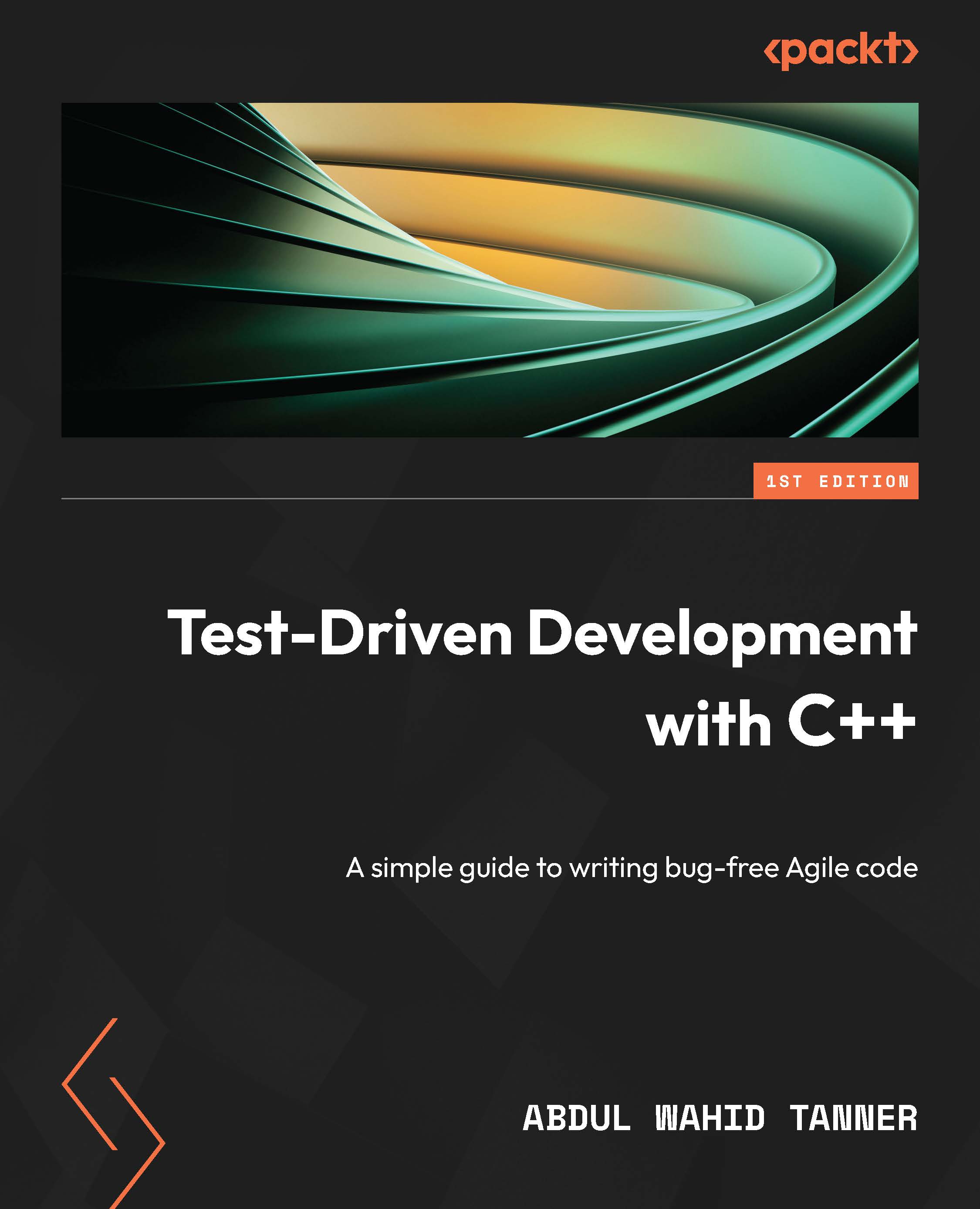
Test-Driven Development with C++

Test-Driven Development with C++

By : Abdul Wahid Tanner
4.5 (2)
close
close
Test-Driven Development with C++

Test-Driven Development with C++

4.5 (2)
By: Abdul Wahid Tanner

Overview of this book

Modern, standard C++ is all that is needed to create a small and practical testing framework that will improve the design of any project. This allows you to think about how the code will be used, which is the first step in designing intuitive interfaces. TDD is a modern balanced software development approach that helps to create maintainable applications, provide modularity in design, and write minimal code that drastically reduces defects. With the help of this book, you'll be able to continue adding value when designs need to change by ensuring that the changes don't break existing tests. In this book, you will use test-driven development (TDD) to gain practical skills by writing a simple testing framework and then using it to drive the design of a logging library. The book will help you enhance your software development skills with test cases. You'll understand how to design and implement test cases. The chapters will also show you how to utilize the TDD approach to be more productive in software development than attempting to code in large unstructured steps. By the end of this book, you'll have gained knowledge of TDD and testing and also built a working logging library with unique features not found in other libraries.
Table of Contents (21 chapters)
close
close
1
Part 1: Testing MVP
10
Part 2: Using TDD to Create a Logging Library
14
Part 3: Extending the TDD Library to Support the Growing Needs of the Logging Library

What should a test look like?

It should be as simple to write a test as it is to declare and write a function, and we should be able to simplify things even further. A normal function can have whatever return type you want, a name, a set of parameters, and a body of code.

A function is also something that you write so that it can be called by other code. This code should know what the function does, what it returns, and what arguments need to be passed. We’ll keep things simple for our test functions and only worry about the name for now.

We want each test function to have its own name. Otherwise, how would we be able to keep track of all the various tests we’ll eventually be writing? As for the return type, we haven’t identified an actual need yet, so we’ll use void.

You’ll learn more about this process in Chapter 3, The TDD Process. When using TDD, don’t get ahead of yourself. Only do what you need to do at the time. As with the void return type, we’ll also not have any parameters.

It might seem too simple but this is a good start. So far, a test is nothing more than a function, which returns nothing and takes no parameters. It has a name to identify it and will include whatever code is needed to run the test.

Because we’re going to start using TDD to help design a simple testing library, our first test should ensure that we can create a test. This is a simple start, which defines a test function and calls it from main. All of this is in a single file called main.cpp:

#include <iostream>
void testCanBeCreated ()
{
    std::cout << "testCanBeCreated" << std::endl;
}
int main ()
{
    testCanBeCreated();
    return 0;
}

You might be thinking that this is not a test, it’s just a function that prints its own name, and you’d be right. We’re going to build it up from the very beginning in an agile manner using only what we have available. Right now, we don’t have a test library to use yet.

Still, this is starting to resemble what we eventually want. We want a test to be just like writing a function. If you build and run the project now, the output is as expected:

testCanBeCreated
Program ended with exit code: 0

This shows the output from running the program. It displays the name of the function. The text in the second line actually comes from my development tools and shows the program exit code. The exit code is the value returned from main.

This is a start but it can be improved. The next section will look at what information a test needs, such as its name.

CONTINUE READING
83
Tech Concepts
36
Programming languages
73
Tech Tools
Icon Unlimited access to the largest independent learning library in tech of over 8,000 expert-authored tech books and videos.
Icon Innovative learning tools, including AI book assistants, code context explainers, and text-to-speech.
Icon 50+ new titles added per month and exclusive early access to books as they are being written.
Test-Driven Development with C++
notes
bookmark Notes and Bookmarks search Search in title playlist Add to playlist download Download options font-size Font size

Change the font size

margin-width Margin width

Change margin width

day-mode Day/Sepia/Night Modes

Change background colour

Close icon Search
Country selected

Close icon Your notes and bookmarks

Confirmation

Modal Close icon
claim successful

Buy this book with your credits?

Modal Close icon
Are you sure you want to buy this book with one of your credits?
Close
YES, BUY

Submit Your Feedback

Modal Close icon
Modal Close icon
Modal Close icon