Sign In Start Free Trial
Account

Add to playlist

Create a Playlist

Modal Close icon
You need to login to use this feature.
  • Book Overview & Buying A Blueprint for Production-Ready Web Applications
  • Table Of Contents Toc
  • Feedback & Rating feedback
A Blueprint for Production-Ready Web Applications

A Blueprint for Production-Ready Web Applications

By : Philip Jones
5 (7)
close
close
A Blueprint for Production-Ready Web Applications

A Blueprint for Production-Ready Web Applications

5 (7)
By: Philip Jones

Overview of this book

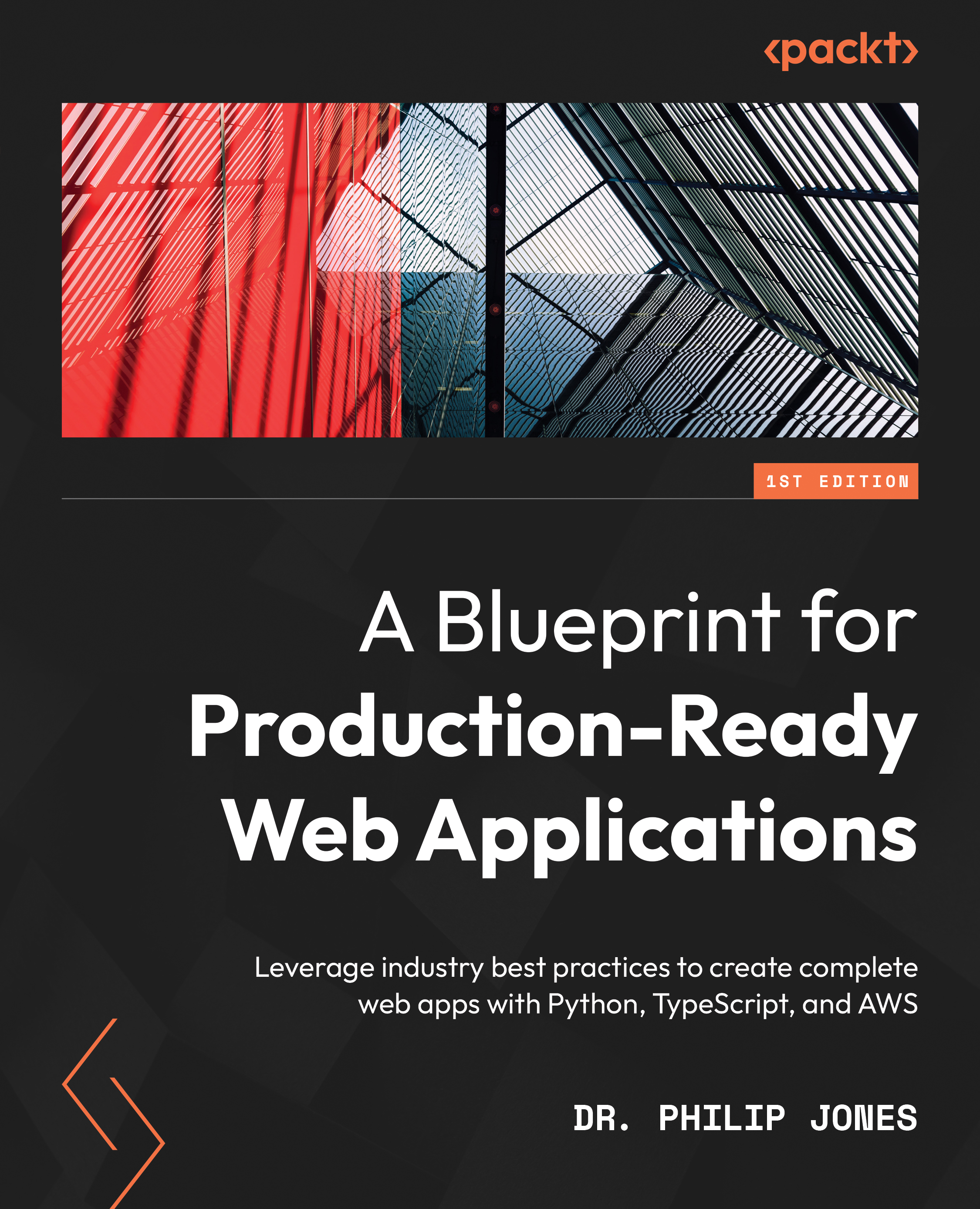
A Blueprint for Production-Ready Web Applications will help you expand upon your coding knowledge and teach you how to create a complete web application. Unlike other guides that focus solely on a singular technology or process, this book shows you how to combine different technologies and processes as needed to meet industry standards. You’ll begin by learning how to set up your development environment, and use Quart and React to create the backend and frontend, respectively. This book then helps you get to grips with managing and validating accounts, structuring relational tables, and creating forms to manage data. As you progress through the chapters, you’ll gain a comprehensive understanding of web application development by creating a to-do app, which can be used as a base for your future projects. Finally, you’ll find out how to deploy and monitor your application, along with discovering advanced concepts such as managing database migrations and adding multifactor authentication. By the end of this web development book, you’ll be able to apply the lessons and industry best practices that you’ve learned to both your personal and work projects, allowing you to further develop your coding portfolio.
Table of Contents (13 chapters)
close
close
1
Part 1 Setting Up Our System
3
Part 2 Building a To-Do App
8
Part 3 Releasing a Production-Ready App

Installing PostgreSQL for database development

Our app will need to store data (the to-dos) in a structured form, which makes a database an ideal choice. This database will need to be running locally to allow us to develop with it, so we need to install it. The database I prefer is PostgreSQL, which is a SQL-based relational database. I prefer it as it is very widely supported, and very powerful.

PostgreSQL is installed using the system package manager as follows:

brew install postgres
scoop install postgresql

If using brew, you will likely need to start postgresql as a service that runs in the background, as follows:

brew services start postgresql

In addition, when using brew, we need to create a superuser, which by convention is called postgres. This user is created with the following command:

createuser -s postgres

However, with scoop, you will have to start the PostgreSQL database whenever you wish to use it with the following command:

pg_ctl start

With the addition of the database tooling, we have all of the local tooling we need to develop our app. This means we can focus on the remote tooling, a GitHub repository.

Visually different images
CONTINUE READING
83
Tech Concepts
36
Programming languages
73
Tech Tools
Icon Unlimited access to the largest independent learning library in tech of over 8,000 expert-authored tech books and videos.
Icon Innovative learning tools, including AI book assistants, code context explainers, and text-to-speech.
Icon 50+ new titles added per month and exclusive early access to books as they are being written.
A Blueprint for Production-Ready Web Applications
notes
bookmark Notes and Bookmarks search Search in title playlist Add to playlist download Download options font-size Font size

Change the font size

margin-width Margin width

Change margin width

day-mode Day/Sepia/Night Modes

Change background colour

Close icon Search
Country selected

Close icon Your notes and bookmarks

Confirmation

Modal Close icon
claim successful

Buy this book with your credits?

Modal Close icon
Are you sure you want to buy this book with one of your credits?
Close
YES, BUY

Submit Your Feedback

Modal Close icon
Modal Close icon
Modal Close icon